Animal rights being used to profit from human misery challenged
By K Raveendran
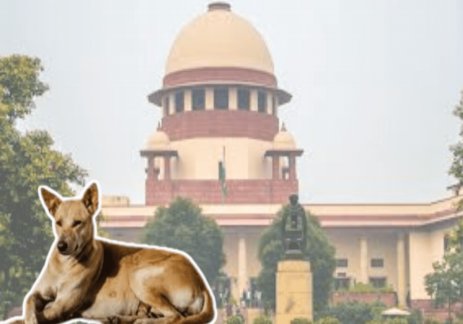
A landmark order by the Supreme Court of India mandating the removal of stray dogs from public-spaces and their relocation into designated shelters marks what appears to be a significant blow to the interests of the vaccine-industry lobby and its aligned advocacy networks. That lobby, long supportive of programmes that emphasise post-bite vaccination over upstream stray-animal population control, finds itself challenged by a judicial intervention that prioritises removal and containment of animals rather than treating the human victims of dog attacks. The court’s message is unmistakable: the status quo — whereby aggressive or unrestrained dogs roam public spaces and the public pays for the downstream medical response — will no longer suffice.
The court’s order instructed authorities in the national capital region to round up stray dogs, relocate them to shelters or pounds, and forbid their release back to the public domain. From the vantage of the vaccine-industry complex, this is a setback because the primary revenue stream arises from treating dog-bite victims with anti-rabies vaccines and immunoglobulins. For decades, the narrative advanced by some animal-rights groups and vaccine-industry allies has stressed sterilisation plus vaccination of stray dogs and return to the streets — a model that generates continuing bite incidents, and thus continuing demand for vaccines. That ongoing cycle has been challenged by the court which implicitly flagged that the animal side of the equation cannot be treated as sacrosanct while victims of attacks bear the cost.
The irony is palpable: when a human commits an offence, law requires punishment or corrective action. Yet a dangerous stray dog — roaming without restraint, capable of inflicting serious injury or death — has enjoyed, in effect, immunity from decisive action. The judicial order draws attention to this asymmetry. It restates the principle that public-safety obligations cannot be indefinitely deferred in deference to animal-rights arguments that prioritise the animals’ freedom of movement over human risk. In that sense the vaccine-lobby’s alignment with those arguments is exposed: by emphasising vaccination of humans after the damage is done, rather than preventing the damage, their interests align more with continuation of the problem than its resolution.
That said, while the court’s verdict carries strong symbolic force, its practical implementation confronts formidable hurdles. Authorities in states such as Rajasthan have already flagged the challenge: municipalities lacking adequate shelters, absence of surveys to estimate numbers of stray dogs, and constraints posed by compliance with animal-welfare body standards.
The logistics of relocating tens or hundreds of thousands of animals, providing them medical care, quarantining aggressive ones and monitoring the shelters via CCTV as the court asked are capital-intensive and politically fraught. Moreover the court’s order runs up against the existing legal regime — the Animal Birth Control (Dogs) Rules, 2023 mandate of capture-sterilise-vaccinate-release has been codified in prior Supreme Court judgments as well. The clash between the older approach and the new order creates legal tensions.
Setting aside the administrative and legal difficulties, the broader implication is that vaccine-industry profits derived from dog-bite treatment may diminish if upstream dog-management is taken seriously. If stray-dog populations are substantially reduced or rendered non-threatening via removal to shelters, there will be fewer bites and thus fewer human vaccine treatments required. The “menace of stray dogs” becomes not only a public-health or civic infrastructure issue, but an economic one—with the vaccine sector’s business model partially premised on the maintenance of high bite-incident rates. The order thus cracks open the dependency of medical interventions on underlying systemic failure. The court’s insistence that “no sentiment should be involved” when children and the aged are exposed to attacks indicates a shift from compassionate tolerance of stray animals to prioritising human safety.
On the other hand, critics of the verdict argue that mass relocation of stray dogs to shelters is “unscientific” and “ineffective,” lacking credible evidence of long-term bite-reduction and posing risks of animal welfare violations. Animal-rights organisations have described the approach as chaotic, highlighting lack of shelter capacity, the trauma to animals and possible legal violation of the ABC rules. There is merit in these concerns: if shelters cannot be properly funded, staffed and regulated, the humanely unintended side‐effects may be severe. Also, if dogs are simply relocated but the underlying conditions of waste, public-feeding, territory maintenance and human-dog interaction remain unchecked, the problem may resurface. From the vantage of vaccine-industry logic, however, such weaknesses and delays serve their interests — prolonging bite incidents and vaccine demand.
The court’s message places municipalities and public-health authorities on notice: bite treatment alone is no longer enough. Prevention via dog-population management must now become central. For the vaccine lobby this means the business environment may change. If programmes shift their emphasis to dog-sterilisation and community-dog management rather than human post-exposure treatment, the revenue model for vaccines could long-term shrink. The lobby’s use of animal-rights actors to resist aggressive stray-dog removal now faces judicial push-back. The narrative that stray dogs must remain free and only human-vaccination is needed is being challenged. (IPA Service)