Sanjay Saxena, Lucknow
In Uttar Pradesh politics, Muslim voters have always played a decisive role. Their unity and strategic voting have altered electoral outcomes many times. Muslims constitute nearly 20 percent of the state’s population and exert influence in more than 125 of the 403 Assembly constituencies. Among these, around 70 seats have a Muslim population exceeding 30 percent. Once a strong support base of the Congress, these voters now tend to shift allegiances according to political winds. Their primary objective has consistently been to keep parties that foreground Hindu interests out of power. This is why, as the Congress weakened, Muslim voters readily turned toward the Samajwadi Party and the Bahujan Samaj Party. In the 2022 Assembly elections, the Samajwadi Party received most Muslim votes, though the BSP also secured a share. However, this pattern changed in recent municipal elections, where Muslim voters did not rally behind a single party but chose candidates of their preference. In many parts of western Uttar Pradesh, Muslim candidates from smaller parties received more support than those from the Samajwadi Party or the BSP. This shift forced political parties to rethink their strategies.
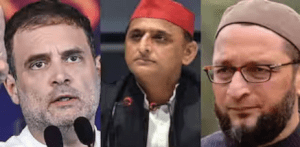
Muslim leaders also attempted to mobilize these votes by forming separate parties. After older organizations like the Muslim League and Praja Socialist Party, newer outfits such as the Peace Party and the Ulema Council entered the fray. In the 2022 Assembly elections, the Peace Party contested several seats in alliance with the National Ulema Council, but achieved limited success. These efforts did lead to some fragmentation of Muslim votes, but no major transformation occurred.
The biggest concern now is the rise of Asaduddin Owaisi’s party, the All India Majlis-e-Ittehadul Muslimeen. After winning five seats in Bihar elections, Owaisi has set his sights on Uttar Pradesh. His party had announced plans to contest 100 seats in the 2017 Assembly elections, and for 2027 it is preparing to fight in 200 constituencies by dividing them into four zones. There is a reason for this confidence. In Muslim-majority districts of western Uttar Pradesh such as Saharanpur, Moradabad, Rampur, Sambhal, and Bareilly, the party’s support base is expanding. Its candidates performed well in municipal elections there. Owaisi’s rise has unsettled the Samajwadi Party, the Indian National Congress, and the Bahujan Samaj Party alike. Recently, concerns over Muslim vote division were also discussed in a meeting of Samajwadi Party MPs. Citing examples from Bihar and Maharashtra municipal elections, some SP leaders even suggested that contesting without Owaisi in an alliance could be harmful. A few MPs proposed an alliance, although Shivpal Yadav dismissed such speculation. Nevertheless, deliberations over Mission 2027 are underway.
The concern of Congress president Mallikarjun Kharge has also come to the fore. A video of his conversation with MP Imran Masood in the Parliament complex went viral, in which he spoke about stopping a Hyderabadi problem from entering Uttar Pradesh. Many interpreted this as a jibe at Owaisi. Kharge warned that such a development would harm everyone. The video has sparked debate in political circles.
Ultimately, the question of which side Muslim voters will support in the 2027 Assembly elections is troubling all parties. If the old pattern holds, most votes may go to the Samajwadi Party, as happened previously. However, with Owaisi’s growing influence, votes could split in more than 70 constituencies in western Uttar Pradesh. Muslim youth there are discontented, and Owaisi speaks directly on Muslim issues. If, on the Bihar model, he wins five to ten seats, the Samajwadi Party’s losses could mount. The Congress, already weakened, would face even greater difficulties. Kharge’s concern reflects this reality.
As for the BSP, it has largely lost Muslim support because its strategy is now focused on Brahmins. If the Samajwadi Party allies with Owaisi, Muslim votes may remain consolidated, but this could cause fissures in SP’s backward-caste vote base while enabling Owaisi to strengthen his own footing through Muslim support. If Owaisi contests independently without an alliance, Muslim votes would split into three parts, benefiting the Bharatiya Janata Party.
It is also being said that recent municipal elections have shown Muslim voters to be more discerning. They no longer blindly follow a single party but decide based on local issues. In 2027, economic concerns, unemployment, development, and religious polarization will all play roles. If the BJP fields candidates in Muslim-majority areas, as seen in the Kundarki by-election, it could make inroads there as well. Overall, most Muslim votes are likely to go either to the Samajwadi Party or to Owaisi, but fragmentation would work in the BJP’s favor. This election could give a new direction to Uttar Pradesh politics. If Owaisi sustains his momentum, a new chapter of Muslim politics will be written. The Samajwadi Party will have to alter its strategy to safeguard its vote bank, while the Congress will need to work hard to regain Muslim support.
(Sanjay Saxena is a Senior Journalist from Lucknow and can be reached at [email protected]; Mob: 9454105568, 82990505)