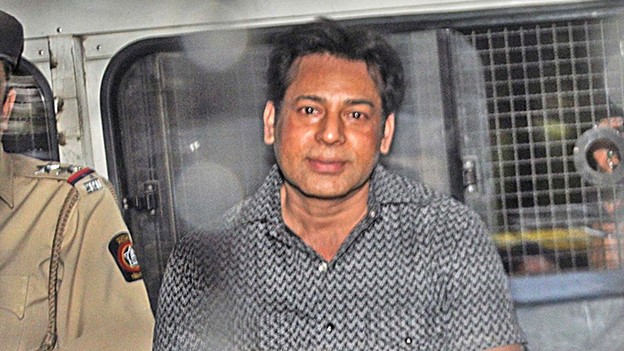
New Delhi, Jan 13: The Supreme Court on Tuesday sought an explanation from 1993 Mumbai serial blasts convict Abu Salem on his claim that he has already completed 25 years of imprisonment, while hearing his plea seeking premature release.
A bench comprising Justice Vikram Nath and Justice Sandeep Mehta asked Salem to justify the computation of his jail term and directed him to place on record the relevant Maharashtra state rules to ascertain whether remission is permissible for a convict sentenced under the Terrorist and Disruptive Activities (Prevention) Act (TADA).
Questioning the claim, the bench asked Salem’s counsel, “How do you calculate 25 years from 2005?” after it was submitted that Salem had completed the maximum period of incarceration as per the assurances given during his extradition from Portugal.
Abu Salem was extradited from Portugal on November 11, 2005, following a prolonged legal process, after India assured Portuguese authorities that he would neither be awarded the death penalty nor be imprisoned beyond 25 years, in line with Portugal’s domestic law and international obligations.
Salem was subsequently convicted in June 2017 and sentenced to life imprisonment by a special TADA court in the 1993 Mumbai serial blasts case.
Earlier, Salem had approached the Bombay High Court seeking premature release under the extradition assurances, while clarifying that he had not yet completed the 25 years stipulated by the Supreme Court in accordance with international commitments.
In its landmark judgment in Abu Salem v. State of Maharashtra (2022), the Supreme Court held that Salem’s incarceration shall not exceed 25 years, to be counted from the date of his extradition to India on November 11, 2005.
A bench comprising Justice Sanjay Kishan Kaul and Justice MM Sundresh of the Supreme Court had ruled that the union of India is bound to release Salem upon completion of 25 years in custody to honour the assurance given to Portugal.
The court had further directed that the Central government should advise the President of India to exercise powers under Article 72 of the Constitution upon completion of the said period.
The 2022 ruling came in a plea filed by Salem challenging the life sentence awarded to him on the grounds that his imprisonment could not extend beyond 25 years due to the assurances furnished during extradition.
Advocate Rishi Malhotra, appearing for Salem, had argued that under Portuguese law, life imprisonment or incarceration beyond 25 years is unconstitutional, and therefore the assurance given by India was binding. Salem was arrested in Portugal on September 18, 2002, along with actor Monika Bedi.
Extradition was granted in relation to the Pradeep Jain murder case, the 1993 Bombay bomb blasts case, and the Ajit Diwani murder case.
Upon his arrival in India on November 11, 2005, Salem was arrested by the CBI in the bomb blasts case and later taken into custody by the Mumbai Anti-Terrorist Squad in the Pradeep Jain murder. In June 2017, a Special TADA Court found Abu Salem and five others guilty of conspiring in and executing a series of bomb blasts across Mumbai in 1993 that claimed 257 lives.
Salem was convicted under various provisions of the Indian Penal Code, TADA, the Arms Act, the Explosive Substances Act, and the Prevention of Damage to Public Property Act. The matter remains under consideration before the Supreme Court.