- Prabhat Kishore
For over three and half decades, the political power in Bihar has revolved around two personalities Nitish Kumar, a technocrat and Laloo Prasad, a law graduate. Both ruled the State directly or indirectly for about 15-15 years, each leading the regional parties with the support of national ally BJP and Congress respectively. Before the pre-Mandal era, the two leaders worked unitedly & were termed as “Hira-Moti” by their well-wishers, and “Ranga-Billa” by rivals. Laloo Prasad was elected as an MP in his first attempt in 1977, but Nitish lost two consecutive elections and reached the Vidhan Sabha in his third attempt in 1985. After the demise of Karpoori Thakur, Ex-CM & leader of the opposition, Nitish Kumar was instrumental in Laloo’s projection as leader of the legislature party; although legislatures had advised him to project himself for the post, but he refused. He was also influential in Laloo’s election as CM, when the Janata Dal came to power in the 1990 Vidhan Sabha election.
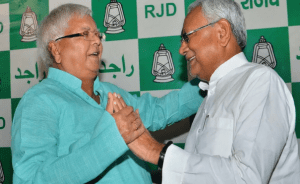
When the Mandal commission report was implemented by V.P. Singh government in 1990, aggressive anti-reservation protests were held by the upper caste lobby under the leadership & patronage of Congress as well as BJP leaders. To counter the anti-reservation protests, pro-reservation campaigns were launched by the backward and SC communities. The outspoken Laloo spearheaded the pro-reservation campaigns and backward community of all castes rallied behind him. Soft-spoken Nitish lagged behind in this movement. The challenge of the outnumbered backwards weakened the opposition. After becoming the centre of power, Laloo started ignoring not only Nitish, but also other non-Yadav leaders. He sidelined Nitish’s suggestions regarding development works and the situation became unbearable for Nitish. Laloo proclaimed “MY” equation as against earlier “All BC”.
The month long campaign & massive rally of the anguished Kurmi Samaj on certain social issues on 12th February 1994 at Patna and Lav-Kush (Kurmi-Koiri) Sammelans in the same year was an indication of resentment among the non-Yadav backwards. Nitish realised that his time for a challenge has come. The split in the Janata Dal took place in 1994 under the leadership of veteran socialist George Fernandes along with Nitish Kumar, Abdul Gafoor & others and the Samata Party was formed. In 1997, Laloo Prasad parted away from the Janata Dal to form his own outfit, the Rashtriya Janata Dal. In 2003, the Samata Party was merged into the Janata Dal (U) to expand its base. Laloo Prasad (7 years 130 days) and his wife Rabri Devi (4 years 360 days) ruled the State since 1990 to 2005 minus the rule of Nitish Kumar for 7 days and President Rule for 31 days; whereas Nitish Kumar ruled since 2005 to 14th April 2026, minus the rule of Jitan Ram Manjhi for 278 days.
In Bihar, the two personalities have their own merits & demerits. In the pre-Mandal era, the Backward classes were not united cohesively and the majority of small artisan & landless castes were not vocal. In 1979, Karpoori Thakur, the CM had to resign under the pressure from the fundamentalist lobby, when he implemented reservation in state services & educational institutions for the backward classes. Laloo was fully aware of the fact. He not only demoralized the upper caste political & social lobby but their bureaucrats too and united backwards to fight for their cause. When the BJP tried to destablise him after the implementation of the Mandal Commission report, he broke a fraction of its MLAs and a repeat of the 1979-like situation flopped.
In his first 5-year tenure, he experimented with some innovative schemes like Charwaha Vidyalaya for working children, Construction of houses for the poor, cleanliness programme in slum areas, Rainbasera for poor rickshaw-pullers & labourers in urban areas. After the bifurcation of Bihar, he re-shaped the 50% reservation to various socially depressed groups in a scientific manner. Under the Congress regime, institutions were named & official functions were held to honor upper caste leaders only. Laloo started these activities for Backward & Dalit leaders, too. Unlike the Chief Ministers of the Congress, he occasionally visited the areas of the depressed classes & intermingle with them. These activities were just a miracle for the people who had seen the earlier CMs as a ruler & not as a leader and this established Laloo as a mass leader.
In second & third tenure of Laloo Prasad or his wife Rabri Devi, minimal works took place in roads/bridges and power generation. The graph of Crime high up and rape, murder & kidnapping become a daily routine. Corruption has been deeply rooted in government departments & Board-Corporations. After 15 years of power, only social awareness with hollow promises was not enough and people wanted roads, schools, hospitals, electricity and other development works. On social forum, he distanced himself from the non-Yadav backwards. He could not develop a think tank, which could advise him for the planned constructive & social works. The involvement of Laloo and other ministers in fodder, coal-tar and other scams tarnished his image. His Party was turned into a family coterie. His mass-base gradually deteriorated and he was eventually ousted from power in 2005.