Rattan Singh Gill
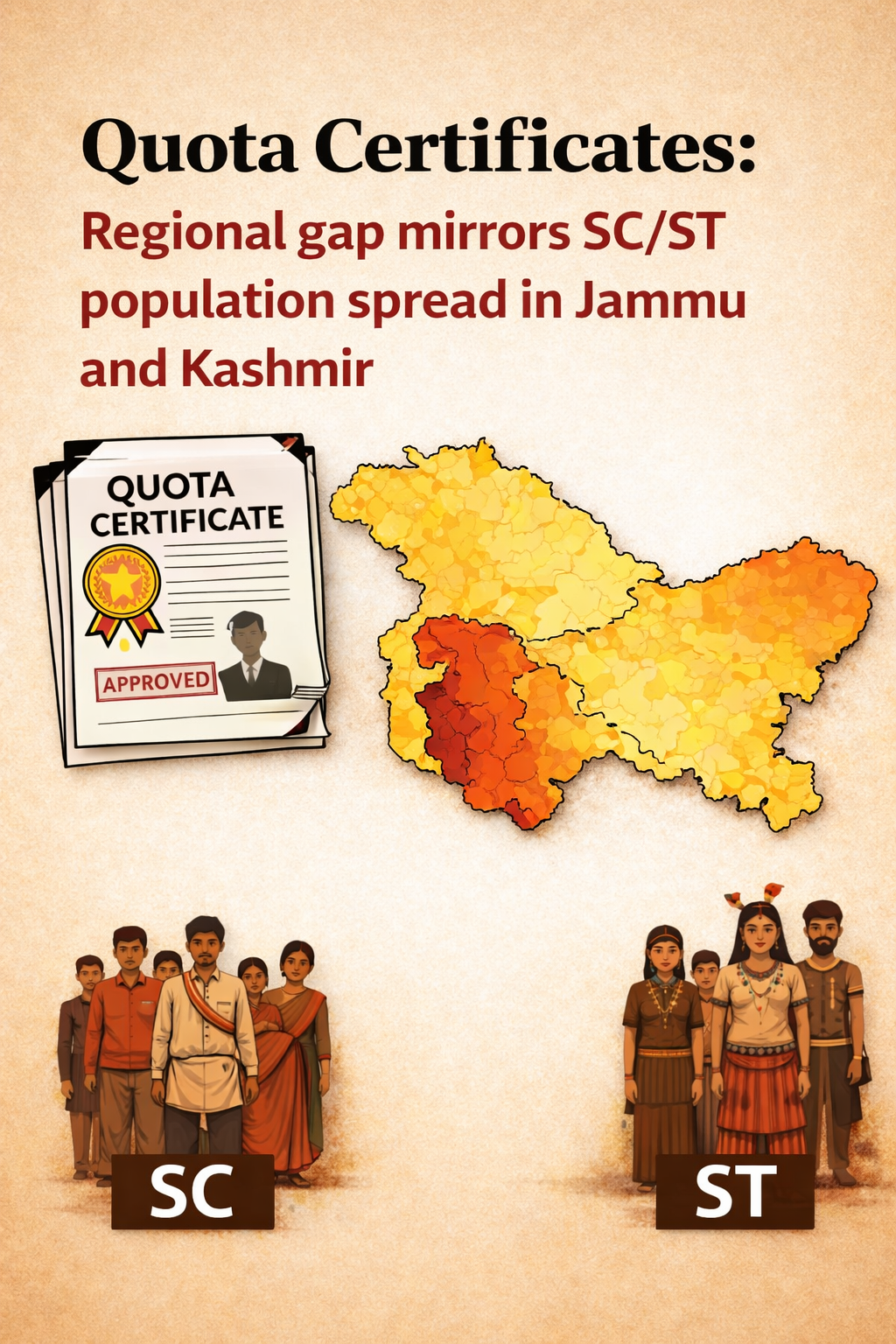
Jammu Tawi, Feb 11: The Jammu & Kashmir Government on Wednesday told the Legislative Assembly that over 11.8 lakh reservation certificates across various reserved categories have been issued so far, with 10.16 lakh in Jammu division and 1.65 lakh in the Kashmir Valley. While the raw figures indicate a wide regional gap, the category-wise break-up shows that the pattern largely aligns with the demographic distribution of eligible reserved populations, especially Scheduled Castes (SC) and Scheduled Tribes (ST).
Replying to a cut motion moved by Peoples Conference MLA Sajad Gani Lone, Social Welfare Minister Sakina Itoo said that 10,16,309 certificates were issued in Jammu and 1,65,021 in Kashmir Valley.
Government data shows that Jammu division accounts for the overwhelming share of certificates in SC and ST categories — groups whose population is heavily concentrated in Jammu region and minimal in most Kashmir Valley districts, as per Census 2011, the latest official demographic dataset.
In the Scheduled Tribe (ST) category, Jammu holds 92.5 percent of certificates, while Kashmir accounts for 7.4 percent. Out of 7,49,970 ST certificates, 6,93,781 were issued in Jammu and 56,189 in Kashmir. Tribal communities such as Gujjar and Bakarwal are largely settled in Jammu’s hilly and border districts, explaining the higher certificate count.
The skew is sharper in the Scheduled Caste (SC) segment. Of 1,41,419 SC certificates, 1,39,664 (over 98 percent) were issued in Jammu division and 1,755 (1.24 percent) in Kashmir. SC population presence in the Valley is officially recorded as negligible compared to Jammu.
In contrast, categories linked more to geography than caste show a more balanced or location-driven pattern. Under the Reserved Backward Area (RBA) category, the split is nearly even — 50,982 certificates in Jammu (50.5 percent) and 49,866 in Kashmir (49.4 percent) out of 1,00,848 total.
For border-linked categories, issuance follows territorial eligibility. In the Actual Line of Control (ALC) category, 93.6 percent certificates went to Jammu and 6.3 percent to Kashmir — 6,732 out of 7,192 in Jammu. All 6,732 International Border (IB) certificates were issued in Jammu division, as the IB belt falls entirely within that region.
In the Other Backward Classes (OBC) category, Jammu accounts for 59.8 percent (78,324) certificates, while Kashmir holds 40.2 percent (52,652).
Officials said the issuance trend reflects the population share and geographic concentration of eligible groups, suggesting that the numerical difference between the two regions is tied more to demographic reality and category eligibility than administrative imbalance.