

By Omkar Dattatray
The ministerial meeting of the Quadrilateral Security Dialogue, popularly known as the Quad, held in New Delhi on 26 May 2026, emerged as one of the most consequential diplomatic engagements in the Indo-Pacific region in recent years. Hosted by India under the leadership of External Affairs Minister S. Jaishankar, the meeting brought together the foreign ministers of the four democratic Indo-Pacific powers — India, the United States, Japan and Australia. The participation of Marco Rubio, Penny Wong and Toshimitsu Motegi reflected the growing strategic significance of the Quad in contemporary global politics. The ministers later called on Prime Minister Narendra Modi, reaffirming the political commitment of all member nations towards strengthening cooperation in the Indo-Pacific.
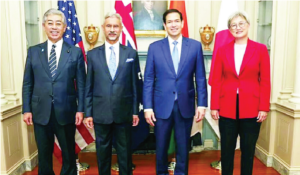
The Quad, formally known as the Quadrilateral Security Dialogue, is an informal strategic grouping of India, the United States, Japan and Australia. Though initially conceived in 2007, the grouping acquired renewed momentum after its revival in 2017 amid rapidly evolving geopolitical realities. Over the years, the Quad has transformed from a loose consultative forum into a significant strategic platform dedicated to promoting a free, open, inclusive and rules-based Indo-Pacific region. The New Delhi meeting, therefore, represented far more than a routine diplomatic interaction; it symbolized the emergence of a new geopolitical architecture shaped by shared democratic values, maritime interests and strategic convergence.
The principal focus of the meeting remained the security and stability of the Indo-Pacific region. Discussions centred on maritime security, freedom of navigation, military cooperation and the growing tensions in the South China Sea and East China Sea. The Indo-Pacific today has become the epicentre of global economic activity as well as strategic competition. Major sea lanes carrying a substantial portion of world trade pass through these waters, making maritime stability essential for global prosperity. The Quad nations emphasized the need to preserve international law, ensure unimpeded commerce and maintain peace in strategically sensitive waters. The ministers also deliberated on enhancing naval coordination and maritime domain awareness to address emerging security challenges.
Though the Quad officially avoids directly naming China as an adversary, the grouping is widely viewed across the world as a balancing mechanism against Beijing’s expanding geopolitical and economic influence. China’s increasing military assertiveness in the Indo-Pacific, aggressive maritime claims, economic coercion and technological expansion have generated concern among many nations. The timing of the Delhi meeting gained added significance because it followed recent high-level diplomatic engagements between the United States and China. Strategic analysts interpreted the meeting as a clear signal that, despite shifting global equations, the Quad continues to remain united and committed to safeguarding regional equilibrium.
One of the major issues discussed during the meeting was maritime cooperation. The Quad countries acknowledged that the Indo-Pacific sea routes are critical not merely for regional trade but for the entire global economy. Consequently, the ministers explored deeper cooperation in maritime domain awareness, joint naval exercises, anti-piracy operations and coordinated monitoring of strategic sea lanes. Such initiatives are aimed at ensuring that international waters remain secure, open and free from coercive control. Naval collaboration among the Quad members has steadily expanded over the years, particularly through exercises like the Malabar naval drills, which symbolize the growing strategic trust among member states.
Another key area of deliberation involved critical minerals and resilient supply chains. The disruptions witnessed during recent global crises exposed the vulnerabilities of overdependence on limited manufacturing centres and fragile supply networks. The Quad ministers, therefore, discussed strategies for strengthening semiconductor supply chains, securing access to rare earth minerals and promoting pharmaceutical resilience. Emerging technologies and economic security are increasingly interconnected with national security, making these issues central to contemporary diplomacy. The meeting highlighted the need for trusted and diversified supply chains capable of reducing strategic dependencies and ensuring long-term economic stability.
Technology cooperation also occupied a prominent place in the discussions. The ministers exchanged views on artificial intelligence, cybersecurity, quantum computing, digital infrastructure and telecommunications. In an era where technological supremacy increasingly determines geopolitical influence, the Quad seeks to establish collaborative frameworks that encourage innovation while protecting democratic values and digital sovereignty. Cybersecurity cooperation has become particularly important as cyber threats, disinformation campaigns and digital espionage continue to grow in complexity and scale. The Quad nations emphasized the importance of creating secure digital ecosystems that are transparent, resilient and inclusive.
Counter-terrorism emerged as another significant dimension of the Delhi meeting. India strongly advocated enhanced cooperation against cross-border terrorism, terror financing, radical networks and cyber-enabled extremism. Terrorism continues to pose a major threat to regional and international peace, particularly in South Asia and parts of the Indo-Pacific region. The ministers acknowledged that modern terrorism has evolved beyond conventional boundaries and increasingly exploits digital technologies, encrypted communication platforms and transnational funding mechanisms. Consequently, greater intelligence sharing, joint monitoring mechanisms and coordinated policy responses are now considered indispensable.
The deteriorating geopolitical situation in West Asia also figured prominently in the discussions. Rising tensions involving Iran and the broader instability in the region have serious implications for global energy markets and international economic stability. The Quad ministers recognized that conflicts in West Asia could significantly impact energy prices, trade routes and strategic alignments across the Indo-Pacific. The meeting, therefore, reflected the expanding scope of Quad diplomacy, which increasingly addresses not only regional concerns but also broader international developments with global consequences.
For India, hosting the Quad Foreign Ministers’ Meeting represented a major diplomatic achievement and reaffirmed its growing stature in world affairs. India today occupies a pivotal position in the Indo-Pacific because of its geographical location, economic potential and strategic capabilities. Under the leadership of Prime Minister Narendra Modi and External Affairs Minister S. Jaishankar, India has pursued a proactive foreign policy that seeks to balance strategic autonomy with deeper international partnerships. Hosting the meeting in New Delhi projected India as a responsible and influential power capable of shaping regional and global discourse.
The Delhi meeting also demonstrated the revival of strategic momentum within the Quad. At a time when the international system is witnessing profound uncertainty, geopolitical fragmentation and intensifying great-power competition, the Quad seeks to provide a platform for constructive coordination rather than formal military confrontation. Unlike traditional military alliances, the Quad operates through dialogue, consultation and issue-based cooperation. This flexibility has enabled the grouping to expand its agenda from security concerns to areas such as climate change, disaster management, technology, health security and economic resilience.
The significance of the Quad today lies in its broader vision of a stable and rules-based international order. The grouping reflects the shared understanding that the Indo-Pacific must remain free from coercion, open to lawful commerce and governed by international norms. In many ways, the Quad represents the evolving strategic consciousness of democratic nations determined to preserve regional balance amid rapidly changing global realities.
The Quad Foreign Ministers’ Meeting in New Delhi, therefore, marked an important milestone in the evolution of Indo-Pacific diplomacy. It underscored the growing convergence among India, the United States, Japan and Australia on critical strategic issues while reinforcing India’s centrality in shaping the future regional order. At a time marked by rising geopolitical tensions, economic uncertainty and technological competition, the Quad seeks to strengthen strategic resilience, promote regional stability and safeguard the principles of a free and open Indo-Pacific. The Delhi meeting thus reaffirmed that the Quad is no longer merely a consultative forum but an increasingly influential pillar of twenty-first century global geopolitics.


