By S K Arya, President, Dayanand Sewashram Sangh
In January 2025, Supreme Court remarks lamented, “Traditional norms and values of the Indian society laid stress on providing care for the elderly. However, due to the withering of the joint family system, a large number of elderly people are not being looked after by their family. Consequently, many older persons, particularly widowed women, are now forced to spend their twilight years all alone and are exposed to emotional neglect and to lack of physical and financial support. This reveals that ageing has become a major social challenge and there is a need to give more attention to the care and protection of older persons. Though the parents can claim maintenance under the Code of Criminal Procedure, 1973, the procedure is both time-consuming as well as expensive. Hence, there is a need to have simple, inexpensive and speedy provisions to claim maintenance for parents.”
This observation was made while addressing the growing challenges around care and rights of elderly family members, and the court highlighted societal transformation with the joint family system eroding and the resulting implications for vulnerable groups, especially senior citizens.
The traditional joint family is breaking apart, as legal disputes over property and elder care increasingly move to courtrooms rather than kitchen tables. Loneliness among urban elderly has hit record levels, according to the latest Longitudinal Ageing Study, yet in pockets across the country, community-led efforts demonstrate that even small acts can begin to mend fractured bonds.
In a time when change feels like the only constant, the resurgence of family-centric rituals and support systems stands out as both a comfort and a powerful statement: India’s future still rests, fundamentally, on the strength of its families.
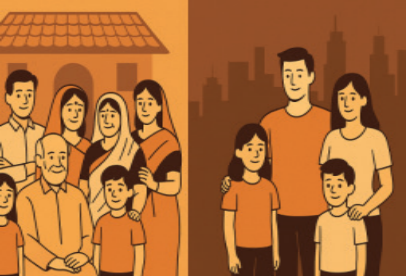
The Indian family, once synonymous with the joint family system, is transforming historic proportions. Over the past two decades, the sway of nuclear families has surged, now constituting nearly two-thirds of all households across the nation. This shift, propelled by urbanisation, economic ambition, and evolving social values, brings with it both new freedoms and unseen costs, particularly in the realm of emotional well-being and social cohesion.
According to the latest research from household surveys and market data, the proportion of nuclear families in India has jumped from around 37% in 2008 to an estimated 66% in 2024. Urban centres and southern states lead the changing face of Indian families, where young professionals and dual-income households seek autonomy and privacy.
But this fragmentation belies the underlying pressures families face today. With rising costs of living, household inflation rates averaging 8% in 2024- and an economic slowdown dampening income growth, nearly half of Indian families express anxiety about their financial futures. The traditional extended family, which once provided emotional, financial, and caregiving buffers, is no longer a reliable safety net for many.
The consequences of this transformation reach far beyond statistics. Mental health professionals report increasing cases of stress, anxiety, and depression, particularly among women. They balance their lives between career, home, single parenthood, and the elderly, and often face loneliness amid nuclear households.
Children also feel the impact, with fewer opportunities for guidance and emotional support from grandparents, uncles, and aunts. Experts warn that the erosion of joint family values contributes to higher rates of interpersonal conflicts and fractured relationships. In recent Supreme Court observations, the rise in family disputes over property and estrangement underlines this growing crisis.
According to a 2023 study, nearly 50% of urban elderly report feelings of loneliness. Numerous mental health disorders are rising steadily in nuclear families, and familial disputes increasingly reach the courts. Another alarming concern is the increasing DINK (Double Income No Kids) concept. The population of DINKs in India has been growing at 30 per cent per annum, according to the Gitnux Market Data Report 2024. The last census taken in 2011 shows that the DINK lifestyle is prevalent in nearly 42 per cent of two-member rural families compared to 22 per cent of similar urban families.
Amidst such contemporary challenges,Arya Samaj’s work gains relevance against sobering social realities.
In this backdrop of shifting family dynamics, Arya Samaj’s age-old call for family unity has found fresh urgency. The organisation’s “Har Ghar Yagya” initiative, launched robustly in 2024, exemplifies its adaptive response, connecting modern nuclear households with the spiritual and social strength of Vedic traditions.
This Door-to-Door Yagya program brings families together through sacred rituals, fostering harmony and mutual respect at home. More than a religious exercise, it catalyses dialogue, reminding families of the values of empathy, cooperation, and shared responsibility amid today’s pressures. Arya Samaj strongly advocates the “RishteBachaiye” Drive through activities such as street plays, school drama clubs and other discussion forums so the message is spread expansively and across all age groups.
Further, Arya Samaj’s expanded outreach encompasses workshops on conflict resolution, women’s empowerment groups, and youth programs aimed at instilling respect and social responsibility. These efforts resonate deeply in a time when families struggle to find balance in changing roles and expectations.
The organisation’s holistic approach,melding spiritual ritual with practical education and community building,offers a vital path forward. In encouraging dialogue over isolation and shared values over individualism, Arya Samaj rekindles the essence of family as the bedrock of society.
Modern India must acknowledge that economic growth and individual ambition cannot thrive without the foundation of strong families and communities. As social scientists and policymakers emphasise, the well-being of the family directly shapes the resilience of the nation.Arya Samaj’s adaptive programs, steeped in tradition yet responsive to contemporary realities, remind us that preserving familial bonds is not about resisting changebut about evolving wisely and compassionately.In an era of fragmentation and challenge, the timely revival of these age-old family values could well be the key to a healthier, happier, and united India.