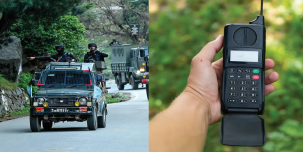
New Delhi: Prominent China affairs expert, Professor Srikanth Kondapalli, on Saturday commented on Beijing’s continued backing of Pakistan during Operation Sindoor, accusing it of double standards on counter-terrorism. He claimed that one of the terrorists involved in the Pahalgam terror assault was using a Huawei mobile phone connected to a Chinese satellite network. According to him, the terrorist had communicated with handlers in Pakistan using that satellite link at the time of the attack.
In an interaction with news agency ANI, Professor Kondapalli, who teaches Chinese Studies at Jawaharlal Nehru University (JNU), reiterated that China had extended support to Pakistan during Operation Sindoor.
What Did Prof. Kondapalli Say About China’s Role in the Pahalgam Attack?
He alleged that there was a Chinese connection, as the terrorist had used a Huawei satellite phone.
“On April 22, during the Pahalgam incident, one of the terrorists was found carrying a Huawei handset connected to a Chinese satellite. He was sending messages back to Pakistan following the attack. This clearly points to Chinese involvement. Before the assault, the Chinese reportedly provided satellite images of the Pahalgam area—around 120 to 129 slides—to Pakistan. This is yet another example of Beijing aiding Islamabad, despite its pledges on counterterrorism with India and within international platforms like the SCO,” Kondapalli stated.
Why Did Prof. Kondapalli Accuse Pakistan of Blocking TRF Mention in the UN?
The JNU professor further said that Pakistan had lobbied to remove references to The Resistance Front (TRF) from UN Security Council discussions after the Pahalgam terror strike.
“The Chinese and Pakistani ambassadors ensured that the TRF’s name was deleted, even though the group initially claimed responsibility for the Pahalgam attack twice before withdrawing it later. The fact that they owned up to it twice shows their involvement. In the Tianjin SCO Declaration, Pahalgam was mentioned, but later the text was diluted with references to the Zafar Express. This shows that China was pressured by Russia to retain mention of the Pahalgam incident, but yielded to Pakistan’s insistence to water it down. It only reaffirms that India cannot rely on China on matters of terrorism,” he remarked.
Chinese Support to Pakistan During Operation Sindoor
Kondapalli also pointed out that China shared intelligence inputs with the Pakistani Air Force during Operation Sindoor.
“Beijing again provided critical data, as even the Pakistani Deputy Army Chief admitted. Besides, China has supplied offensive military systems such as JF-17 and J-10 fighter jets and HQ-9 surface-to-air missile batteries. Interestingly, after the Pahalgam attack, Chinese Foreign Minister Wang Yi called for an ‘impartial inquiry,’ while China itself has never permitted investigations into Xinjiang-related insurgencies or the origins of COVID-19. The contradiction is glaring,” he said.
Following the Pahalgam terror attack, in which 26 tourists were killed, Indian security forces launched Operation Mahadev and neutralised the terrorists involved. Subsequently, India conducted Operation Sindoor, striking at terror bases across Pakistan and Pakistan-occupied Jammu and Kashmir (PoJK) and repelling Pakistani aggression while targeting enemy airbases.