
US-India relationship is now central to the Geo-politics of Indo-Pacific region
By T N Ashok
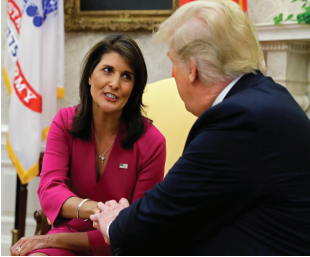
NEW YORK: When Nikki Haley, former U.S. ambassador to the United Nations and a former Republican presidential contender, warned that “alienating New Delhi at a time of rising Chinese assertiveness would be a strategic disaster,” she was not speaking in a vacuum. Her intervention came days after President Donald Trump slapped a steep 50% tariff on Indian goods, sending shockwaves through New Delhi and rattling the fragile balance of India–U.S. ties.
At first glance, her statement could be read as political theatre, a tactical jab at Trump from a rival within the Republican fold. But peel away the surface, and Haley’s comments touch upon decades of painstaking U.S. diplomacy that has sought to pry India away from its Cold War legacy of reliance on Moscow and embed it firmly in the orbit of the democratic West.
The stakes here are enormous—not just for Trump and his electoral calculations, but for Prime Minister Narendra Modi’s balancing act between strategic autonomy and global alignment, and for Nikki Haley’s own positioning as a candidate who claims to understand both America’s foreign policy imperatives and India’s civilizational trajectory.
It is tempting to dismiss Haley’s urgency as “ethnic loyalty.” Born to Sikh parents from Punjab, she often refers to her Indian heritage. But Haley’s record suggests that her warning stems less from ancestral pride than from a deeply strategic American lens. During her UN tenure, she was among the loudest voices pressing for a harder line against China, arguing that Beijing’s economic rise had translated into military aggression, cyber theft, and coercive diplomacy.
Her contention now is simple: in the Indo-Pacific chessboard, India is the indispensable piece. While alliances with Japan, South Korea, and Australia anchor U.S. power in the Pacific, only India can stretch that reach into the Indian Ocean and landmass bordering China’s vulnerable western flank. To push New Delhi away at such a moment, Haley argues, would be catastrophic.
This perspective reflects more than her personal candidacy. It reflects a school of U.S. policy thought—stretching back to the George W. Bush administration—that sees India as the “natural partner” in the long game of constraining China.
So why is Trump seemingly sabotaging that playbook? His decision to levy 50% tariffs on Indian goods with effect from August 27 is not just a commercial measure; it is political theater and geopolitical leverage rolled into one.
Publicly, the justification is India’s purchase of discounted Russian crude oil and its stubbornly high tariff barriers. Privately, insiders suggest Trump views Modi as a leader who responds only to “tough love.” The tariffs are designed to test Modi’s red lines—how far he will go to preserve ties with Moscow, and whether he can be bent into offering concessions to U.S. agriculture and technology lobbies ahead of America’s 2026 midterm elections.
There is also the “Howdy Modi” paradox. Trump once basked in the glow of the massive 2019 Houston rally with Modi, billing himself as India’s best friend in Washington. That camaraderie has since soured, partly because Modi has refused to cut energy lifelines from Russia and partly because Trump is cultivating ties with Pakistan as a hedge in Afghanistan’s messy post-U.S. landscape.
In Trump’s transactional worldview, India is too proud, too independent, and too unwilling to yield immediate gains—unlike Islamabad, which can be nudged with aid packages and military deals. The tariffs, therefore, are not just about trade. They are Trump’s way of testing Modi’s submission.
For Prime Minister Modi, this is a moment of acute discomfort. On one hand, his government insists that “strategic autonomy” remains non-negotiable. India will buy Russian oil because it keeps prices affordable for its vast population, particularly farmers and small businesses. It will not open its dairy and agriculture markets simply to appease American lobbies. And it will continue to assert sovereignty in trade and technology policy.
On the other hand, Modi knows India cannot afford a rupture with the United States at a time when Chinese threat along the Line of Actual Control (LAC) remains a live threat. The bloody Galwan clash of 2020 is still fresh in the Indian psyche, and Beijing’s new road-building across contested Himalayan regions suggests that tensions are only set to grow.
Without U.S. intelligence sharing, military technology, and diplomatic backing, India’s ability to stand firm against China weakens. Thus, Modi finds himself squeezed: bend to Trump and risk appearing weak domestically, or resist and risk losing the American partnership just as Beijing sharpens its knives.
This is where Haley’s warning becomes crucial. Her essay with Bill Drexel of the Hudson Institute argues that: India is not China – It is a democracy, however flawed, and a net contributor to global security. To treat New Delhi with the same punitive instincts Washington reserves for Beijing is to misunderstand the terrain.
India’s Russia dilemma is not permanent – Decades of defense dependence and energy necessity tie India to Moscow, but these can be unwound gradually through U.S. technology transfers, investment, and energy cooperation. Alienating India now risks cementing its reliance on Russia.
History matters – From Reagan’s 1982 state dinner for Indira Gandhi to George W. Bush’s 2005 civil nuclear deal, the U.S. has invested decades in cultivating India. To squander that because of one leader’s obsession with tariffs would undo bipartisan achievements.
Supply chains, defense partnerships, and demographic power make India indispensable to the free world’s strategy against China. Trade irritants should not derail the larger vision. In short, Haley is urging Trump—and the American electorate—to zoom out.
Is Trump truly willing to risk India for short-term gains? Analysts suggest three possible motives: Negotiating Tactic – The tariffs are a bargaining chip. Trump is betting that Modi will blink first, offering concessions on Russian crude purchases or trade barriers in exchange for tariff relief.
By posturing tough on India, Trump appeals to his protectionist base, which resents outsourcing and foreign imports. The move plays well in swing states where manufacturing jobs are sensitive.
Geopolitical Pressure on Russia – By targeting India’s Russian oil imports, Trump signals to Moscow that its global back channels are shrinking. India, as the largest buyer of discounted Russian crude, becomes the pressure point in Washington’s sanctions chess game.
Whether this is pure bluff or a genuine attempt to reshape India’s behaviour remains unclear. But the risk, as Haley points out, is that Modi may not cave—and instead double down on strategic self-reliance, looking to Europe, Japan, or even a more transactional relationship with China to offset American hostility.
The India–U.S. relationship has often swung between euphoria and estrangement. The 2008 nuclear deal symbolized breakthrough alignment. The Trump–Modi rallies of 2019 promised a new chapter. Yet every few years, trade disputes, visa frictions, or geopolitical differences resurface.
The difference today is that the China factor makes estrangement costlier than ever. If Washington and New Delhi drift apart now, Beijing will be the only winner. The U.S. would lose a partner capable of tying down Chinese forces on the Himalayan front, and India would lose access to the world’s most advanced military and technological ecosystem.
For Modi, the challenge is to reassure domestic audiences that he is not capitulating to American diktats while keeping open channels for de-escalation. For Trump, the risk is alienating the one partner most central to his anti-China rhetoric. For Haley, the opportunity is to present herself as the candidate who can repair what she portrays as Trump’s reckless brinkmanship.
The coming weeks will test whether Trump’s tariffs are the opening shot in a prolonged trade war with India, or simply a negotiating ploy that ends in compromise. Modi will weigh retaliatory tariffs, WTO complaints, and deeper ties with Europe and East Asia. The U.S. business community, already alarmed, will pressure the White House to reconsider—few American tech and defense firms want to lose access to India’s booming market.
But at the heart of the drama lies a bigger question: will the United States prioritize narrow trade grievances, or the larger strategic imperative of countering China with India as a frontline partner? Nikki Haley has staked her answer in that direction. Trump’s answer remains deliberately ambiguous, part of his brand of unpredictability. Modi’s answer will depend on how far he can stretch India’s autonomy without breaking the partnership altogether.
Nikki Haley’s warning is more than campaign rhetoric. It is a stark reminder that U.S.–India ties stand at a crossroads. The shadow of China looms large, Russia remains a complicating factor, and Trump’s tariff diplomacy risks undoing years of careful bridge-building.
Whether Modi succumbs or stands firm, whether Trump relents or doubles down, and whether Haley’s candidacy gains traction on the back of her foreign policy acumen—all of these remain open questions.
What is clear, however, is that the U.S.–India relationship is no longer a sideshow. It is a central axis of 21st-century geopolitics, and the choices made in Washington and New Delhi over the next few months will shape not just bilateral trade but the balance of power in Asia for decades to come. (IPA Service)


