“Aao School Chalein: NEP 2020 – A Quiet Revolution”
Ashraf Hussain Katoch
The National Education Policy 2020 (NEP 2020) is a landmark reform introduced by the Government of India, aimed at transforming the country’s education system. It replaces the National Policy on Education, 1986, and seeks to reimagine India’s classrooms for the future, with the vision of making India a global knowledge superpower.
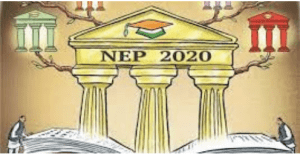
Key Features of NEP 2020
New Curriculum Structure:
The policy introduces a 5+3+3+4 structure, replacing the traditional 10+2 system. It focuses on foundational, preparatory, middle, and secondary stages of education.
Holistic Development:
NEP emphasizes critical thinking, creativity, and multidisciplinary learning to foster well-rounded individuals.
Vocational Education:
Vocational training is integrated from Class 6 onwards to enhance employability and bridge the gap between academic and practical knowledge.
Technology Integration:
The policy promotes digital learning, online platforms, and technology-enabled assessments.
Teacher Empowerment:
Focus is laid on continuous professional development and training for teachers.
Inclusive Education:
It aims to provide equitable access to quality education for all, especially marginalized communities.
Foundational Literacy and Numeracy (FLN):
A strong emphasis is placed on achieving universal foundational literacy and numeracy.
Multilingualism:
Teaching in local languages and mother tongues is encouraged, particularly in early grades.
Multidisciplinary Approach:
The policy promotes broad-based education with flexible curricula across disciplines.
Higher Education Reforms:
The proposed Higher Education Commission of India will bring structural reforms, including flexible degree programmes with multiple entry and exit options.
Reforms and Goals
NEP 2020 aims to achieve a 100% Gross Enrolment Ratio (GER) in school education by 2030 and increase GER in higher education to 50% by 2035.
Implementation and Challenges
While NEP 2020 has been widely welcomed as a transformative policy, its successful implementation poses challenges, including adequate funding, infrastructure development, and teacher training.
Overall, NEP 2020 has the potential to revolutionize India’s education system, making it more inclusive, flexible, and aligned with 21st-century needs.
Government Schools in Jammu & Kashmir: Progress Under NEP 2020
Jammu & Kashmir, after its reorganisation as a Union Territory, has moved swiftly to align its school education system with NEP 2020. Government schools, once grappling with issues of infrastructure, enrolment, and learning outcomes, are now showing steady and visible progress.
Early Start and Policy Adoption
J&K began implementing NEP 2020 from the academic session starting April 2022. The School Education Department rolled out Vidya Pravesh, a three-month play-based school preparation module for Class 1, and introduced Indian Sign Language as a subject at the secondary level.
In December 2025, the UT government designated the J&K Board of School Education (JKBOSE) as the State School Standards Authority (SSSA), as mandated under NEP. This body now monitors school standards related to safety, infrastructure, teacher qualifications, governance, and financial transparency—clearly separating regulation from academics.
Access and Enrolment Gains
According to the Economic Survey (2023–24), over 98% access to schooling has been achieved across all levels in J&K. The UT has 24,137 schools (18,724 government and 5,413 private), with total enrolment crossing 26.17 lakh students in 2024–25.
Literacy has risen significantly from 11.03% in 1961 to 68.74% in 2011. Enrolment ratios have improved across levels:
- Primary GER: 104.02
- Upper Primary GER: 68.93
- Secondary GER: 60.85
Dropout rates have also declined:
- Primary: 1.5%
- Upper Primary: 3.2%
- Secondary: 12.9%
Foundational Learning and Early Childhood Care
Under the NIPUN Bharat Mission, J&K is implementing a three-year Balvatika/pre-primary stage in government schools and anganwadis. Over 1.19 lakh children benefited from the Vidya Pravesh module in 2024–25, ensuring a smoother transition to formal schooling.
This aligns with NEP’s 5+3+3+4 structure and addresses early learning gaps, especially in rural and hilly districts.
Assessment Reforms and Quality Focus
The School Education Department has introduced summative assessments for Classes 1–8 (particularly Classes 5 and 8) from the 2024–25 session, shifting focus from rote learning to competency-based evaluation.
Schools now conduct continuous School-Based Assessments (SBA). Students who do not meet expected competencies receive remedial teaching and supplementary assessments before promotion. District Institutes of Education and Training (DIETs) maintain student databases to track academic progress.
Leadership Perspective
Lieutenant Governor Manoj Sinha (October 2025) stated that the education system in J&K is undergoing a major transformation under NEP 2020. He noted that government schools are improving remarkably, adopting innovative and student-centric approaches, and moving away from outdated learning patterns.
He also highlighted that girls in J&K are excelling in academics as well as co-curricular activities.
Higher Education Reforms in J&K
The Higher Education Department has confirmed that NEP 2020 has been implemented across all Government Degree Colleges in J&K. Institutions now offer job-oriented and skill-based courses under the four-year undergraduate structure, with multiple entry and exit options.
Changes Seen on the Ground
- Mother Tongue Instruction:Teaching in regional languages up to Grade 5 is being actively supported.
- Teacher Training:Efforts are underway to ensure 100% participation in NISHTHA 2.0 training programmes by NCERT.
- Equity in Education:Girls’ GER now exceeds the overall GER at all levels—Primary (114.5), Upper Primary (80.0), and Secondary (67.5).
Challenges Ahead
Despite notable progress, challenges remain, including difficult terrain, teacher shortages in remote areas, and the need to upgrade laboratories for vocational education.
However, with central schemes such as Samagra Shiksha and PM SHRI, strong policy backing, and institutional monitoring through SCERT and SSSA, government schools in J&K are steadily advancing towards NEP’s vision of equity, quality, and future-ready learning.
Way Forward
The Government of Jammu & Kashmir, under the leadership of the Hon’ble Chief Minister and Education Minister, is actively addressing these challenges. Initiatives such as co-locating anganwadi centres with schools and introducing competency-based curricula are strengthening the foundation of the education system.
In essence, NEP 2020 is not just a policy—it is a quiet revolution that is reshaping the future of education in India, moving it beyond textbooks towards holistic, inclusive, and skill-oriented learning.
(The writer is a Teacher at Govt Primary School, Pogal Paristan, Ramban and can be reached at [email protected]; Mob 9596889639)