Omkar Dattatray
In games as well as in politics, nothing is impossible, and nothing can be ruled out. What has happened is not ordinary but extraordinary, historic, unprecedented, and epoch-making: after 15 long years, the TMC is out, and the BJP has made its debut. For the first time, the lotus has fully bloomed in the bastion of the Trinamool Congress, and Mamata Banerjee was defeated along with her party. The end of syndicate and jungle raj has thus become not only a possibility but a hard reality.
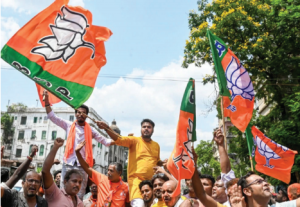
In the crucial West Bengal Assembly elections, women played a pivotal role, and there is no exaggeration in stating that they were the real kingmakers. The people of West Bengal voted for change, development, security, and national pride. The SIR conducted by the ECI also played a significant role in weeding out illegal and foreign voters, contributing to free and fair elections.
As of early May 2026, the “lotus blooming” in West Bengal refers to the Bharatiya Janata Party’s (BJP) high-stakes campaign, with exit polls projecting a victory over the incumbent TMC. Prime Minister Narendra Modi and other BJP leaders expressed confidence that the party symbol—the lotus—would fully bloom, symbolizing a shift in governance and an end to the existing administration.
Voters supported promises of transparency, good governance, improved law and order, and enhanced security for women. This marks the BJP’s maiden victory in the state, as it succeeded in dislodging the TMC government. Large numbers of voters endorsed a change in the political system, rejecting maladministration, irregularities, and poor law and order.
The electorate showed faith in the BJP’s slogan of parivartan (change) and development. The party crossed the majority mark of 147 seats, though the contest remained close. Ultimately, the people chose the BJP to experience a shift toward pro-development governance, with some also supporting the party’s ideological stance.
Through the democratic power of the ballot, the TMC government was voted out. Mamata Banerjee lost the Nandigram seat to Suvendu Adhikari. The BJP secured around 43–44 percent of the vote share, reflecting significant public support. Voters expressed concern over women’s safety, unemployment, and governance issues, and turned out in large numbers for change and development. The results indicate a strong saffron surge across the state.
Key Aspects of the 2026 “Lotus Bloom” Narrative
Political Context: Prime Minister Narendra Modi and BJP leaders expressed strong confidence that the lotus would bloom, signifying victory. This was borne out as the BJP won the high-stakes Assembly elections, marking a historic shift in West Bengal’s political landscape.
Key Issues: The campaign focused on alleged misrule over the past fifteen years and promoted the idea of a “double engine” government for better development and security. Voters appeared to support this promise, reflecting anti-incumbency sentiment.
Electoral Projections: While Mamata Banerjee predicted victory, most exit polls indicated a BJP win, which ultimately proved accurate.
Symbolic Moments: During the campaign in April 2026, Prime Minister Modi visited Thanthania Kalibari in Kolkata and purchased a lotus from a local seller, blending cultural symbolism with political messaging.
Regional Focus: The campaign emphasized rural outreach and key districts such as Purulia, Bankura, and West Bardhaman, contributing to the shift in political dynamics.
The phrase “lotus bloomed” signifies the BJP’s decisive performance after an intense contest. As trends became clear, it was evident that the party had gained a commanding lead, eventually crossing a strong majority. The metaphorical bloom of the lotus reflects both electoral success and the aspirations of the people.
The BJP’s rise in West Bengal marks a significant political transformation. With a strong mandate, the focus now shifts to governance and the fulfilment of promises. The electoral outcome suggests that the people voted against corruption, fear, and misgovernance, seeking a new phase of development and stability in the state.
(The author is a columnist, social activist, and freelancer.)