Whistleblowers flag organized tree mafia, allege forest staff nexus and repeated inaction despite ground reports
Ajay Sharma
Reasi, February 2
Even as illegal cutting of valuable Khair trees in Forest Division Reasi — particularly in Range Pouni — continues unabated, the concerned authorities appear either in deep slumber or allegedly complicit in the ongoing crime, raising serious questions about enforcement on the ground.
Khair wood, considered highly valuable due to its commercial and medicinal uses, is increasingly becoming a target for illegal timber operators. Despite repeated complaints and visible signs of fresh felling, no strong deterrent action has reportedly been taken, emboldening offenders and exposing glaring gaps in forest protection.
According to sources, there is alleged deep-rooted corruption within sections of the forest department, involving officials from guard level to higher ranks, allowing the unchecked felling of these trees worth lakhs of rupees each. The scale and frequency of the activity suggests a coordinated network rather than isolated violations.
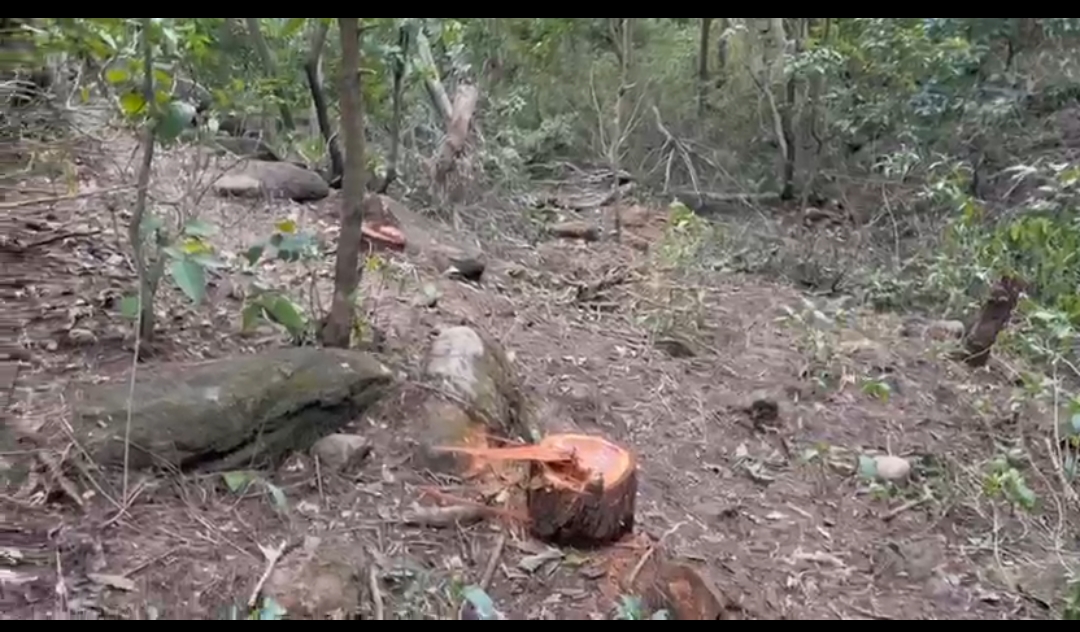
“The Khair tree has become a focal point for illegal activities in Jammu and Kashmir’s lower Himalayan belts,” sources said, adding that on-ground reports from the area adjacent to Domail indicate that dozens of mature Khair trees have been felled in state-owned forests and nurseries, with stumps and fresh cuts visible across multiple forest patches.
Field inputs suggest that the illegal operations are being carried out in clusters to maximize extraction before detection. Sources claimed that between 10 to 12 trees were cut at a single site, with similar incidents reported in nearby areas like Sudeen and Sandoor, pointing to a pattern rather than a stray act.
“As you can see, these trees have been cut down. There are many such trees. These trees belong to Khair. They have been cut down in the forest,” said a whistleblower. He further alleged, “This is happening because of the cooperation of the forest. Our forest officers know everything.”
The whistleblower further noted that the guard had reported the incident to the Block Officer (BO) Pouni and the Divisional Forest Officer (DFO) Reasi, but no immediate or visible action followed. The reported inaction, despite formal intimation, has added to public suspicion and anger.
“There is an inquiry. This inquiry is suppressed because there is some collusion,” the whistleblower alleged, adding that local block officers and guards, being from the same area, enable these activities by either overlooking violations or delaying action. He urged the Lieutenant Governor’s administration to order an independent probe into the matter, warning that without accountability of senior officials, “such activities will not be done in the jungle.”
He also pointed to what he described as a recurring seasonal corruption cycle linked to Khair extraction. According to the whistleblower, there is an extended pattern of corruption tied to the “Khair season,” where officials allegedly seek postings in Reasi for illicit gains — drawing a parallel with apple harvest-linked postings in parts of Kashmir.
“Whenever permission for Khair is available, in District Reasi, Range Pouni, there has been corruption and theft,” the whistleblower claimed. He added that in the past few years, a range officer, block officer, and guard were suspended for similar Khair-related irregularities, yet no lasting systemic reform followed and the illegal trade resurfaced through new channels.
The whistleblower further asserted that inquiries into such cases are often diluted or buried due to alleged collusion, resulting in a cycle where exposure rarely translates into accountability or prosecution.
Environmental observers warn that continued illegal felling of Khair trees not only causes heavy revenue loss to the government but also damages fragile forest ecosystems and regeneration cycles. They stress that unless surprise inspections, digital forest mapping, and third-party vigilance checks are introduced, the Khair smuggling network may continue to operate with impunity.
Forest Department officials in Reasi were not available for comment despite repeated attempts to reach them.