- Aditya Pandey
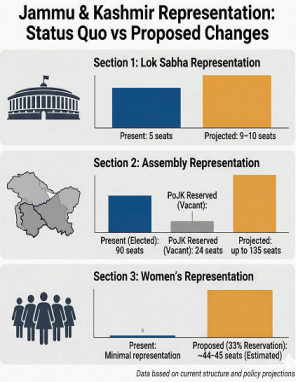
The Delimitation Bill, 2026, was tabled by Union Home Minister Amit Shah in the Lok Sabha, sparking extensive discussions and debates across the house. However, both the Delimitation and Women’s Reservation Bill were ultimately rejected, with 298 votes in favour and 230 against falling short of the two-thirds majority required for a constitutional amendment. For Jammu & Kashmir, India’s northernmost region, the outcome carries particular significance. The J&K assembly has 90 seats, of which 24 remain permanently vacant, reserved for Pakistan-occupied Jammu & Kashmir. In practice, therefore, the J&K Assembly has 90 elected seats, while 24 additional seats reserved for Pakistan-occupied J&K remain vacant. At the national level, J&K sends five members to the Lok Sabha, representing the constituencies of Jammu, Udhampur, Anantnag-Rajouri, Baramulla, and Srinagar.
Had the Delimitation Bill, 2026 and the Women’s Reservation Bill been passed, they could have brought significant changes to J&K that not enough people were even aware of. In terms of delimitation, the redrawing and expansion of constituencies could have pushed Lok Sabha representation from 5 to almost 9 or 10. Assembly seats, currently comprising 90, could have been increased up to 135 under a model growth of 50%. Nominated MLAs could have risen from 5 to 7, with expanded representation for women, Kashmiri Migrants, and PoJK refugees.
On the Women’s Reservation front, 33% of seats would have been reserved for women in the Lok Sabha and State assemblies. For J&K specifically, almost 3 Lok Sabha seats would have been proposed for women, and 44-45 assembly seats would have been kept reserved for female legislators.
The delimitation question, however, was never going to be straightforward for J&K. Both Jammu and Kashmir divisions have competed for decades over political imbalance, and seat numbers alone cannot resolve this. Jammu itself accounts for a substantial share of J&K’s geography and population, and has historically felt underrepresented in legislative outcomes. The critical question would have been where these new seats would fall. A delimitation process that does not honestly reflect population and geography could have deepened existing grievances rather than addressing them. Moving from 90 to 135 seats sounds like progress, but the 24 unfulfilled seats reserved for PoJK make this an even more complicated and unresolved promise, a reminder that representation in J&K has always been unfinished business.
The political space of J&K has been very narrow for women. Reserving 44-45 assembly seats would have been a real structural shift, the kind of change that has demonstrably worked in local governance across India, and one that tends to bring more women into political careers driven by social work, not just seat-filling. Greater Lok Sabha representation would have also meant a stronger voice for the state at the national level. That said, a politically expedient delimitation ignoring regional balance would have risked being worse than the current arrangement.
With the bills now rejected, the situation in J&K largely remains what it was: 90 effective assembly seats, 5 Lok Sabha members, minimal women’s representation, and the 24 PoJK seats still lying vacant. The structural gaps that these bills sought to address have not gone away; they have simply been left unresolved once again. For a state that has spent decades arguing over who gets more representation, this is a familiar place to be. The question of equitable delimitation and meaningful women’s representation in J&K remains open, waiting for a future legislative attempt that, if it comes, will need more careful and balanced implementation than political urgency often allows.
Democracy isn’t just about the number of seats. It’s about whether those seats actually represent the people beneath them. The people of J&K have waited a long time for that kind of representation. The rejection of these bills means they will have to wait a little longer.
(The writer is a student of M.A. in New Media Communications at the Indian Institute of Mass Communication (IIMC), Jammu.)