
By Bushan Parimoo
“It is a mortifying truth, and ought to teach the wisest of us humility, that many of the most valuable discoveries have been the result of chance rather than of contemplation, and of accident rather than of design,” said Caleb C. Colton (1780–1832), the English clergyman and one of the most frequently quoted authors for his words of wisdom.
His words indeed come nearly true in my chance observation, which has led me to the analysis described below.
The Jammu & Kashmir Academy of Art, Culture and Languages (JKAACL), of the erstwhile State of Jammu and Kashmir—now a Union Territory—is an almost co-equal institution of letters at the UT level, similar to what the Sahitya Akademi is at the national level.
Established in 1958 by the Government of Jammu and Kashmir under the then extant Constitution of Jammu and Kashmir, the JKAACL was considered an autonomous corporate body until 2019.
However, in 2021, the Government of Jammu and Kashmir converted the Academy into a “Society” registered under the Societies Registration Act, 1860.
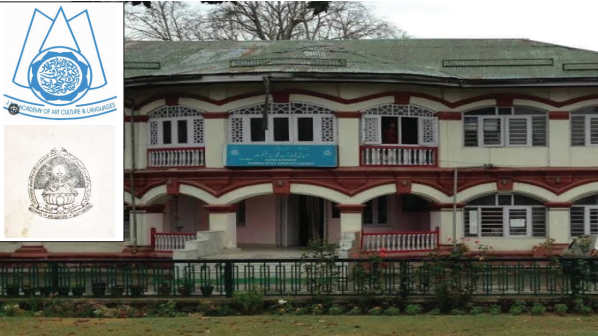
Following its establishment 67 years ago in 1958, the JKAACL adopted a desirable trilingual, secular, and non-religious logo. It featured a picture of an open book resting on a fully bloomed lotus flower. Atop the book were placed a sitar, an inkpot, a colour palette with a brush, and a lamp on a tall pedestal resembling a candle stand, radiating light piercing through the dark background—quite a symbolic representation of the objectives for which the Academy was established.
The artistically designed logo carried the name of the Academy in English, Hindi, and Urdu. The English name occupied the base, while the Hindi and Urdu names adorned the flanks, meeting in parabolic curves towards the top, where two doves faced each other—symbolising peace.
The original logo, as it appeared, is shown in the attached black-and-white image (sourced from the Academy’s 1968 publication).
Evidently, this logo appears to have remained in use without interruption until 1968. Then, something seems to have changed silently within this institution of letters, leading to the disbanding of the old logo in favour of a new one.
However, when exactly this transition took place is not known to me.
Nonetheless, it was replaced by a more parochial and implicitly sectarian logo (attached image in blue, sourced from the internet), which shows three triangle-like forms with elliptical bases and a floral motif at the centre, inside which the name of the Academy is written in calligraphic Persio-Arabic script.
This revised logo appears in the Academy’s publications from 1988 onwards.
I do not know whether the present Government dispensation and nationalistic authorities are aware of this silent change of the J&K Academy of Art, Culture and Languages’ logo—and whether it is possible for them to assert their authority to direct the Academy to re-adopt the original logo, given the post-2019 political reality of Jammu and Kashmir, and the need for non-parochial, nationalist institutional symbols and motifs.
Such an intellectual decision could go a long way in breaking the bigoted and subversive mindset that persists in intellectual circles in the UT and could instead reflect the spirit of academic and scholarly discipline that leaves no room for any suspect mindset.
However, one matter of paramount importance is to ascertain whether the change in logo has any legislative sanctity, since the original was adopted under the then extant provisions of the Constitution of Jammu and Kashmir.
(The writer is a Jammu-based columnist.)


