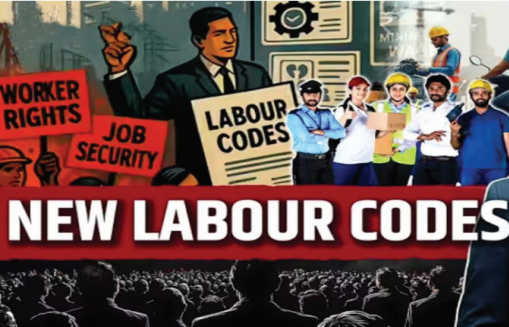
A new chapter in India’s labour reforms — replacing 29 archaic laws with four modern labour codes — is being hailed as a historic step toward global standards, worker welfare, and industry competitiveness.
However, a joint platform of 10 labour unions has criticised this move as anti-worker, arguing that it will strengthen employer dominance and weaken workers’ bargaining power.
According to Advocate Kishan Sanmukhdas Bhawnani of Gondia, Maharashtra, the reforms support national economic initiatives such as Atmanirbhar Bharat and Make in India, as labour reforms are a key pillar of global investment and industrial development.
Historical Context of Indian Labour Laws
Gondia: Labour reforms in India have been debated globally for decades. Labour laws enacted between 1930 and 1950 laid the foundation for independent India’s industrial structure and worker protections. However, over time, profound changes in industrial models, technology, employment patterns, and global markets have occurred.
Today’s economy is digital, skill-driven, and globally integrated. In such an environment, labour management based on outdated legal structures neither benefits industries nor protects workers adequately.
Against this backdrop, the Indian government has implemented four new labour codes —
The Wage Code (2019)
The Industrial Relations Code (2020)
The Social Security Code (2020)
The Occupational Safety, Health and Working Conditions Code (2020)
These came into effect on November 21, 2025, marking one of the biggest structural transformations in India’s labour market. Advocate Bhawnani notes that reactions from labour organisations remain deeply divided. While 15 major trade organisations welcomed the move as a step toward making India a hub for global manufacturing and investment, 10 labour unions strongly opposed it as anti-labour. The Bharatiya Mazdoor Sangh (BMS) has termed the reform long-awaited and positive.
Need for Reform beyond the Colonial-Era framework
Most of India’s labour laws were created during British rule to regulate and control industrial activities. Their objectives centred more on maintaining production and protecting colonial interests, rather than uplifting workers, expanding social security, or encouraging economic growth.
Although amendments were made after independence, legal simplification and integration never took place. As a result, India’s labour system became highly complex, with 29 separate laws and hundreds of regulations, leading to high compliance costs for industries. Workers, too, struggled to understand and claim their rights.
International bodies such as the World Bank and the ILO have frequently recommended labour reforms in India to strengthen worker protections while boosting employment and investment. To address these concerns, the government consolidated old laws into a unified framework of four labour codes.
Objectives of the Four Labour Codes
According to Advocate Bhawnani, the fundamental objective of the new system is to simplify, unify, and modernise labour laws to suit a rapidly evolving work environment. The main goals include:
Strengthening workers’ rights and social security
Simplifying and making regulations transparent
Encouraging large-scale employment generation
Increasing formality in the labour market
Attracting global investment
Improving working conditions across sectors
He further states that these reforms complement national economic programmes like Make in India and Atmanirbhar Bharat.
Understanding the Four Labour Codes
Code on Wages (2019):
Merges four separate wage-related laws.
Ensures timely and fair wages for all workers.
Clarifies provisions relating to minimum wages, overtime, bonuses, and payment procedures.
Expands minimum wage protection to unorganised and gig workers.
Industrial Relations Code (2020):
Aims to maintain industrial harmony and ensure smoother dispute resolution.
Simplifies procedures related to strikes, layoffs, and re-employment.
Industry groups claim it will ensure productivity and investor confidence, but unions fear it will legalise easier layoffs.
Social Security Code (2020):
A landmark change that brings gig and platform workers under social security for the first time.
Expands benefits like EPF, ESI, maternity cover, insurance, and pension.
Occupational Safety, Health and Working Conditions Code (2020):
Focuses on workplace safety, hygiene, and fair working conditions.
Aligns Indian workplace standards with international safety norms.
Benefits of Replacing 29 Laws with 4 Codes
Permanent-Level Benefits for Fixed-Term Employees:
Fixed-term staff will get benefits equivalent to permanent workers, including social security, paid leave, and medical cover.
Gratuity eligibility reduced from five years to one year.
Expected to encourage direct hiring and reduce contract dependency.
Minimum Wages and Timely Payment:
All workers will receive minimum wages linked to a national floor rate.
Timely wage payment will be legally enforced, preventing unauthorized deductions.
Women Allowed to Work in All Shifts and Roles:
Women may work in night shifts, mining, heavy machinery, and hazardous sectors, provided safety measures and consent are ensured.
Equal pay is mandatory.
Women’s representation in grievance committees made compulsory.
Better Working Hours and Overtime Protection:
Work hours set between 8–12 hours daily and 48 hours per week.
Double wages for overtime.
Written consent required for extended hours.
Leave accrual after 180 days in export and similar sectors.
Universal Appointment Letters and Formalisation:
Every employer must issue appointment letters.
Ensures transparency in employment and access to benefits.
Expected to formalise jobs in sectors like IT, textiles, ports, and logistics.
Legal Recognition for Gig and Platform Workers:
Gig workers get official status.
Aggregators must contribute 1–2% of their revenue to welfare (capped).
Benefits become portable across states through Aadhaar-linked IDs.
Mandatory Safety and Health Checks in Hazardous Industries:
Free annual health check-ups for workers.
Safety committees mandatory in large units.
Strict adherence to national safety standards.
Expansion of the Social Security Net:
Coverage extended to MSMEs, single workers in hazardous sectors, and platform workers.
Wider inclusion in ESI coverage and pension protections.
Protection for Digital and Media Workers:
Journalists, freelancers, dubbing professionals, and media workers get regulated work hours, timely pay, and appointment letters.
Safeguards for Contract, Migrant, and Unorganised Workers:
Migrant and contract workers to receive equal pay and continuous access to government schemes.
Employers must provide social security and basic workplace facilities like clean drinking water and sanitation.
These reforms are particularly significant for over 90% of India’s unorganised workforce.
Conclusion
Upon evaluation, the implementation of the four labour codes emerges as a transformative step toward building a self-reliant India. The reforms aim to simplify labour governance while balancing worker protection and industrial growth.
Although criticisms and challenges remain — especially from trade unions concerned about worker rights — it is clear that India’s labour framework is moving towards global competitiveness. With these changes, India appears positioned to build a stronger, more secure, and more competitive labour market for the future.
(The Compiler Author – Tax Expert Columnist, Litterateur International Writer, Advocate from Maharashtra 9226229318)