By T N Ashok
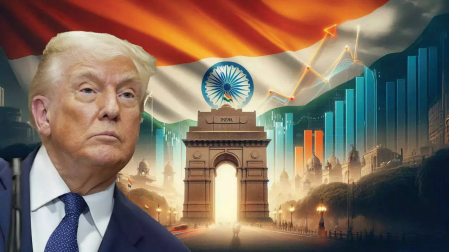
NEW YORK: The United States under the deal maker President Donald Trump and India under the charismatic Prime Minister Narendra Modi are arm wrestling despite being buddies on the global stage. They both represent two largest democracies that spent a decade investing in strategic convergence.
Now in August 2025, they are locked in a blunt-force test of leverage. President Donald Trump has doubled duties on Indian imports to 50%, explicitly tying tariff relief to New Delhi cutting purchases of discounted Russian crude. Prime Minister Narendra Modi has responded with public steel and private hedging, signalling that India’s energy security—and the political economy built on cheap oil—won’t be bartered away easily. The question in Washington and New Delhi is the one on every boardroom slide: who yields first, and at what price?
The White House has made the linkage overt. Senior trade adviser Peter Navarro said tariffs could be rolled back if India stops buying Russian oil—an unusually direct quid pro quo that fuses trade policy with wartime sanctions goals. The 50% rate took effect this week, after an earlier jump to 25% in early August; the stated rationale is that Indian purchases “fund” Russia’s war machine and undercuts U.S. industry.
India’s basic position is similarly unambiguous: it imports more than 85% of its crude and will buy “wherever it gets the best deal,” prioritizing affordability and diversification. Russian barrels, often at discounts to Middle Eastern grades, have become central to that calculus. Reuters and others report that while state refiners briefly paused purchases when discounts narrowed, volumes remain significant and could rise again in September as arbitrage improves.
Politically sensitive, too, is the industrial footprint behind these flows. Reliance Industries—Mukesh Ambani’s refining behemoth at Jamnagar—has emerged as the single biggest corporate beneficiary of discounted crude, underpinned by long-term supply arrangements with Rosneft. That capacity, among the world’s most complex, converts Russian crude into refined products legally sold into Europe and the U.S., exploiting a well-known sanctions loophole on “origin.”
Think tanks estimate Europe’s imports of Indian refined products surged post-2022. That’s commerce, not contraband—but it is exactly the kind of “leakage” the White House is now trying to constrict via tariffs.
Strip away the chest-thumping and you have three overlapping contests: Sanctions enforcement by trade weaponization. The administration is testing whether a big, blunt tariff can achieve what price-cap diplomacy and shadow-fleet crackdowns haven’t: reduce cash flows to Moscow by throttling the largest remaining buyer of its crude. It’s a gambit with collateral risk: tariffs impose costs on U.S. importers and consumers and strain a pivotal Indo-Pacific partnership even as Washington worries about China.
India’s energy-price politics. Modi’s macro story—manufacturing push, inflation control, growth optics—rest in part on cheap feedstock. Cheaper Russian barrels help cap pump prices, hold down input costs for transport and industry, and pad refiner margins that, in turn, support investment and jobs. Yanking that cushion risks visible pain before key state elections and broader national milestones.
The Trump-Modi battle has also significant political dimensions. PM is facing elections in Bihar in October this year. He , as the Prime Minister of such a powerful nations can not seem to be openly capitulating to Trump at this hour. He has to show that the country can depend on him for upholding the honour of the nation. On the contrary, Trump faces a backlash on deportations, federal troops deployment, stripping medicare and torpedoing health care benefits to low income groups, scrapping food stamps, making goods including groceries costlier at home, all of which could turn the tide of the very voters, who put him in power in 2024, turn against him in November 2026 midterm polls.. Trump has to appear strong before them and not be a TACO – Trump always chickens out.
Indian corporate interests may also play an important role in decision making. Reliance can pivot back toward Middle Eastern crude if Russian flows tighten; traders note its flexibility and scale. But switching isn’t costless, and margins could narrow. State-run refiners, which paused some Russian cargoes when discounts eroded, face the same arithmetic: spot spreads dictate politics more than press releases do.
The Washington Post, Guardian, FT, Axios, and others all frame the 50% tariff as leverage rather than an immovable object—implying room for transactional de-escalation if India gives something that can be sold domestically as “wins.”
Trump’s mindset is transactional, theatrical, and oriented to scoreboard politics. Tariffs are a familiar instrument: shock the counterpart, flood the zone with blame (“they fund Putin’s war”), and then offer a visible “deal” that can be touted at rallies and on cable hits—tariffs halved in exchange for “Modi backing down.” Navarro’s public conditionality is a tell: the administration wants an outcome it can frame as deterrence in action. But Trump also likes flexibility; if he can rebrand a partial step as total victory, he often does.
Modi’s mindset blends strategic autonomy with political stoicism. The doctrine is consistent: India won’t be drafted into bloc discipline that raises domestic costs. Energy security is treated as sovereign function; lectures from abroad tend to stiffen, not soften, Delhi’s posture. Publicly yielding under pressure is politically toxic. But Modi is not dogmatic about sourcing—he is opportunistic. If equivalent barrels are available from the Middle East or the U.S. at similar economics, India will shift without calling it capitulation. The aim is to maintain the option to buy Russian crude, not to die on that hill if spreads collapse.
Between an all-or-nothing tariff war and abject capitulation, several “middle-path” packages are in play—each designed to give both sides billboard-ready talking points:
A volumetric or share cap with verification. India could commit (quietly or semi-publicly) to limit Russian crude’s share of imports below a threshold (say, under one-third, enforced over rolling averages), with third-party verification of cargo origin through attestations and AIS data. The White House scales tariffs back to 25%—or selectively exempts sectors like pharmaceuticals or IT hardware—citing “material risk reduction” to Kremlin revenues.
Refined product transparency and routing constraints. Delhi can pledge enhanced transparency on refined-product exports to destinations that have sanctions regimes, plus stricter internal guidance to avoid routing that would convert Russian-origin crude into products shipped to the U.S./EU. Think better paperwork, audits, and industry codes—measures that allow Washington to claim it closed the “loophole,” even if overall Indian intake remains sizable.
Swap barrels, not friends. Encourage Indian refiners—especially the flexible private majors—to increase Middle East and U.S. cargoes while phasing down spot Russian buys when discounts narrow. Reliance has already signalled the ability to pivot sourcing mixes if Russian supply tightens; an engineered pivot dressed as market response lets Modi say economics, not Washington, drove the change. Partial tariff relief follows.
India locks in additional U.S. LNG or long-term petrochemical feedstock deals, tosses in a purchase framework on defense co-production, and greenlights a few market-access sweeteners (data localization carve-outs, med-device tariffs, or e-commerce friction points).
Some analysts argue visas and financial channels (think dollar clearing or insurance) are more surgical than global tariffs. If Washington subtly eases up on tariffs while reserving the right to use targeted financial levers against specific trades that look like sanctions evasion, both sides get tools—and face-saving.
From a U.S. interest perspective, the optimal “yield” is tactical, not strategic: scale back the blanket tariff while locking in verifiable constraints that trim Russia’s rent capture.
Washington gains more by extracting a measurable, reportable reduction in Russian-linked flows than by insisting on zero—especially if “zero” pushes India deeper into alternative financing and BRICS channels.
From India’s interest perspective, the first “yield” should be optical, not material: concede process (transparency, audits, voluntary guidelines, a headline number for Russian share) while preserving optionality to buy discounted barrels when spreads justify it. If India barters modest, monitored limits for tariff relief that protects labor-intensive export sectors in gems, textiles, leather, and seafood, Modi safeguards both inflation optics and export employment. In other words: trade constraints on the margin to gain tariff relief at the core.
That aphorism misunderstands his pattern. Trump is comfortable declaring victory and moving on if he can point to a concession he can brand as decisive—even when the underlying policy change is incremental. If Delhi offers a package that caps Russian share, tightens export transparency, and inks some U.S. energy/defense buys, there’s a clear path for the White House to say: We got Modi to stop financing Putin’s war—and drop tariffs to 25% (or carve out key categories) accordingly. That is not “chickening out”; it’s classic deal re-labeling.
Neither leader benefits from an open-ended tariff war. Trump wants a headline victory against “funding Putin”; Modi wants affordable energy and dignified autonomy. There is a deal space where India trims and tidies Russian exposure—by share caps, transparency, and diversified sourcing—while the U.S. trims tariffs and claims a sanctions win.
The leader who “yields first” will do so by changing form, not substance: Washington by swapping the sledgehammer for a scalpel; New Delhi by swapping some barrels and more paperwork for market access. When both can call that a win, this standoff ends. (IPA Service)