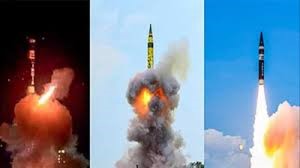
New Delhi, July 17 – In a significant display of nuclear deterrence, India on Thursday conducted back-to-back test launches of two nuclear-capable ballistic missiles—Prithvi-2 and Agni-1—from the Chandipur test range off the Odisha coast.
The Defence Ministry confirmed that both missiles, with strike ranges of 350 km (Prithvi-2) and 700 km (Agni-1), were successfully launched by the Strategic Forces Command (SFC), validating all operational and technical parameters.
Though officials described the tests as routine periodic trials, the timing—just weeks after cross-border hostilities under Operation Sindoor (May 7–10)—suggests a clear message of strategic readiness aimed at Pakistan, as both missiles are specifically designed for shorter-range threats.
This is believed to be the first time India has tested two nuclear-capable missiles on the same day, heightening the strategic significance of the event.
India’s missile arsenal also includes longer-range systems like Agni-2 (2,000 km), Agni-3 (3,000 km), and the Agni-5 (over 5,000 km), which are primarily intended for deterrence against China. The upcoming Agni-Prime missile (1,000–2,000 km) is expected to gradually replace both Agni-1 and Agni-2.
The Agni-Prime and Agni-5 are notable for their canister-launch capability, allowing swift transport, longer shelf life, and high mobility. Agni-5 has also been successfully tested with MIRVs (multiple independently targetable reentry vehicles), enabling a single missile to strike multiple targets spread across hundreds of kilometers.
While India continues to modernize its nuclear deterrent, it still trails far behind China in overall nuclear capabilities. According to the Stockholm International Peace Research Institute (SIPRI), China adds about 100 nuclear warheads annually and maintains a stockpile of around 600 warheads, compared to India’s 180 and Pakistan’s 170. (Agencies)