A master class in coalition politics delivers the NDA an overwhelming mandate
By T N Ashok
When the votes were counted in Bihar’s 2025 assembly elections, the result was unambiguous: The Bharatiya Janata Party and Janata Dal (United) alliance had secured 202 of 243 seats, decimating an opposition that just months earlier had harboured hopes of unseating the incumbents.
The landslide victory wasn’t merely about numbers. It represented a sophisticated recalibration of Indian state politics, where traditional caste calculations gave way to welfare promises, where memories of past chaos outweighed present grievances, and where women voters emerged as kingmakers.
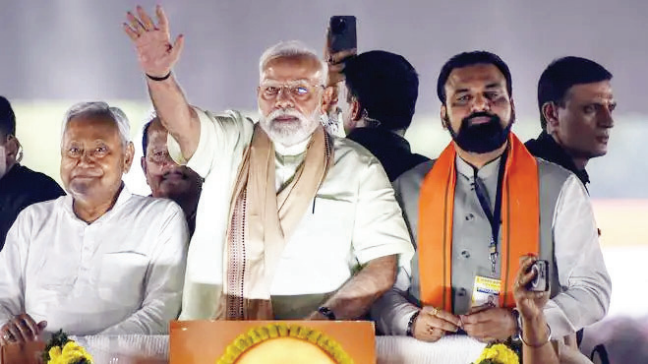
At the campaign’s center stood an unlikely but effective duo: Narendra Modi, India’s prime minister and the BJP’s national face, and Nitish Kumar, Bihar’s chief minister whose political longevity has survived multiple alliance shifts. Together, they created a narrative of competence that the opposition struggled to counter.
Kumar remains “Sushashan Babu” — the governance chief — to many Biharis, a reputation built over years of infrastructure development and relatively corruption-free administration. Despite concerns about his age and history of switching coalition partners, his administrative record still commands respect across the state’s diverse electorate.
Modi brought national gravitas and sharp campaign messaging, linking Kumar’s state-level achievements to his government’s broader development agenda. The partnership transcended mere political convenience: The BJP and JD(U) contested seats on equal terms, signalling genuine power-sharing rather than a dominant party accommodating a junior partner.
The National Democratic Alliance’s success began with meticulous seat-sharing arrangements. Rather than the destructive internal competition that has plagued other coalitions, the NDA parcelled out constituencies based on each party’s strengths. The BJP, JD(U), and smaller partners like the Lok Janshakti Party and Hindustani Awam Morcha avoided overlapping candidacies and pooled resources strategically.
This discipline created a unified electoral front that contrasted sharply with the opposition’s fragmented approach. While the Mahagathbandhan — the grand alliance of opposition parties — bickered over seat allocations and messaging, the NDA projected cohesion and purpose.
Perhaps no campaign theme proved more potent than invoking “Jungle Raj” — the lawlessness that characterized Lalu Prasad Yadav’s rule in the 1990s and early 2000s. Modi and Kumar repeatedly warned that opposition victory would return Bihar to those chaotic years, when kidnappings, extortion and caste violence were rampant.
The irony wasn’t lost on observers: This election was among the most peaceful in Bihar’s recent history. Yet the narrative resonated with voters old enough to remember that era and young voters whose parents had lived through it. For an electorate craving stability, the NDA positioned itself as the only credible bulwark against a return to disorder.
The election’s most decisive demographic shift came from women, whose turnout surged past men’s in several districts by double-digit margins. The NDA had cultivated this constituency for years through targeted welfare schemes: free bicycles for schoolgirls, liquor prohibition, and most recently, the Mahila Rojgar Yojana, which provided ₹10,000 grants for women entrepreneurs.
These weren’t merely handouts but investments in creating a loyal political base. Female voters responded enthusiastically to a message that combined economic opportunity with social dignity. In constituency after constituency, this newly mobilized electorate proved critical to the NDA’s margins.
Bihar politics has long been defined by caste arithmetic, with parties building coalitions around Yadavs, extremely backward castes, Dalits and upper castes in various combinations. The 2025 election suggested this old formula is weakening.
The NDA constructed a broader social coalition that cut across traditional caste lines. By appealing to non-Yadav backward castes, extremely backward classes, Dalits, sections of upper castes and women as a cross-cutting identity, the alliance diluted the Rashtriya Janata Dal’s traditional base among Muslims and Yadavs.
While caste identity remained relevant, the NDA’s welfare-driven narrative proved more compelling than the opposition’s identity politics. Free electricity for the first 125 units, increased pensions, and support for grassroots workers weren’t cosmetic promises but central to how voters evaluated the parties.
The Mahagathbandhan’s defeat was partly self-inflicted. The coalition suffered from internal divisions, poor message discipline and strategic errors. Most notably, its leaders leaned heavily on allegations of electoral fraud — “vote chori” or vote theft — invoking Congress leader Rahul Gandhi’s warnings about manipulated voter rolls.
The Election Commission and NDA dismissed these claims, and voters appeared unpersuaded. Rather than mobilizing support, the accusations made the opposition look disorganized and distracted from substantive issues.
The leadership contrast also worked against the opposition. Tejashwi Yadav, the RJD’s youthful face, pursued vigorous attacks on corruption and dynastic politics but couldn’t match Kumar’s reputation for governance and reliability. For voters, the choice came down to experience versus promise — and they chose the former.
Yet victory brings its own challenges. The NDA’s welfare promises carry an estimated price tag of ₹28,000 crore ($3.18 billion) — a daunting sum for a relatively poor state. The fastest path to revenue would be scrapping the liquor prohibition that women voters strongly support, potentially generating ₹3,000-4,000 crore annually.
Tax increases on government services and commodities offer another avenue but risk spiking inflation and alienating the same voters who delivered victory. The opposition will certainly exploit any such moves, particularly if prohibition is lifted.
Bihar’s 2025 verdict offers a roadmap for coalition politics in India: welfare delivery, disciplined messaging and social engineering can overcome traditional caste calculations. The Modi-Kumar alliance demonstrated that a well-constructed coalition with clear power-sharing and unified purpose can dominate even in India’s most politically complex state.
For the opposition, the defeat is existential. Rebuilding will require more than reconstructing caste coalitions — it will demand a compelling alternative narrative on governance and development.
For now, Bihar has chosen stability over change, experience over youth, and welfare promises over identity politics. Whether the NDA can deliver on those promises will determine if this victory marks a lasting realignment or merely a temporary triumph. (IPA Service)