Kishan Bhawnani, Maharashtra

Guru Tegh Bahadur Singh’s message of martyrdom was not restricted to any single land or community. Over the centuries, his sacrifice has evolved into one of the strongest moral foundations of the global human rights movement. The international observance of the 350th martyrdom year of Guru Tegh Bahadur Ji in 2025, therefore, holds immense historical, cultural, and political significance.
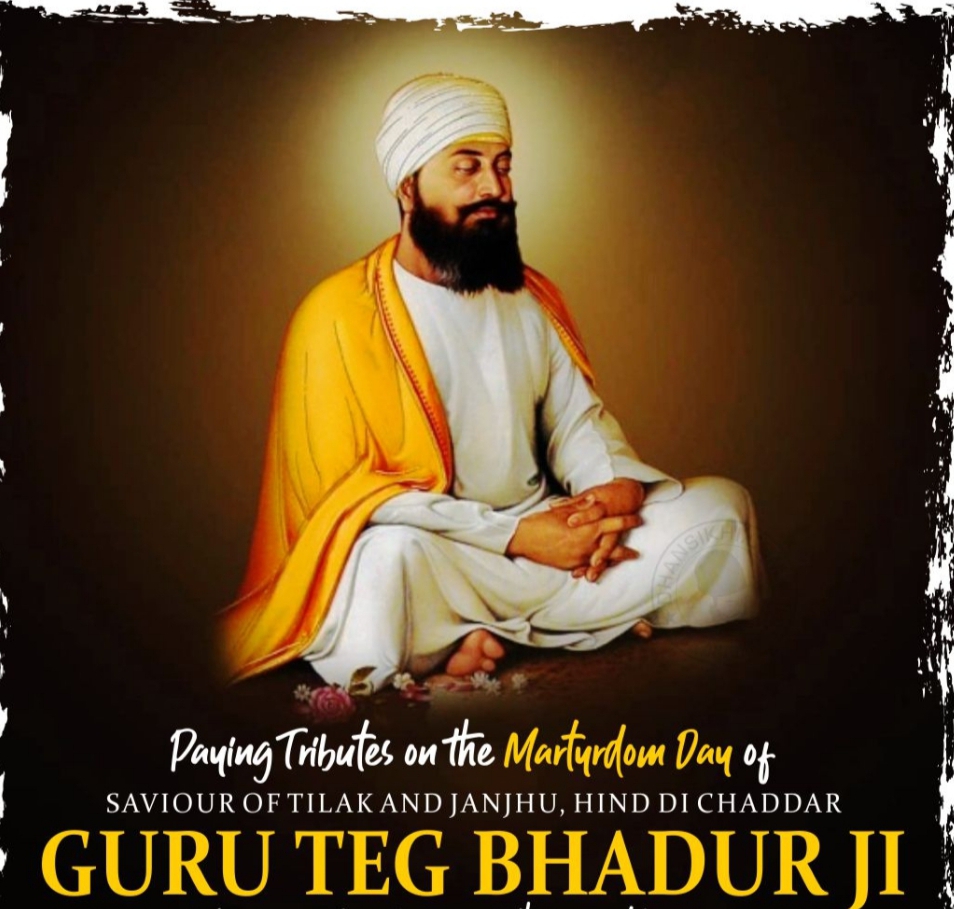
The global observance of November 25, 2025, marks more than a ritual remembrance. It recalls a rare and unparalleled moment in world history when a spiritual leader laid down his life not for his own faith, but to protect the religious freedom of others. Guru Tegh Bahadur, the ninth Guru of Sikhism, is remembered not merely as a martyr, but as a defender of conscience, justice, and human rights. Throughout Indian history, he has been recognized as the “Hind di Chadar”—the shield of India. His sacrifice represents the essence of Indian pluralism and the constitutional principle of secularism long before constitutionalism existed.
This event remains unique in the history of human rights. In the 17th century, when religious persecution and forced conversions under Mughal rule had created an atmosphere of fear, the Kashmiri Pandits turned to Guru Tegh Bahadur Ji for protection. At a time when violence, coercion, and state oppression dominated society, Guru Tegh Bahadur Ji boldly proclaimed that faith cannot be controlled by political power. He deliberately chose the path of sacrifice—not for political resistance, not for territorial gain, but to protect the right of every human being to practice their belief freely.
His public execution in Delhi’s Chandni Chowk was not just the killing of a dissenter; it was a clash between ideas. It symbolized the victory of spiritual integrity over authoritarian cruelty. Centuries before the United Nations drafted the Universal Declaration of Human Rights in 1948, the principles of freedom of conscience, protection of religious identity, and independence of thought had already been established by his martyrdom. This is why international scholars today describe Guru Tegh Bahadur Ji as “The First Human Rights Defender of the Modern World” and “The Saint of Freedom of Conscience.”
Guru Tegh Bahadur Ji’s martyrdom demonstrates that religious freedom is not merely an individual privilege but a fundamental value of human civilization. His sacrifice was not only a defense of religious identity; it was a defense of human dignity itself. This universal moral message is what elevates his legacy beyond geographical, cultural, or religious boundaries.
A Universal Message for Today’s World
If we consider the message of global peace, coexistence, and humanity conveyed by Guru Tegh Bahadur Ji, it becomes clear that his legacy is especially relevant in the contemporary global context. The world today is grappling with religious conflicts, cultural intolerance, extremism, and racial divisions. In such times, Guru Tegh Bahadur Ji’s life stands as an ethical compass that reminds us that the true purpose of religion is not division, but spiritual upliftment and social harmony.
He spoke for the marginalized, the oppressed, and the voiceless—Dalits, farmers, and downtrodden communities. His teachings reflect the ideals of equality, compassion, moral courage, and sacrifice. Today, discussions on interfaith dialogue, peaceful coexistence, and religious tolerance dominate international forums. The United Nations and global human rights organizations continue to struggle for world peace, rights of minorities, and freedom of expression. Guru Tegh Bahadur Ji’s ideology brings a profound philosophical and ethical context to these efforts.
He asserted that religious diversity is not a cause for conflict, but a manifestation of the richness of human culture. His principle of “Sarbat da Bhala” (welfare of all) deeply resonates with the United Nations vision of global peace and collective human development. At a time when nations are divided by identity politics and religious polarization, his teachings remind us that humanity stands above all forms of identity—national, religious, caste-based, or ethnic.
Today, his legacy is studied and celebrated across continents—Canada, the United States, Europe, Britain, Australia, and in many Asian countries. International conferences, cultural events, and academic symposia dedicated to him show that his message has not faded; instead, it continues to grow in moral relevance. Sikh communities and global human rights institutions commemorate him as a symbol of “Freedom of Faith” and “Liberty of Conscience.”
Global Significance of the 350th Martyrdom Year (2025)
The global commemoration of Guru Tegh Bahadur Ji’s 350th martyrdom year is a reminder that the struggle for religious freedom is not merely a legal or political concern, but a profound human value. Even today, many regions of the world—whether in the Middle East, Africa, Asia, or Europe—are witnessing rising religious intolerance, state control over belief, persecution of minorities, and violence rooted in ideological dominance.
At such a time, Guru Tegh Bahadur Ji’s sacrifice stands as a moral warning and a timeless source of inspiration. If international leadership in 2025 adopts his ideals within global policies related to human rights, interfaith peace, religious freedom, and international cooperation, it could shape a more humane global order. International forums must ask: Does the world truly recognize freedom of belief as a universal right, or does human rights still surrender to political power and ideology?
The Message of Martyrdom: A Call to Action for the World
The remembrance of Guru Tegh Bahadur Ji is an opportunity not merely for homage but for action. His teachings must inspire world efforts to protect religious liberty not just in constitutions and treaties, but in lived reality. Academic research, recognition by global institutions, and incorporation of his humane principles into peace-building initiatives can transform this commemoration into a historical milestone.
His martyrdom proves that one individual’s moral conviction can alter the course of history. It reminds today’s youth that opposing injustice, violence, and intolerance is not only a right—it is a responsibility. If the world embraces this 350th year as a moment to strengthen the moral foundations of humanity, then this commemoration will not only honour the past, but also guide the future.
Guru Tegh Bahadur Ji’s 350th martyrdom year is not merely a religious observance. It is a celebration of one of the greatest legacies in world history—a legacy of human rights, freedom of conscience, and moral courage. His life shows us that humanity, freedom, and peace are values greater than any empire, ruler, or ideological force. In a world still threatened by intolerance and conflict, his message shines like a beacon for the future.
As the world pays tribute to him on November 25, 2025, it must reflect honestly whether we are upholding his ideals. The true homage to Guru Tegh Bahadur Ji is not in tribute alone, but in building a world where every human being can live with dignity, freedom, and peace. Only then will the spirit of his sacrifice truly illuminate global civilization.
(The Compiler Author is a Tax Expert. Columnist Litterateur Writer and can be reached at 9226229318)