Dr. Parveen Kumar*
The Mahatma Gandhi National Rural Employment Guarantee Act (MGNREGA) enacted in 2005 and that provided 100 days of guaranteed wage employment to adult members of rural households willing to do unskilled manual work is now a history. The Act was a landmark achievement of the than UPA government giving a legal guarantee for right to work. The Mahatma Gandhi National Rural Employment Guarantee Act (MGNREGA) played a key role in providing wage employment, stabilizing rural incomes and creating basic infrastructure and assets in rural settings. Now after abour two decades, government replaced it with Viksit Bharat Guarantee for Rozgar and Ajeevika Mission-Grameen (G RAM G). The new programme aligns rural employment with the long-term vision of Viksit Bharat @ 2047, while strengthening accountability, infrastructure outcomes and income security.
Since Independence, a lot of employment initiatives have been started by various governments that aimed at rural development along with creation of employment opportunities. The employment generated through various programmes was of two type self employment as well as wage employment. Self employment opportunities were created through provision of loans to youths for setting up their own business units like loans under Micro Units Development and Refinance Agency (MUDRA). Wage employment programmes primarily focused on providing wage employment to under privileged and poor especially in rural areas. The Jawahar Rozgar Yojana (JRY), Sampoorna Grameen Rozgar Yojana (SGRY) which was later merged with MGNREGA was a wage employment programme. All the programmes focused on reducing poverty, improving agricultural productivity and creating employment for surplus and underemployed rural labour. Over the period of time, wage employment programmes have gradually evolved as key instruments for supporting rural livelihoods while also strengthening basic infrastructure, with approaches adapting to changing socio-economic conditions over time.
The Mahatma Gandhi National Rural Employment Guarantee Act (MGNREGA) was started as a flagship programme aimed at enhancing livelihood security by providing at least 100 days of guaranteed wage employment each year to rural households willing to undertake unskilled manual work. The programme was a unique one in many ways and within a few years, the act achieved many things which many other rural development schemes of the past could not achieve. A range of administrative and technological reforms strengthened its implementation, leading to notable improvements in participation, transparency, and digital governance. What was worth of the act was the women’s participation in the scheme. It rose steadily from 48 per cent to 58.15 per cent between FY 2013-14 and FY 2025-26. The use of ICT in this programme in the shape of Direct Benefit Transfer, Aadhaar seeding with Bank accounts of beneficiaries added to the wider coverage of this scheme.
Despite success of this programme, some issues started emerging putting a question mark on the efficiency and implementation of scheme. Research studies done in various states revealed gaps. These gaps related to the no. of works which were not found on the ground, expenditure did not matched physical progress, use of machines in labour-intensive works, and frequent bypassing of digital attendance systems. Besides wages were drawn against the persons who were no more in this world. Things worsened during post pandemic period. As the no. of years passed on misappropriation accumulated and only a small proportion of households were able to complete the full one hundred days of employment in the post pandemic period.
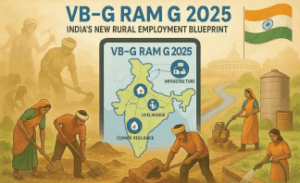
The government on Dec. 16, 2025 introduced the Viksit Bharat Guarantee for Rozgar and Ajeevika Mission Gramin Bill in the Lok Sabha which was passed by both the houses on Dec. 18, 2025. The Bill also got the presidential assent and is now an act that has replaced MGNREGA. The Viksit Bharat G RAM G guarantees 125 days of wage employment per rural household in each financial year to such rural households whose adult members volunteer to undertake unskilled manual work, contributing to income security by increasing the no. of days of employment in a year by 25. Under the new act, there is a 60 days no work period to ensure the availability of agricultural labour during peak sowing and harvesting season. Workers will receive 125 guaranteed days of employment within the remaining 305 days, ensuring that both farmers and labourers benefit. The disbursement of daily wages shall be made on a weekly basis or, in any case, not later than a fortnight after the date on which such work was done. Under MGNREGA, if a person seeking work is not provided employment within 15 days, the state government must pay them an unemployment allowance. The Bill retains this provision.
Employment generation will be under four broad categories. These four categories are of works are ensuring water security through water-related works like construction of canals, check dams, water harvesting structures, rejuvenation of existing water bodies and afforestation works; works to create core-rural infrastructure like roads, bridges, buildings, health institutions, electricity transmission; works related to livelihood- related infrastructure like storage structures, dairy infrastructure, rural business haats and special works to mitigate extreme weather events like construction of folds/cyclone shelters, embankments and forest fire management etc. Further all assets created will be aggregated into the Viksit Bharat National Rural Infrastructure Stack, ensuring a unified, coordinated national development strategy. Planning under VB G RAM G has been decentralized through Viksit Gram Panchayat Plans, which are to be prepared locally and spatially integrated with national systems such as Prime Minister Gati Shakti.
The new Bill represents a major upgrade over MGNREGA, fixing structural weaknesses while enhancing employment, transparency, planning, and accountability. Under MGNREGA works were scattered and lacked clear focus. On the other hand works under G RAM G have been broadly categorized into four categories. Earlier MGNREGA was a central sector scheme while G RAM G is a centrally sponsored scheme with states also bearing 40 per cent of the budget. In case of Northeastern and Himalayan states the funding pattern is 90:10. However in case of UTs without legislature the central government has to bear all the expenditure. In the new architecture, states share both cost and responsibility through a normative allocation framework creating stronger incentives for effective implementation and preventing misuse. Planning is grounded in regional realities through Gram Panchayat Plans. The Centre will set the standards, while states will execute with accountability, resulting in a cooperative partnership that improves efficiency and strengthens outcomes.
The Act also provides that the central government will determine state-wise normative allocation for each financial year. The parameters for these allocations will be prescribed by the central government under rules. The state government will bear any expenditure incurred in excess of this allocation. MGNREGA had established Councils at the central and state levels to undertake implementation and monitoring. The new act retains these provisions and also provides that their composition will be specified under Rules. It also constitutes a National Level Steering Committee which will provide high-level oversight, and recommend normative allocations. It also has Steering Committee for each state. The state committee will oversee convergence with other programmes, aggregation of district plans into state plans and coordinate with the National Committee.
To conclude, the act will strengthen the rural economy by linking employment generation with productive asset creation, leading to higher household incomes and improved resilience. The guarantee of 125 days of employment will lead to household earnings, stimulate village-level consumption and help reduce distress-driven migration. The support in the form of digital attendance, fixed interval payments and data-driven planning has the potential to steer rural economies to new heights.
(The author writes on agriculture and social issues; can be reached at [email protected])