Degrees in Hand, Jobs Out of Reach: A Generation Between Hope and Uncertainty
By Rishabh Anand (IIMC Jammu)
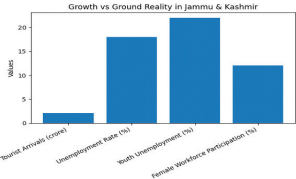
In 2023, Jammu and Kashmir recorded over 2 crore tourist visits—a historic high. Yet, for many educated young people in the region, one question remains unchanged: where are the jobs?
The current state of Jammu and Kashmir is defined by this stark contrast. On paper, the region is undergoing a period of noticeable change, marked by record-breaking tourism, improved infrastructure, and enhanced connectivity. Beyond this narrative of expansion, however, lies a quieter and more complex reality: development that has not yet fully translated into broad, long-term opportunities.
The most visible symbol of this revival is tourism. With more than 2.1 crore visitors in 2023, local hospitality-related businesses have seen a resurgence. Numerous livelihoods have benefited—from small vendors in Gulmarg and Pahalgam to houseboat owners on Dal Lake. This surge offers relief and hope for a region that has experienced prolonged instability. However, tourism remains vulnerable and seasonal, dependent on external factors such as market trends, weather conditions, and political stability. Consequently, it cannot serve as the sole foundation for sustained economic growth.
Unemployment, however, continues to pose a significant challenge. According to the Centre for Monitoring Indian Economy, the unemployment rate in Jammu and Kashmir often ranges between 15 and 20 percent—substantially higher than the national average. The situation is particularly concerning among educated youth. Government job openings frequently attract lakhs of applicants for a limited number of positions, highlighting both the scale of demand and the lack of viable alternatives.
At the core of the issue lies a widening gap between education and employability. While access to higher education and aspirations have increased, the local economy has not kept pace in generating employment opportunities. The absence of a robust private sector, limited industrial growth, and an overdependence on government jobs have created a structural imbalance. As a result, many graduates face long-term uncertainty, underemployment, or the need to seek opportunities outside the region.
The implications extend beyond economics. When education fails to translate into meaningful employment, it risks eroding confidence and slowing social mobility. The growing gap between aspirations and opportunities can significantly affect both individual futures and the broader social fabric.
At the same time, Jammu and Kashmir is undergoing a generational and cultural transition. With internet penetration estimated at around 60 percent, digital exposure has expanded horizons. Young people are increasingly influenced by global trends, emerging career paths, and evolving social norms. While this has fostered awareness and innovation, it has also heightened expectations—often creating a mismatch between what is aspired to and what is locally attainable.
Women in the region are also navigating this shifting landscape. More women than ever are pursuing higher education, and female literacy has risen to over 68 percent. However, workforce participation remains relatively low, reflecting persistent social and structural barriers. The progress, though uneven, is real and underscores the need for policies that actively promote women’s economic inclusion.
All of this raises a fundamental question: what constitutes meaningful development? Increased tourism, improved infrastructure, and better connectivity are important benchmarks. However, true development must be inclusive—capable of generating stable livelihoods, encouraging entrepreneurship, and ensuring that growth extends beyond a few sectors.
Today, the story of Jammu and Kashmir is not merely one of recovery or resilience, but of imbalance. It is about a skilled youth unable to find employment commensurate with their qualifications, a graduate preparing for competitive exams year after year, and a young woman striving to balance ambition with social expectations.
There is no denying the region’s immense potential. However, this potential must be matched with economic diversification and clear policy direction. Strengthening private investment, promoting skill-based industries, supporting local entrepreneurship, and aligning education with market needs are essential steps toward bridging this gap.
Without such a foundation, growth risks becoming superficial—visible in statistics, yet disconnected from everyday realities.
A region cannot thrive on numbers alone—until its youth find their place in this growth story, the promise of progress will remain incomplete.
Sources:
- Ministry of Tourism, Government of India (Tourism Statistics 2023–24)
- Jammu & Kashmir Tourism Department (Official Data)
- Centre for Monitoring Indian Economy
- National Statistical Office (PLFS Reports)
- Ministry of Education
- Telecom Regulatory Authority of India