CHENNAI, Sept 21 – The Union government is preparing to integrate skill-based learning into the senior secondary school curriculum, a move that Education Minister Dharmendra Pradhan said will bring a “paradigm shift” in the country’s education system. The initiative, he noted, is in line with the recommendations of the National Education Policy (NEP) 2020, which prioritises competency over certificates and degrees.
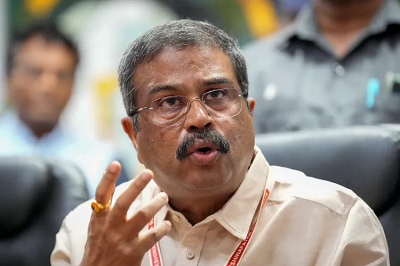
Speaking at the Dakshinapatha Summit 2025 hosted by the Indian Institute of Technology (IIT) Madras on Sunday, Pradhan announced that Classes 11 and 12 will soon have a formal skill-oriented curriculum in addition to the existing science, commerce, and humanities streams. “We are on the job to introduce skill-based curriculum for Class 11 and 12. Education should not just be about degrees, but about making students competent,” he said.
The minister explained that the new structure would open opportunities for students to pursue subjects such as computer programming, drone technology, and artificial intelligence alongside core subjects like mathematics and languages. He stressed that the earlier model of optional skill-based learning will now be replaced with mandatory inclusion from Class 6 onwards. “Skill education will no longer remain selective. It will become a formal part of the curriculum,” he added.
Highlighting Prime Minister Narendra Modi’s vision, Pradhan said the focus must shift from producing degree-holders to nurturing competent individuals prepared for the future economy. He pointed out that the NEP 2020 explicitly recommends introducing skill-based learning at every stage, and its implementation will be critical for achieving the Centre’s Viksit Bharat 2047 vision.
Pradhan also praised IIT Madras for fostering innovation and promoting student-led startups. Recalling his interaction with IIT students and faculty, he thanked Director V. Kamakoti and his team for encouraging special talents, including those who excel in sports and music. He noted that under progressive NEP policies, many students from diverse backgrounds, including government schools, are gaining entry into prestigious institutions like IITs.
The minister also met with students enrolled under the ‘IITM for All’ initiative, which seeks to make IIT Madras accessible to rural and underprivileged students. These students are pursuing a four-year online BS Data Science programme designed to expand opportunities for those outside the traditional IIT admission system.
On the larger picture, Pradhan observed that India now has more than 1.75 lakh startups, with many founders becoming job creators rather than job seekers. “The new narrative is about entrepreneurship and innovation, and IITs are competing with each other in this direction,” he said.
Calling the NEP 2020 a “philosophical document,” Pradhan asserted that every recommendation in the policy will need to be implemented in the next two decades. He underlined that skill-based education is central to this transformation and will redefine how Indian students are prepared for global opportunities. (Agencies)