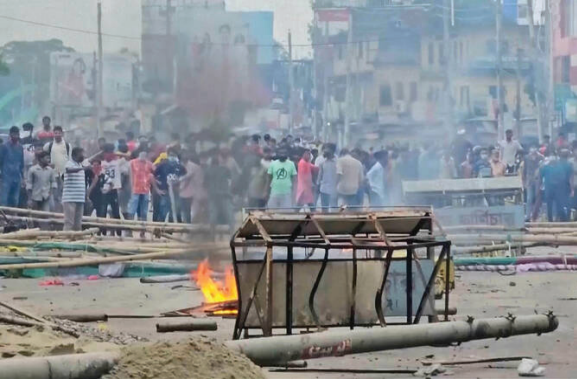
Large number of commoners joined AL in beating NCP supporters
By Ashis Biswas
KOLKATA: In Bangladesh, the recent eruption of violence involving pro-government forces and opposition supporters of the currently banned Awami league (AL), at Gopalganj, reveals the failure of the country’s interim Government, to stamp its political authority among a bitterly divided population. The shocking outburst of public anger among common people against their interim rulers and the ruthless reaction of the law enforcing agencies, exposed how far Bangladesh was from restoring democracy and order.
While the interim rulers succeeded in winning the day against pro-opposition forces, the political price paid for its success was considerably high, The foray into Gopalganj, a known stronghold of the AL, as well as a personal political base for the late Sheikh Mujibur Rahman, carried out by the newly set up National Citizens Party (NCP), was at best a controversial, move if not a deliberate provocation. ..
In some ways, it became an important trial of strength for both the ruling pro-Government parties and forces and the banned AL opposition. For some months now, there was reportedly a growing perception among common people that the ruling makeshift government run by Dr M. Yunus as the Chief Adviser to the President, had been losing ground steadily. It had promised the people a lot, without actually delivering much especially in bringing the general elections any nearer. The reasons for the Gopalganj flare-up : the Government’s palpable failure to achieve its even its short term promised goals These involved i the restoration of law and order, bringing down the cripplingly high inflation, the highest in Asia, special schemes to attract fresh international investments, etc .
In the political sphere, there were promises to implement much needed administrative reforms to facilitate free and fair polls, regular consultations between the government and the opposition parties, to reduce corruption among major leaders and officials during the AL rule, the arrest and trial of people, especially AL leaders including former Prime Minister Hasina among others.
It was not as though the new government did not make a beginning to complete its work on all such matters and then arrange for a fresh general elections at the earliest. However, progress was far too slow.
Many prominent AL leaders and officials had simply left the country, some to take shelter in India while others went elsewhere. The new government, enjoying the support initially from the Jammat Islami and the Bangladesh Nationalist party (BNP) both entities known for their consistently critical if not hostile attitude towards India, could not make much headway on other fronts either.
A few arrests were made, but in view of the massive corruption allegedly carried out by the AL which the new government banned, these did not count for much. There was little progress in locating the hundreds of millions of dollars reportedly salted away in foreign banks by former officials and leaders.
On the other hand, the head of the interim Government Dr Yunus spared no opportunity to provoke India, the neighbour closest to Bangladesh politically and in trade. Dhaka sought to involve China and even Pakistan and Turkiye, in controversial mew schemes, while discontinuing joint Indo-Bangla traffic connectivity and other projects.
The bigger country, instead of reacting strongly, withdrew its crucial financial help and inputs in foreign trade and related matters, putting Bangladesh into major difficulties.
Clearly Dr Yunus had sought to take advantage of the generally anti Indian anger witnessed in Bangladesh in the wake of the AL’s decline. But as things got more difficult, they became disillusioned with his anti-Delhi postures and actions, which upset even Chamber of Commerce circles!
It was not long before, not only the BNP, but many others as well, strongly reminded him that people were aware of his tasks as defined at the time of his takeover : to create the general situation conducive or free and fair elections and clean up the administration generally. .By poking his nose into business that did not concern him, he only neglected his normal duties and wanted to initiate major policy changes for which an interim ruler had no authority!
So it was no surprise that common people who were not normally anti-Government, also joined the hard core AL supporters in an all out fighting against the cadre of the NCP leaders and their few local supporters who had gone into Gopalganj to desecrate the memorial of the late Mujibur Rahman. They were attacked by a well armed mob with bricks, sticks and stones. Their condition would have been precarious if they were not rescued by the police and later by army units. .
It was the first major action of resistance from common people against the interim government. The AL issued a strong statement condemning the new rulers and warned them of further reaction in the days ahead. Mrs Hasina issued a call from India urging upon the AL to maintain its unity and keep the organisation ready for combatting government personnel in the coming days and weeks. The days of Yunus’s rule, she stressed were numbered.
Meanwhile, initial reports claimed that at least 51 people, mostly AL supporters and Hindus, had been killed during the violence and attacks even during the curfew restrictions that followed. Hundreds of houses and offices, mostly belonging to resident Hindus had been burnt and over 400 people were missing. (IPA Service)