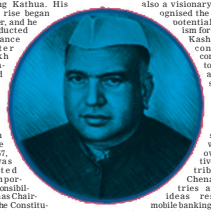
Girdhari Lal Dogra
(17th July 1915 – 27th November 1987)
By Ravi Rohmetra
Remembering Girdhari Lal Dogra, a veteran Freedom Fighter, towering statesman, former Minister and Member of Parliament, on his 38th death anniversary on 27th November 2025, reminds us of an era defined by simplicity, dedication and public service. He served as Finance Minister of Jammu & Kashmir for an unmatched period of 26 years, leaving behind a legacy of transparency, integrity and people-centric reforms.
Duggar land, known for its rich history and cultural strength, has produced many distinguished personalities in politics, academia and public service. Among them, Girdhari Lal Dogra remains one of the most revered. His life was dedicated to uplifting the poor and working for the welfare of society. Humble, compassionate and firm in his principles, he believed that true service to humanity was service to God. For the underprivileged, he became a guardian figure whose name continues to be remembered with affection and respect.
Born on 17th July 1915 in Bhaiya village of Hiranagar tehsil in Kathua district, Dogra grew up when Maharaja Pratap Singh ruled the princely state of Jammu & Kashmir. He pursued his B.A. and LL.B. from Punjab University. His interest in politics began during college days, and he soon came in contact with Shri Kichloo, a prominent Congress leader in Punjab. Dogra later became editor of the weekly newspaper “Kissan”, published from Jammu, through which he boldly highlighted the problems of farmers. He married Kumari K. Kunta of Smailpur, the daughter of Pandit Prem Nath Dogra’s elder brother, thus connecting two eminent Duggar families.
In 1947, during the Emergency Administration, Dogra was appointed as Officer In-charge of Administration in District Kathua. In a crucial moment of history, he mobilised local resistance against Pakistan-backed “Mujahids,” who attacked areas bordering Kathua. His political rise began soon after, and he was inducted as Finance Minister in Sheikh Mohammad Abdullah’s cabinet in 1948. He continued to serve in that role till 1957, and was entrusted with important responsibilities such as Chairman of the Constitution Drafting Committee, Member of the Finance Committee and Member of the University Council of J&K University.
With political realignments in the State, he later joined the Democratic National Conference under the leadership of G.M. Sadiq. He played a prominent role in the opposition and continued to represent the Hiranagar constituency for most of his political life. Dogra was reappointed as Finance Minister in 1960 and 1964. He also served as Member of Parliament, getting elected to the Lok Sabha from Jammu–Poonch in 1980. Throughout his political journey, he remained admired as a polite, dependable and towering figure who never sought personal gain.
One of his most remarkable achievements was the historic Land Reforms Act of 1952, under which the tiller was made the owner of the land. This bold step transformed the lives of peasants and ensured dignity for agricultural labourers. He was also a visionary who recognised the economic potential of tourism for Jammu & Kashmir. The concept of constructing tourist huts at scenic spots, which later boosted tourism infrastructure, was his own initiative. His contribution to Chenab Industries and early ideas resembling mobile banking reflect his far-sighted development thinking. Recognising his competence, Prime Minister Indira Gandhi had once offered him the prestigious post of Lok Sabha Speaker.
His simplicity distinguished him as a true “people’s man.” Dogra served as Finance Minister from 1957 to 1975, got elected to Parliament twice and contested—and won—five elections from Hiranagar. He held key responsibilities in both Congress and National Conference and was respected across party lines. His landmark decision to provide tube-well facilities to the Kandi belt revolutionised access to drinking water in Jammu. This system continues to sustain life in many areas even today.
Dogra Ji’s political philosophy was rooted in secularism. Leaders across the political spectrum describe him as the “tallest leader of his time,” one who fought against communal divisions and worked tirelessly for unity. He lived modestly and served with unwavering honesty. Jammu remembers him not merely as a leader, but as a humanitarian who stood firmly with the poor and marginalised.
A statue of Girdhari Lal Dogra was installed near PHQ on the road to Jammu Railway Station by the Girdhari Lal Dogra Memorial Trust on 27th November 2011 and unveiled by the then Chief Minister Dr. Farooq Abdullah. His family also remained connected with public life; his son-in-law, the late Arun Jaitley, served as Union Finance Minister in Prime Minister Narendra Modi’s government and held key portfolios under Atal Behari Vajpayee.
The finest tribute we can pay to this great son of Jammu is to emulate his values—selfless service, integrity, simplicity and genuine love for the people. Girdhari Lal Dogra’s contributions continue to inspire generations. Though he is no longer with us, his legacy lives on in every reform that touched the lives of common citizens. He stands as an enduring symbol of humility, resilience and public service—a leader who dedicated his life to the upliftment of humanity and remains immortal in the hearts of the people he served.
(Ravi Rohmetra is a Freelance writer and a social worker. He can be reached at M.No.9419652999; e-mail:[email protected])