Sakshi Jha (IIMC Jammu)
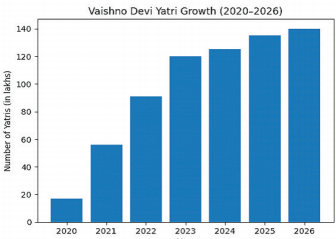
Jammu’s tourism story is no longer just about faith it is slowly becoming a narrative of transformation, resilience, and new possibilities. For decades, the region has been synonymous with the sacred shrine of Vaishno Devi Temple, drawing millions of pilgrims every year and shaping the local economy almost entirely around religious travel. However, data from 2020 to 2026 reveals a significant shift in this pattern. The COVID-19 pandemic brought tourism to an abrupt halt, with yatri numbers dropping sharply to nearly 17 lakhs in 2020, a stark reminder of the sector’s vulnerability. Yet, what followed was a remarkable recovery 56 lakh visitors in 2021, rising to 91 lakhs in 2022 reflecting both the resilience of faith-based tourism and the gradual reopening of travel. By 2024, the numbers had surged further, and projections suggest around 1.35 crore visitors in 2025 and close to 1.4 crore by 2026, marking not just recovery but expansion.
What makes this growth particularly noteworthy is not just the increase in numbers but the changing nature of tourism itself. Jammu is no longer being seen only as a pilgrimage stop; it is emerging as a more diverse travel destination. Places like Patnitop, Mansar Lake, and Bahu Fort are gaining popularity among tourists who are seeking short getaways, scenic landscapes, and nature-based experiences. Between 2021 and 2026, non-religious tourism in the region has grown by nearly 30–35%, while eco-tourism alone is witnessing an annual increase of around 20–22%. This shift indicates that visitors are increasingly looking beyond traditional pilgrimage routes, exploring Jammu’s natural beauty, heritage sites, and peaceful retreats.
Infrastructure development has played a crucial role in enabling this transition. Improved connectivity through expanded capacity at Jammu Airport, better highway networks, and enhanced rail access have made the region more accessible than ever before. At the same time, government initiatives such as homestay promotion schemes have boosted local participation in tourism, increasing accommodation capacity by nearly 40% since 2020. This has not only created employment opportunities but has also strengthened rural tourism circuits, allowing smaller and lesser-known destinations to enter the tourism map.
Despite these positive trends, challenges remain. Jammu still relies heavily on a single religious destination, making it vulnerable to fluctuations. Limited digital promotion of lesser-known sites, short tourist stays, and seasonal overcrowding continue to restrict its full potential. To sustain and strengthen this growth, there is a clear need for strategic planning integrating tourism circuits, promoting eco-friendly models, and investing in targeted marketing campaigns that showcase Jammu as more than just a stopover.
At this critical juncture, Jammu stands on the brink of redefining its identity. The numbers from 2020 to 2026 do not merely tell a story of recovery after a crisis; they signal a deeper transformation from a pilgrimage-centric economy to a more balanced, year-round tourism hub. If guided carefully, this shift can position Jammu as a destination where faith blends seamlessly with experience, nature, and opportunity, offering visitors not just a journey of devotion but a richer, more immersive travel experience.
Source: Data compiled from Shri Mata Vaishno Devi Shrine Board (SMVDSB), Ministry of Tourism (GoI), and J&K Tourism Department reports; projections for 2025–2026 based on trend analysis.