By Sarabjit Singh
Jammu/Lucknow, March 23: The “Lucknow Multi-Products Cluster,” established in the Bhulbhulpur-Rasulpur Sadat area of Lucknow, has today emerged as a powerful example of rural entrepreneurship. At the heart of this success stands ‘Jute Wali Didi’ (The Jute Sister)—Anjali Singh—who began her journey in 2010 with just a single machine and one other woman. Today, that very endeavor has transformed into one of the country’s largest Common Facility Centers under the SFURTI scheme of the Ministry of Micro, Small, and Medium Enterprises (MSME), Government of India.
The sincere effort of ‘Jute Wali Didi’—alias Anjali Singh—who started her work with a single machine sixteen years ago, now appears to be gaining global recognition. Produced under the ‘Jute for Life’ project—an initiative of the Khadi Gramodyog Mission—her jute bags and other products are no longer confined merely to local markets; they are now successfully carving a niche for themselves in the markets of the United States as well.
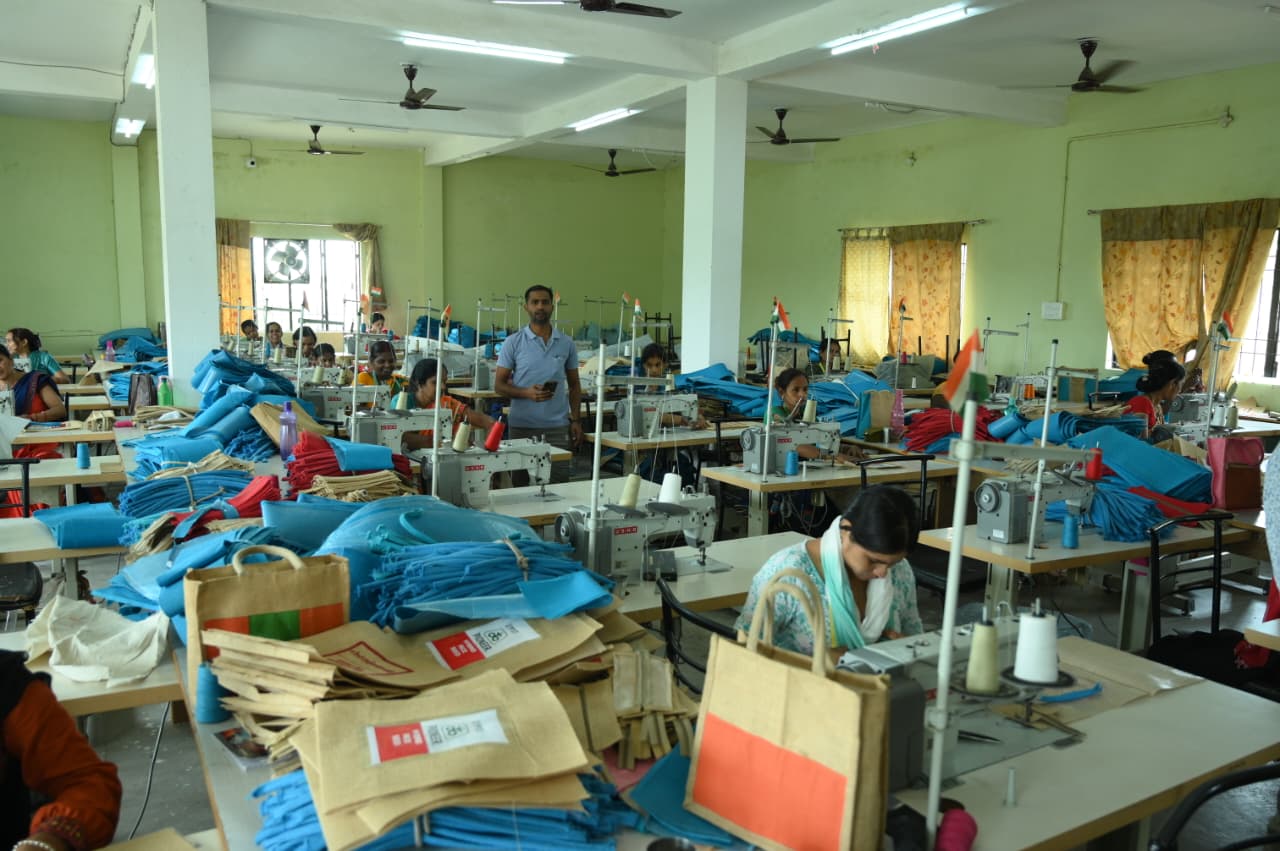
Compared to plastic bags, jute bags are considered to be environmentally safe. What makes this success particularly remarkable is that it is not the achievement of a large-scale industry, but rather the result of the hard work and collective effort of a group of rural women. Today, the initiative provides employment to over three hundred women.
In collaboration with the Jammu PIB, a delegation visited Indira Nagar, Lucknow, to observe the various jute products crafted by Anjali Singh and the women associated with the cluster. They also toured her production facility and observed its operational workflow.
Speaking on the occasion, Anjali Singh shared her journey: “Initially, after completing my MBA, I secured a job in the private sector; however, I found no happiness or fulfillment in that employment. Consequently—despite having absolutely no prior business background—I decided to venture into the jute industry. Today, I have successfully empowered over a thousand rural women to become entrepreneurs.”
She further added, “It was with this very objective in mind that I embarked on my journey in the jute sector back in 2009.” Initially, I installed a machine right at home—which cost 8,000 rupees—and brought one woman on board to assist me. Then, we got to work. I established specific ground rules for our operations: we would supply exclusively to corporate clients and institutions; we would undertake production only *after* receiving an order; we would not build up inventory; and we would not sell through retail shops. I would personally visit international NGOs and universities, carrying samples to showcase our work. Witnessing our success, other women began to join our ranks as well.
These women, hailing from the villages surrounding Lucknow, are—for the most part—women with limited formal education; yet, they possess a strong desire to make something of them. We trained these women to craft essential items such as jute bags, jewellery, traditional *moods* (stools), and slippers. Today, seeing the success of their work, everyone is eager to lend a helping hand.
Currently, they are manufacturing and supplying bags and various other goods—tailored to specific requirements—to a diverse range of institutions, government departments, and organizations across various cities in India. Recently, bags produced by our group were specially commissioned and sent for an event held at the Ram Temple in Ayodhya. The annual turnover of their organization has now reached 2.5 crore rupees. Furthermore, an organization based in the United States has placed an order with them for the production and shipment of bags.
She shared the following details:
“The Ministry of MSME has sanctioned a grant for us. Across India, only two ‘Mega Projects’ have been sanctioned thus far, and ours is one of them. With the assistance of the Government of India, we are currently establishing a ‘Common Facility Center’ where 740 women will be provided with machinery to work on. This is set to become India’s first large-scale manufacturing unit where such a massive number of women will be employed.
Over the past 16 years, we have trained approximately 1,000 women, and currently, well over a thousand women remain actively associated with us. All of these women are rural entrepreneurs. In the initial stages, we even taught these women how to read. Every single one of these women now holds a bank account, and they all conduct their transactions digitally; they do not operate on a cash basis.”
She further added, “Growing up, I never imagined that I would eventually run a business; I became an entrepreneur quite by accident. However, having undertaken this work, I feel—today—both self-reliant and self-confident.” I can now confidently say that every woman should strive to stand on her own feet. If you have an idea, summon the courage to act upon it. Yes, it is true that women are sometimes met with discouragement or even rebuff, but we must not lose heart. Once you achieve success, the entire world will follow in your footsteps.
Today, more than 300 women are employed at her Common Facility Center. Depending on the nature of their work, they are earning anywhere between ₹5,000 and ₹15,000. Furthermore, she has, to date, provided training in jute bag manufacturing to thousands of women across the region. These women are now generating income from the comfort of their own homes.