By Col. Dev Anand Lohamaror
When Russia launched its comprehensive military operation against Ukraine on February 24, 2022, most military analysts estimated that the conflict would end within a few weeks or months. However, even after more than four years, this war continues to rage, constantly mutating into new forms. Millions of soldiers and civilians have paid a direct or indirect price. According to the United Nations and various international assessments, civilian casualties have risen steadily, while military losses on both sides are estimated to have reached several hundred thousand. This war has not only changed Russia and Ukraine; it has redefined global energy security, food supply chains, the defense industry, global trade, NATO’s role, and the geopolitical world order. Today, it is clear that twenty-first-century warfare is no longer just about tanks, artillery, and fighter jets. It has become a war of artificial intelligence, autonomous drones, cyber capabilities, precision strikes, and control over critical infrastructure.
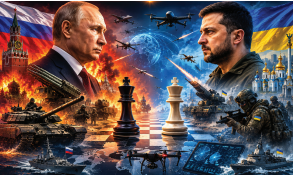
In the initial phase of the war, Russia attempted to achieve a swift victory through the large-scale deployment of armored vehicles, cruise missiles, and air power. Conversely, Ukraine compensated for its limited conventional capacity by leveraging modern weapons obtained from Western nations, satellite-based intelligence, and advanced drone technology. Over time, this conflict shifted from conventional warfare to intense technological competition. Today, both sides deploy hundreds of drones and missiles every day. Artificial intelligence-based drones, loitering munitions, swarm drones, and long-range precision strikes have become the defining identity of this war.
In recent months, Ukraine has significantly altered its strategy, making Russia’s energy infrastructure its primary target. Continuous drone attacks on oil refineries, fuel depots, pipelines, and logistics centers have triggered a fuel crisis across many Russian regions. This strategy aims beyond causing economic damage; its objective is to paralyze both Russia’s military supply chain and its civilian economy. Farmers in several agricultural regions of Russia have complained of severe difficulties in farming, irrigation, tractor operation, and crop transport due to acute fuel shortages. A localized fuel shortage within a global energy superpower reflects the fundamentally changing nature of modern war.
This shift has created an extremely unexpected situation. Russia, which for decades has been a leading exporter of petroleum products, was recently forced by circumstances to import gasoline from India. Petroleum products processed in Indian refineries provided temporary relief to some regions of Russia. This event is not just a matter of trade, but a striking sign of the new reality of global energy politics. During wartime, friendships, trade agreements, and strategic necessities rapidly shift according to immediate circumstances.
However, while Western media presented Russia’s fuel crisis as a sign of military weakness, the reality is far more complex. Russia’s command structure heavily prioritizes the military over civilian needs. Therefore, despite fuel shortages appearing in civilian areas, the direct impact on front-line military operations remained relatively limited. During this same period, Russia carried out large-scale missile and drone attacks on many Ukrainian cities, including the capital, Kyiv. On several occasions, hundreds of drones and dozens of missiles were fired in a single night. Russia sent a clear message: it will respond to attacks on its energy infrastructure with more extensive military action.
The situation on the ground remains in a state of constant flux. Russia continues to move forward gradually in the Donbas, Kupyansk, Sumy, and Kharkiv regions. Many military analysts believe that while Ukraine has succeeded in damaging Russia’s logistics system and fuel supply, it has not yet achieved a decisive breakthrough to stop Russia’s overall military progress. On the other hand, Russia has also plunged far more time, resources, and manpower into this war than it ever anticipated. This is why the conflict does not seem to be moving toward an early solution.
The question of political leadership is equally critical. Ukrainian President Volodymyr Zelenskyy has led his country through incredibly difficult circumstances, securing widespread financial and military support from Western nations. At the same time, his public rhetoric and political style often become subjects of global discussion. For any democratic leader, maintaining public morale during wartime is essential, but ultimately the supreme test of leadership lies in protecting the lives of its citizens and soldiers. On the other side, Russian President Vladimir Putin has indicated that he is prepared for a long conflict and appears unwilling to back down from his declared strategic objectives. For this reason, the possibility of an early peace agreement between the two sides remains highly limited.
The reality is that this war is far from over. NATO aims to weaken Russia over the long term by providing economic, technical, and military assistance to Ukraine, while Russia seeks to establish a permanent strategic advantage while maintaining control over occupied territories. A decisive victory has not been achieved by either side. In such a scenario, the conflict is highly likely to continue for a prolonged period. Only a circumstance where an extremely destructive military capability is unleashed, or a major geopolitical agreement takes place, can suddenly alter the trajectory of the war. Otherwise, the current conditions point toward a long, exhausting battle of attrition.
Europe’s security architecture has also been completely transformed. Poland, the Baltic states, and other Eastern European nations are more alert than ever before regarding the security of their borders. Russia’s expanded military footprint in Belarus and the close strategic cooperation between the two countries have significantly increased NATO’s concerns. If any border-related incident or direct military confrontation occurs in the future, its impact will not be confined to Ukraine, but will fundamentally destabilize the security system of the entire European continent.
Very important lessons emerge for India from this entire conflict. The first and biggest lesson is that critical infrastructure will be the primary target in future wars. Oil refineries, power generation grids, gas pipelines, railway junctions, bridges, communication networks, airbases, ports, and data centers are the lifelines of a modern nation. If precision drone and missile attacks successfully target these assets, catastrophic damage can be inflicted on the adversary country’s economy and military capacity, even without launching a massive ground invasion.
India has taken important steps in this direction in recent years. Investment has been rapidly increased in indigenous drones, loitering munitions, artificial intelligence-based surveillance systems, counter-drone technology, multi-layered air defense, and indigenous missile programs. The Indian Armed Forces have prioritized the procurement and domestic manufacturing of various categories of drones and anti-drone systems. Operation Sindoor also made it clear that precision, swift, and calibrated military action against hostile structures in this era of hybrid and proxy warfare has become a core element of modern defense strategy. If India faces a conflict with any neighboring adversary in the future, it will not just be the number of soldiers on the border that matters; drones, artificial intelligence, electronic warfare, cyber capabilities, space-based surveillance, and the hardening of critical infrastructure will play the decisive role.
The second major lesson for India is the absolute necessity of self-reliance. Modern wars are not won by soldiers alone; they are won by industrial base, technology, energy reserves, semiconductor manufacturing, software engineering, artificial intelligence, and resilient supply chains. If a nation’s critical technology, propulsion engines, electronic subsystems, or software frameworks depend entirely on foreign sources, it can come under immense pressure during times of war or geopolitical polarization. Therefore, from defense production to digital platforms and energy security, the concept of Aatmanirbhar Bharat has evolved from an economic program into an indispensable requirement for national security.
The Russia-Ukraine war has proven that future victory will be decided not just on the tactical battlefield, but in factories, research laboratories, energy plants, artificial intelligence algorithms, and domestic industrial capacity. The nation that can manufacture drones rapidly, ensure its energy security, develop cutting-edge cyber and space capabilities, and keep its supply chains insulated from external shocks will gain a definitive strategic edge in the coming decades.
Ultimately, the Russia-Ukraine war is not just a localized conflict between two nations. It has become a living laboratory of twenty-first-century warfare, where new technologies, strategies, and military doctrines are evolving every day. Instead of merely watching this war from a distance, India must actively absorb these lessons to accelerate its national security readiness, industrial self-reliance, energy security, and defense modernization. Future wars will be won or lost in the fields of technology, economy, energy, and artificial intelligence long before the first shot is fired on the borders.