By Mudasir Dar
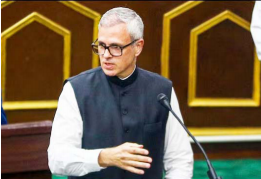
There are moments in history that reveal not just the condition of society, but the character of its leaders. July 14, 2024, in Srinagar was one such moment. In a scene that rapidly spread across television and social media, Omar Abdullah — the sitting Chief Minister of the Union Territory of Jammu and Kashmir — was seen climbing a wall to enter the so-called Martyrs’ Graveyard in Srinagar. This, despite the fact that the main gate stood open, and his father Dr Farooq Abdullah and senior party colleagues had already entered through it.
The act, symbolic as it was, raises troubling questions not just about theatrics in politics, but about the slow drift of mainstream dynasts into the performative tactics once used by separatists. This was not just a climb over a wall. It was a climb into a narrative of victimhood — crafted, staged, and calculated — to remain politically visible in a region that has long begun to move on from its troubled past. Much of the media — including an editorial in a national daily — framed the incident as a case of disrespect or administrative overreach. But what truly deserves scrutiny is the intellectual dishonesty at the core of this drama.
CCTV footage clearly revealed that no restrictions were placed. The entrance gate was open, and National Conference leaders entered through it without facing any obstruction. What, on the other hand, justifies the actions of a sitting Chief Minister climbing a wall like a protester desperate for space?
It is safe to assume at this point that the optics are minimal to non-existent in this case, as there indeed wasn’t any form of denial. We are witnessing a Kashmir that is gradually turning tranquil in comparison to the suffering of yesteryears. Young voters are shunning conflict, compelling the desperate need to showcase relevance through such actions. He wasn’t blocked by the government. Instead, he was blocked by the unrelenting force of the political timeline that has moved forward without him.
It is important to remember that earlier, Omar Abdullah’s government — while he was Chief Minister — geographically constrained the gatherings at the graveyard on July 13 due to security reasons. He did not stage any of the dramatic, theatrical entrances that he did on July 14. There was no speech about some constitutional cap, and no imagery of climbing walls and victimhood. During his Chief Ministerial term between 2009 and 2014, he seldom exhibited this fervour for this day. He did not bring the day to life with such performative urgency, nor did he, in those years, champion the 1931 uprising solely as a badge of singular nationalist honour. In fact, he had publicly stated that the date had been “politicised by separatist groups”.
But now, stripped of the security blanket of dynastic dominance, he finds it easier to borrow from the separatist playbook — the very script that he once criticised. The date of July 13 has long been exploited by leaders in Pakistan, PoK, and Kashmir’s separatist networks to malign the Indian state and project a false history of alienation.
That same national daily editorial even acknowledges this, yet fails to question why Omar Abdullah is now mimicking the tone and tactics of these very actors. He is no longer opposing them. He is echoing them. And now, when he sees his political space shrinking — when new young leaders are emerging, when villages once linked to militancy are raising the national flag — he is returning to separatist-style politics, dressed in the uniform of democracy. This is not leadership. This is imitation. This is acting like a separatist while still holding a constitutional post.
If any aspect should draw one’s attention, it is not the wall Omar climbed, but the relative peace which enabled him, his co-workers, and colleagues to even perform this act. The disengaged irony of senior leader Sakina Itoo, sighted on a scooty making her way to the graveyard to partake in the performance, transports one back to an easier Srinagar, without the need for secured convoys and unbothered by fear.
This is not a negligible detail. Not long ago, watching Srinagar navigate with such liberty and ease was a far-fetched idea. Officials faced constant threats. Even appointed MLAs would travel from one location to another with armed escorts. Now, Honourable Ministers, as they are termed, confront and mock the very government responsible for their newfound privileges and unprecedented comfort. They roam at will.
Who is responsible for this difference? Not the National Conference, nor dynastic politics. It is the respectful, firm, balanced, and people-driven approach of Hon’ble Lieutenant Governor Manoj Sinha, who, since 2020, has transformed Kashmir’s social landscape. The National Conference squandered decades trying to gain the public’s trust. This government earned that trust in just a few years by establishing peace.
The central point of conflict here goes beyond gainful access to a graveyard. It highlights a politically “elite” class that is out of touch with the very people it claims to represent. Kashmiris are no longer impressed by poorly performed dramas and empty political slogans. The youth are thirsting for opportunities rather than mere obituaries. In districts that were once regarded as bastions of militancy, young people are now proudly raising the national flag, organising sports activities, taking up careers in the civil services, and even starting their own businesses. Unlike Omar Abdullah, who insists on climbing walls, they are busy ascending ladders of growth, aspiration, and national engagement. The symbolic gate he refused to cross was not closed by the state, but rather shut by his own failure to lead in this emerging reality.
Omar Abdullah’s wall-scaling could be justified as a form of performance art — and it wasn’t random either. It was a deliberate spectacle, designed to invoke sympathy, attract headlines, and advance a narrative of grievance that has been overused. However, the people of Kashmir — just like people across the world — are moving forward in every sense. They have shown that the era of theatrics is over. They are too smart, too aware, and far too forward-thinking to fall for contrived, staged victimhood.
The open gate at the graveyard was more than a physical structure. It was a metaphor, for the doors now open to progress, peace, and integration. But some politicians are so invested in their past that they choose to climb walls rather than walk through those doors. The question is no longer whether the state disrespected Omar Abdullah. The real question is — does he respect the people’s mandate for a peaceful, forward-looking Kashmir?
For the youth of Kashmir, the time for slogans has passed. They want sincerity, not spectacle. And if some leaders cannot adapt to this shift, it is not Delhi’s fault, or the LG’s — it is their own. (Courtesy: News 18)
(The writer is a social and peace activist based in Kashmir. He is a Rashtrapati Award recipient in world scouting and has contributed to many local and national publications)