“Disability is only in the body, not in the spirit. A Soldier never gives up”
By Brig Harcharan Singh (Rtd), Director North, War Wounded Foundation
Background Introduction
- For the first time ever, a study was conducted on Disabled Soldiers by the War Wounded Foundation in 2024, through USI, New Delhi. The study was conducted by Veer Mata, Smt. Meghna Girish. A total of 194 War Wounded Soldiers and 75 Cadets were included in the survey. A total of 32,498 soldiers were wounded from 1947 to 1999, while 1,363 soldiers suffered injuries in the 1999 conflict. An average of 200 soldiers are killed/wounded annually.
- The Rights of Persons with Disability Act, 2016 (Modification to 1995 Act) gives out rights to disabled persons in India, meeting obligations under the UN Convention (UNCRPD). It gives equal opportunity to people with disability, but neither is it applicable to the Armed Forces, nor has an alternate Act been enacted to ensure soldiers also get equal employment opportunities as their civil counterparts. Another striking anomaly is that cadets undergoing training for officers do not get benefits of ESM if injured during training. It is a salute to the spirit and nationalism of Indians that in spite of such odds, the majority of the disabled soldiers/cadets want their children to join the Armed Forces. The soldier gives his life/limbs due to the feeling of national pride, izzat of the unit/Army, high motivation, courage, leadership, and trust that the country will look after his family in case he is killed/injured. The majority of them positively affirmed that they get looked after by the Army in case they require any support.
Raising of War Wounded Foundation (WWF)
- Due to small problems encountered by disabled soldiers at grassroots levels, two war veterans took the initiative to raise WWF in the year 2002, who were themselves injured during war — Lt. Gen. Vijay Oberoi (injured in the 1965 War) and Maj. Gen. Ian Cardozo (injured during the 1971 War). Lt. Gen. Asit Mistri is presently the President of WWF.
Working of WWF
- WWF contributes to nation-building through highly motivated soldiers who act as role models for civil society/youth through their dedicated efforts. These war-wounded soldiers participate in economic activities through entrepreneurial ventures. WWF motivates disabled soldiers to reduce their dependence on others and enables them to work independently, supported by various welfare schemes. A very important component of this venture is maintaining close liaison with disabled soldiers through volunteer ESM. The head office is located at Noida, under a Director (Coord). The liaison by the volunteer ESM of WWF provides much-needed psychological support to the disabled soldiers, who can also share problems related to pension, family, health, mental well-being, and entrepreneurship plans. A toll-free number is also available for counseling and guidance.
Methodology for Guidance to Disabled Soldiers
- The aim of WWF is to “Convert Disability into Ability.” The emphasis is on the following:
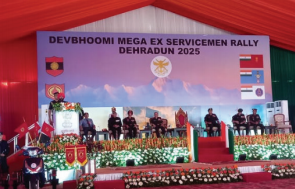
(a) Holding rallies and symposiums in various regions of the country, where disabled soldiers assemble to develop camaraderie. Expert panelists provide inputs on health, finance, pension, welfare schemes, motivation, and psychological issues to develop positivity and character and provide solutions to the problems faced by disabled soldiers.
(b) For an injured soldier, reduced mobility is a critical barrier, as due to medical disability, many of them cannot move independently. A total of 120 mobility equipment items have been provided to disabled soldiers by WWF to make them independent.
(c) Training is a major component if a soldier desires to enter the field of entrepreneurship. The soldiers and dependents are trained, as per requirement, for various fields to develop skills. Two paper plate/glass-making machines have been donated to Army Skill Development Centres to train ESM in this profitable venture.
(d) Entrepreneurship is inherent to a soldier, who acquires qualities of hard work, dedication, honesty, etc., from the Army. Twelve soldiers have been helped with startup projects. Another twelve soldiers have been donated autorickshaws to enable them to add to their income.
(e) For a disabled soldier, a user-friendly toilet is essential. Toilets are modified, which enables them to use them independently, without help from others.
(f) Needy wounded soldiers are supported for their daughters’ marriage.
(g) Help is given for education, special medical assistance, and any other viable requirement, including support to cadets.
Specific Support for Building Positivity and Enhancing Self-Confidence
- A helpline of WWF provides counseling and psychological support to disabled soldiers, as per requirement.
- During rallies, interaction with citizens is organized, where soldiers share their saga of bravery with the citizens, who feel proud listening to the stories of valor narrated by the soldiers.
- In the yearly Mumbai Marathon, a contingent of WWF participates — a much-appreciated venture by citizens, who salute the spirit and resilience of the soldiers.
- To highlight problems of disabled soldiers, research is undertaken by WWF, in conjunction with USI, on issues affecting war-disabled persons for projection to the government.
Conclusion
- Battles are not fought by soldiers alone, but it is a national effort. WWF has been able to establish rapport between the war-wounded soldiers and citizens/youth through various events. Through these interactions, the confidence of citizens in their soldiers multiplies, listening to stories that provide a peep into the determination, resilience, and bravery of our soldiers. It has been an endeavor of WWF to provide psychological support to disabled soldiers through regular interactions and establishing a close link with them. WWF is working towards developing positivity in disabled soldiers, as “Attitude Determines Aptitude.” Though a number of welfare schemes are being run by the government, correction is required in certain areas. One can see a marked difference in welfare schemes in two neighboring states like Punjab and J&K, where Punjab is liberal and proud to look after its ESM/Veer Naris, which again necessitates amendments to government orders in J&K to match emoluments.
- Most war-wounded soldiers are generally in the age group of 36 to 45 years; hence, an amendment to the Rights of Persons with Disability Act, 2016, is required to ensure disabled soldiers are provided with alternative employment. Cadets do not get ESM status and pension, which may affect volunteers to join the Armed Forces in the times to come. Lateral induction to other government jobs must be explored immediately. NGOs like WWF may be trying to address inadequacies; however, without government support, major issues cannot be resolved. The Indian Armed Forces have been serving the nation with dedication but must remember, “A soldier dies twice — once on the battlefield and once when the nation forgets him.”