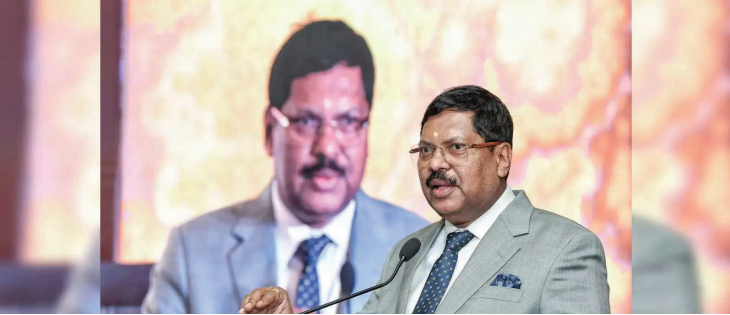
His I-Day message corrects a long-standing public misconception
By K Raveendran
On Independence Day, Chief Justice of India B. R. Gavai offered a reminder that struck at the heart of India’s constitutional order. “The Supreme Court is not a superior court to the High Courts. Both are equal constitutional courts,” he said, pulling back the veil on a long-standing public misconception. For decades, the Supreme Court has been seen as the final word in law, towering above the High Courts. But in Gavai’s framing, the apex court is not a master but a partner in the constitutional project.
The statement was more than a technical clarification. It was a deliberate reassertion of equality within the judiciary, part of a broader pattern that has come to define his short tenure as Chief Justice. Only a few days ago, Justice Gavai made it clear that even the CJI’s pronouncements carry no extra judicial weight compared to those of his colleagues. “The Chief Justice’s position is just as important as any other judge of the Supreme Court,” he said, reminding the public that authority in courtrooms flows not from titles but from the Constitution.
This stripping away of hierarchy has been his hallmark. Where some of his predecessors sought to cloak the office in grandeur and ceremonial importance, CJI Gavai has cultivated an image of restraint. No pomp, no overreach, no effort to magnify the office beyond its constitutional role. His realism, coupled with an absence of self-importance, has won quiet admiration both inside the legal community and beyond it.
Lawyers who have appeared before him speak of a judge who listens more than he speaks, who encourages colleagues to dissent rather than steers them to consensus by force of position. His court has been less about pronouncements from the bench and more about deliberation among equals. To many, that is not just refreshing but transformative: a reminder that the judiciary’s strength lies in collective wisdom, not in the authority of one individual.
His Independence Day message was equally significant for what it said about the High Courts. In practice, the Supreme Court’s visibility often overshadows the constitutional authority of High Courts. Citizens tend to view Delhi as the only forum where rights are ultimately safeguarded. Gavai’s intervention sought to correct that perception, restoring dignity to High Courts as equal partners in the constitutional scheme. The implication is profound: justice does not reside only in the capital but is dispersed across states, closer to citizens, through courts empowered to protect fundamental rights.
For a federal democracy like India, that assertion matters. It strengthens the idea that constitutional values are not guarded by a single institution at the top but by a network of courts, each carrying equal responsibility. In a political environment where centralisation of authority is often on the ascendence, the Chief Justice’s federal instinct could not have been more timely.
What makes this message resonate is the credibility of the messenger. Justice Gavai’s leadership style has been consistently grounded in humility. He has resisted the temptation to dramatise his role, and in doing so, has humanised the office. For ordinary citizens, this matters. At a time when institutions are often criticized for appearing aloof or elitist, here is a Chief Justice who insists that no one judge, no one court, no one office towers above another. That attitude, more than any individual ruling, may be his greatest contribution.
Yet, poignancy shadows his tenure. Only a few months remain before his retirement. Like many of his predecessors, Justice Gavai will have served as Chief Justice for a short span, a consequence of the rigid seniority system. The brevity of his tenure inevitably limits the scope for deep institutional reform. His vision — of equal courts, of shared authority, of humility in leadership — may not have the time to take root in practice.
But brevity does not erase significance. Sometimes, the power of an idea lies not in how long it is championed but in how clearly it is articulated. In his speeches, in his courtroom manner, in the deliberate understatement of his office, CJI Gavai has set a benchmark for what judicial leadership can look like. He has shown that credibility does not require spectacle, and that the judiciary can command respect through restraint as much as through assertion.
The legacy of his words will likely endure longer than his tenure. His reminder that High Courts are not subordinate but equal partners may embolden judges across the country to exercise their constitutional authority with greater confidence. His insistence that the Chief Justice is only “first among equals” could serve as a quiet corrective to the personality-driven tendencies of institutional life. And his realism, his insistence on substance over show, may well shape expectations of what citizens look for in their judges.
The judiciary will, of course, continue to face its familiar challenges: mounting pendency, uneven access to justice, questions of credibility. No single Chief Justice can resolve these. But by choosing humility over grandeur, CJI Gavai has offered an alternative vision of leadership. His Independence Day message, delivered without flourish but with precision, reflects a belief that institutions draw their dignity not from hierarchy but from fidelity to the Constitution.
As the calendar ticks toward his retirement, the temptation will be to measure his tenure in judgments and administrative reforms. Yet his true legacy may lie elsewhere — in the tone he set, in the philosophy he articulated, in the example he offered. For in reminding the nation that no court, no judge, no office is above another, Chief Justice Gavai has left behind something more enduring than spectacle: a judiciary that, if it listens, may find strength in humility. (IPA Service)