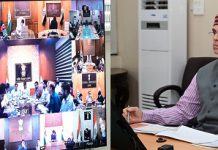
New Delhi, Feb 1: Finance Minister Nirmala Sitharaman presented the Union Budget for 2026-27 in the Lok Sabha on Sunday, emphasising India’s sustained economic growth and resilience amid global uncertainties.
Highlighting a strong macroeconomic stability with a growth rate of around 7 pc, she said, “The Modi government has decisively chosen action over ambivalence, delivering reforms that have improved lives and reduced poverty.”
The Budget focuses on balancing ambition with inclusion, aiming to transform aspiration into achievement. Sitharaman noted, “This is a Yuva Shakti-driven Budget inspired by three duties: to accelerate economic growth, build resilience to global volatility, and ensure inclusive development.”
Key reforms announced include significant steps to build domestic manufacturing capacity, enhance energy security, and cut critical import dependency. The government proposes to boost manufacturing in sectors such as biopharma, semiconductors, textiles, and infrastructure, with dedicated funds like Rs 100 billion for Biopharma Shakti and an expanded Rs 400 billion outlay for electronics manufacturing.
A major thrust is on supporting MSMEs through a three-pronged approach, including a proposed Rs 100 billion SME growth fund and measures to improve liquidity and compliance via TReDS and GeM integration. Infrastructure development will be scaled up with a capital expenditure target of Rs 12.2 trillion and initiatives like 20 new waterways and coastal shipping schemes aimed at boosting trade and connectivity.
On the financial front, the Budget aims to strengthen the banking sector with a new high-level committee for banking reforms and restructuring of key public NBFCs. Tax reforms include the rollout of the new Income Tax Act from April 1, reduced TCS rates for education and medical expenses, and rationalization of prosecution under the Income Tax Act. Notably, tax holidays are extended till 2047 for cloud services from Indian data centers, and safe harbor provisions are enhanced for IT services.
Sitharaman stressed the importance of integrating India with global markets, stating, “India must continue to take confident steps to ensure long-term economic stability while fostering innovation through cutting-edge technology and AI as force multipliers.”
The fiscal deficit for FY27 is pegged at 4.3 per cent of GDP with a debt-to-GDP ratio expected to decline to 55.6 per cent, underscoring the government’s commitment to fiscal prudence. Tax devolution to states continues at 41 per cent, with Rs 1.4 trillion allocated as grants.
The Budget also prioritizes social sectors and employment generation, proposing schemes for medical tourism hubs, upgrading allied health skills, promoting sports goods manufacturing, and supporting vulnerable populations, including women entrepreneurs and the differently-abled.
Finance Minister Sitharaman reaffirmed the government’s reform momentum: “Over 350 reforms have been rolled out since August 15, and the reform express is well on its way to boosting growth, employment, and production across the country.”
The Budget is seen to lay a foundation for India’s ambitious vision for 2047, balancing rapid growth with inclusive, sustainable development.
Centre allocates Rs 43,290 Cr for J&K
New Delhi, Feb 1: Finance Minister Nirmala Sitharaman on Sunday proposed transfer of over Rs 43,290 crore to Jammu and Kashmir for 2026-27, higher by 4.72 per cent over the current fiscal.
According to the budget document, total transfers to the Union Territory have been pegged at Rs 43,290.29 crore, up from Rs 41,340.22 crore in 2025–26 Revised Estimates (RE).
The funds have been proposed as ‘Central Assistance to Union Territory’, which has risen by Rs 2,030.97 crore, from Rs 40,619.30 crore in 2025–26 to Rs 42,650.27 crore in 2026–27, an increase of 5 per cent.
There is a rise in the funding for the Jhelum–Tawi Flood Recovery Project (JTFRP-EAP) from Rs 185.34 crore to Rs 259.25 crore in 2026–27, a rise of 39.9 per cent.
The fund transfer towards disaster relief and capital support stands at Rs 279 crore, same as in 2025-26. Also, the amount for capital expenditure of the UT has been retained at Rs 101.77 crore for the next fiscal year.
Budget charts path to 5 trillion-dollar economy milestone: Sinha
Jammu Tawi, Feb 1: Jammu and Kashmir Lieutenant Governor Manoj Sinha on Sunday hailed as pragmatic the Union Budget 2026-27, which he said will chart a path to the 5 trillion dollar economy milestone within a few years and adopt a comprehensive fiscal strategy that will balance growth ambition and social welfare.
He expressed gratitude to Prime Minister Narendra Modi and Union Finance Minister Nirmala Sitharaman for the development of ecologically sustainable mountain trails in Jammu and Kashmir. This will generate fresh employment opportunities and invigorate the tourism industry with renewed vigour, he said.
“Budget 2026-27 is pragmatic. It will prioritise economic acceleration, create future-ready infrastructure, sustain growth momentum, chart the path to the 5 trillion dollar economy milestone within a few years. The comprehensive fiscal strategy will balance growth ambition with social welfare,” he said.
The lieutenant governor said the budget emphasises accelerating economic expansion, strengthening infrastructure and advancing manufacturing capabilities across seven strategic sectors, while maintaining a steadfast commitment to welfare.
“It will have a transformative impact on burgeoning industries, renewed momentum for semiconductor advancement through India Semiconductor Mission 2.0, and a substantial stride toward diminishing India’s reliance on other countries for rare earth elements with specialised rare earth zones,” he said.
Sinha said that with Artificial Intelligence, job creation and service sector enhancement taking centre stage, India’s competitive edge will strengthen across every economic domain, while this progressive financial blueprint will establish the foundation for comprehensive sectoral expansion and global prominence.
This will speed up the path to the Rs 5 trillion economy milestone within a few years. It also presents the ambitious vision to achieve developed economy status in less than two decades, he said.
The lieutenant governor said the budget also promises unprecedented empowerment for youth, women and farmers.
“With manufacturing, infrastructure, MSMEs, healthcare, urban advancement, electronics, and supply networks forming the core of the future strategy to maintain the country’s economic momentum, I believe we will be able to expand domestic production and ensure substantial employment generation,” he added.
Budget allocation insufficient for development needs: Satish
Jammu Tawi, Feb 1: The Union Budget 2026-27 evoked mixed reactions from politicians and industry leaders in Jammu and Kashmir, with some indicating that it failed to meet the UT’s expectations while some hailed it as a pro-poor, reform-oriented and future-ready budget.
Minister Satish Sharma criticised the quantum of funds allocated to the Union Territory, saying that it was “peanuts” and insufficient to meet its developmental requirements.
“This is peanuts. If the Centre truly wants to help the people of Jammu and Kashmir, it should grant a package of at least Rs 50,000 crore,” Sharma told reporters in Jammu.
He said the region, which had dealt with a major setback in terms of development after the Pahalgam terror attack, was not receiving its due share of funds and “today, you are giving us Rs 1,400 crore”.
All India Congress Committee General Secretary Ghulam Ahmad Mir also said there was nothing substantial for Jammu and Kashmir in the budget.
“If you see, unemployment is rising in Jammu and Kashmir every passing day. This budget has nothing in terms of a package or major power project that could generate employment here,” Mir, an MLA from Dooru in Anantnag district, said.
He said the Narendra Modi-led BJP government at the Centre has not taken any major developmental initiative in Jammu and Kashmir ever since it came to power in 2014.
“The rail project, road projects, the tunnels, the AIIMS and IIM were all started under the UPA (United Progressive Alliance) tenure. This government has done nothing substantial in the past 10 years,” he said.
Budget signals push for developed India, shows strong focus on J&K: JCCI
Jammu, Feb 1: The Union Budget 2026 reflects a strong push towards building a developed India and an additional Rs 2,000 crore allocation for Jammu and Kashmir reflects the Union government’s focus on its development, an industry official said on Sunday.
The President of the Jammu Chamber of Commerce and Industries (JCCI), Arun Gupta, said that J&K has remained under the special focus of the Union Government, and the additional allocation of Rs 2,000 crore is a direct message that its focus is on the Union Territory and its development.
“I feel that this budget reflects a move towards a developed India. Every sector has been given priority, and each has been provided adequate space,” he told reporters here.
Union Finance Minister Nirmala Sitharaman has proposed an allocation of Rs 43,290.29 crore for Jammu and Kashmir in the Budget, nearly Rs 2,000 crore higher than the current financial year.
Terming the budget as balanced, the JCCI president said that its proper implementation at the state level would ensure benefits reach people across all sectors.
He said that the budget has made provisions for sectors including industry, MSMEs, semiconductors, education, defence, agriculture and sports, ensuring balanced growth across the economy.
“As far as Jammu and Kashmir is concerned, the budget session is scheduled to begin from tomorrow. However, the increased allocation by the Union Government clearly sends a message that it is serious about the development of the Union Territory,” he said.
He said that JCCI wants Jammu and Kashmir to progress in the same way as other states are developing. “In fact, I believe that with a special approach, the Union Government should focus on Jammu and Kashmir. Jammu and Kashmir has remained under the special focus of the Union Government, and the additional allocation of Rs 2,000 crore is a direct message that its focus is on Jammu and Kashmir and its development,” he added.
Congress accuses Centre of neglect in J&K Budget Allocations
SRINAGAR, FEB 1: Senior Congress leader Tariq Hamid Karra on Sunday launched a sharp attack on the BJP-led central government, calling the Union Budget “another full of disappointments” for Jammu and Kashmir and accusing it of “deliberate financial and political neglect” of the Union Territory.
The J&K Congress chief alleged a persistent pattern of deprivation, stating the region has been denied a “people’s budget” for years.
Karra specifically targeted the adjustment in funding for inflation, known as the “natural step-up,” which he said was historically around 10 percent. “Last year it was reduced, and this time a mere 4.2 percent step-up has been given, that too as a resource gap filler. This is a classic case of step-motherly treatment,” he claimed.
He also dismissed the ?289 crore allocation for disaster management as “insignificant,” saying it does not match the scale of infrastructure and agricultural losses J&K has suffered, particularly during past floods.
When asked about the unfulfilled promises of the incumbent administration on issues like electricity, gas connections, and the removal of the Public Safety Act (PSA), Karra put the onus on his party’s alliance partners in the J&K government.
“They have to respond to their manifesto’s assurances. Had we been in government, we would have acted,” he said.
He affirmed that the Congress would forcefully raise the demand for the restoration of full statehood to Jammu and Kashmir.
In a strong condemnation, Karra also spoke about recent incidents involving Kashmiri students in some parts of the country, calling it a “sustained campaign” where Kashmiris are being “considered aliens” and “declared anti-national.”
“This is happening prominently in BJP-ruled states. In Congress-ruled Himachal Pradesh, swift action was taken. There is a deliberate attempt to create a market of hatred for electoral gains,” he alleged, accusing the BJP and RSS of fueling division.
Karra said the Congress legislative party would finalize its strategy for the budget session, focusing on statehood, public welfare, and the safety of Kashmiri citizens across India.