By Tushi Deb
In the aftermath of the Bihar Assembly results, one question looms larger than seat counts and alliance arithmetic: Are regional political leaders losing their face and, with it, their relevance? The electoral tremors in the state suggest that what once passed as grounded regional clout is now facing a nationalised political tide—one powered by an unmistakable, near-epochal force: Narendra Modi’s expanding footprint, especially among women voters. Ever since the debacle of the Bihar Assembly elections, the grand experiment of the opposition now looks like a political fossil!
There comes a moment in the political ecosystem when a coalition stops being a movement and turns simply into a photo album—a memory of leaders who once stood together for the camera, but never for a coherent idea. The INDIA alliance today resembles exactly that: a magnificent announcement with negligible architecture, a grand coalition in theory but a crumbling cookie in practice.
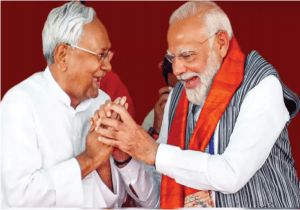
The cracks were visible from the beginning; voters are merely noticing them now. The INDIA alliance was once built on one premise: that strong regional players could collectively counter the Modi juggernaut. But what happens when those very regional chieftains start losing their relevance? In Bihar, Tejashwi Yadav’s aura evaporated the moment the voting booths opened. In West Bengal, Mamata Banerjee’s Trinamool is facing the same moral and organisational exhaustion that has eventually led to the sinking of the Lalu Prasad Yadav led RJD. In Tamil Nadu, DMK’s dominance no longer feels as unshakeable as it did a year ago. In Jammu & Kashmir, Omar Abdullah’s territorial influence has shrunk to a sentiment rather than a force.
No analysis of this electoral moment is complete without acknowledging the gigantic, structural impact of Narendra Modi—particularly in mobilising and converting female voters. For decades, women were treated as appendages to the male vote. Modi inverted that logic. By addressing household needs—fuel, toilets, housing, healthcare, and cash support—he created a direct political relationship with women, cutting through caste equations and regional loyalties alike. In Bihar, this translated into a decisive shift: villages where women queued at dawn to vote overwhelmingly tilted toward the NDA. Regional parties, lacking a comparable multi-year welfare architecture, were simply left gasping.
With the poll bugle of Bengal clearly heard, the big question arises: is the Trinamool headed the RJD Way? A collapse of governance, the simmering cauldron of corruption and a dictatorial hegemony of ‘Parivarvaad’ with Mamata and her nephew Abhishek Banerjee ruling the party, where prominent senior leaders have been shrouded under the dual-deadly clout of the Aunt and her nephew! Whispers in Kolkata’s political circles today sound eerily similar to the murmurs that once drifted through Patna’s corridors: Has a once-dominant regional powerhouse begun to lose its identity? What the Rashtriya Janata Dal experienced in Bihar—an erosion of credibility, the rise of fatigue around dynastic succession, and the inability to counter a nationalised BJP machine—now seems to echo, with unsettling precision, in the Trinamool Congress.
It’s a clear picture today, when the pillars weaken, the tent collapses. So, is the INDIA alliance a coalition without chemistry? The INDIA bloc attempted to simulate what UPA once had—but UPA had two things this alliance never enjoyed: A national anchor, however limited, and mutual ideological accommodation, however fragile. But the present alliance has neither. It is a collective of parties united not by purpose, but by their shared anxiety over Narendra Modi’s political permanence.
So has the Modi Factor turned into a ‘One-Man Disruptive Force’? No coalition in India has successfully countered Modi because they’ve tried to oppose him, not out-think him. Modi’s dominance has altered the political gravitational field in decisive ways: The BJP has become the national pole, drawing voters across caste, region, and class. When a national mood rises, regional coalitions fall flat, and the INDIA alliance is simply a collateral damage of this phenomenon.
So is the INDIA bloc now decimated into a mere coalition of Prime Ministerial Aspirants? One of the more ironic features of the INDIA bloc is this: Everyone wants the throne, but no one has a kingdom. The Congress dreams of reviving its national space, Trinamool Congress supremo Mamata Banerjee sees herself as the natural challenger. Arvind Kejriwal imagines himself as a reformist giant. DMK wants southern veto power. RJD wants relevance and survival! This isn’t a coalition—it’s a waiting room where each leader hopes the others will exit first.
At its core, the INDIA bloc depends on a Congress revival. But Congress itself is in a slow-motion implosion, shedding states, cadres, and credibility with alarming consistency. Its moral leadership has dimmed; its organisational strength is skeletal; its electoral instincts are rusted. A weak anchor doesn’t hold the ship—it sinks with it. The Verdict: The coalition cookie of the INDIA alliance has crumbled beyond relevance and recognition and what remains now are the miniscule crumbs across the political bedrock of India. With regional parties debilitated, the Congress adrift, and no common minimum programme beyond anti-Modism, the INDIA alliance today appears less like a political bloc and more like a WhatsApp group that has muted itself! It hasn’t just lost momentum—it has lost meaning. The 2025 election cycles, including Bihar’s verdict, have made one thing clear: The INDIA alliance is not the alternative India sought; it is the reminder of how opposition politics failed to reinvent itself in the face of the giant ‘Karmayogi’ Narendra Modi himself!
(The columnist is a noted writer, senior journalist and Managing Editor of You Tube Channel ‘We The Nation News’ and can be reached at [email protected]