
Taliban must prove diplomatic prowess through deft handling
By Girish Linganna
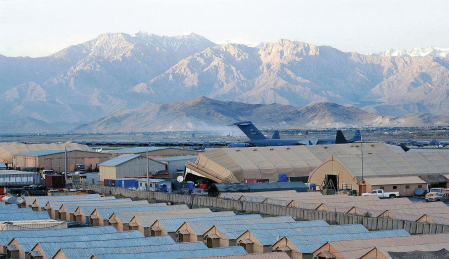
The sudden but intense border clashes between Afghanistan and Pakistan have revived global speculation that former US President Donald Trump might be trying to regain control of the Bagram military base, once the heart of America’s war machine in Afghanistan. Pakistan triggered the conflict when it carried out airstrikes inside Afghanistan earlier this month — coinciding with the Taliban’s acting foreign minister’s visit to India. Days before that, Trump had issued a warning that “bad things” could happen if the Taliban refused to return Bagram to US control, a statement that only fuelled growing rumours of Washington’s new Afghan ambitions.
Trump’s known proximity to Pakistan’s Army Chief, Field Marshal Asim Munir, and the buzz about secret crypto deals, mining rights for rare earth minerals, and plans to counter China’s growing power have added intrigue to the unfolding drama. For Washington, Bagram represents more than a base — it’s a strategic vantage point at the crossroads of Eurasia, offering surveillance over China, Iran, Russia, Central Asia, and Pakistan’s nuclear assets.
There are many reasons why America wants the Bagram base back. The US forces secretly vacated it at night in 2021, days before their final withdrawal, leaving behind billions in equipment and decades of investment. The Taliban quickly took control, marking a symbolic end to America’s 20-year war. Today, reclaiming Bagram would help the US re-establish a military footprint in the region at a time when tensions with China, Iran, and Russia are rising.
For Pakistan, such a development could also be profitable. As a rent-seeking state, Pakistan has long mastered the art of turning strategic geography into money. Hosting supply lines, logistical hubs, and intelligence cooperation could bring hundreds of millions of dollars in aid and contracts. Located about 60 km north of Kabul, Bagram Air Base was first built by the Soviets in the 1950s, later expanded by the US after 9/11 with reinforced runways, hangars, and barracks — making it one of the world’s most powerful airbases.
Even if Washington regains control of Bagram, it cannot operate without Pakistan’s logistical support. Afghanistan is landlocked, with no sea access. To move fuel, food, weapons, and equipment, American supplies must pass through Pakistan’s Karachi port and highways leading north to Afghanistan. Routes through Iran are politically impossible, and Central Asian paths rely heavily on Russian cooperation — something Washington no longer enjoys. Thus, the US would again depend on Pakistan, just as it did during its earlier occupation.
Meanwhile, Afghanistan’s six neighbours — Pakistan, Iran, Turkmenistan, Uzbekistan, Tajikistan, and China — are watching events closely. Each has its own stakes in the shifting power dynamics. A US presence at Bagram could help Washington control the Taliban, which, according to NDTV, has increasingly resisted Pakistan’s influence and become unpredictable. Pakistan, already nervous about India’s expanding ties with Kabul, fears a two-front threat — from India and a defiant Taliban-led Afghanistan. Hence, Islamabad continues to push for what it calls “strategic depth” — using Afghanistan as a buffer zone for political and military safety in case of conflict with India.
Interestingly, even after the recent border clashes, the Saudi-Pakistan defence pact remained unaffected, showing that Pakistan still views Afghanistan as vital to its long-term security plans. Saudi Arabia, too, chose to maintain its alliance with Islamabad despite the tensions, signalling that the Afghan battlefield is part of a much larger regional equation. Adding to the complexity, Iran has started building closer ties with the Taliban, positioning itself as a potential alternative partner.
As Pakistan expels thousands of Afghan refugees, Iran has stepped in to absorb many as migrant workers, deepening its influence. For now, a fragile ceasefire holds between Kabul and Islamabad, thanks to Saudi and Qatari mediation. Yet, as NDTV notes, many exiled Afghan leaders and resistance fighters — especially those linked to the old US-backed regime — are quietly advocating for Washington’s return.
One of them, Abdullah Khenjani, head of the Political Bureau of the National Resistance Front (NRF), recently wrote in The National Interest that if Trump truly wants Bagram back, he should ally with the anti-Taliban resistance, made up largely of former Afghan soldiers who once fought alongside US troops. Similarly, Afghan journalist Natiq Malikzada argued that trusting the Taliban for Bagram’s security would be a mistake, since only the resistance groups maintain genuine local support.
The NRF, now operating from Tajikistan, echoes the Northern Alliance of the 1990s — which was armed and funded by India, Iran, and Russia before the US invasion in 2001. Many analysts believe that Trump’s new Bagram vision could involve reviving this old supply corridor through Tajikistan, though such plans seem unrealistic today. Tajikistan, too, is landlocked, meaning it must depend on other nations for transit, making the idea of another American-led war logistically impossible.
If any such plans were ever realised, they would likely repeat history — another cycle of war, destruction, and eventual withdrawal, just like Operation Enduring Freedom, America’s longest war that ended in 2014 but saw the Taliban return to power anyway. This time, the road to Bagram is far tougher. The Taliban have publicly rejected Trump’s proposals, declaring that Afghanistan’s sovereignty is non-negotiable.
Moreover, America no longer enjoys the international backing it had in 2001. Then, even rivals like Russia, China, and Iran quietly supported the US-led war on terror. Pakistan joined militarily, while India provided logistical and diplomatic help. Now, those very nations are united against a renewed US presence in the region.
The recent Moscow Format talks, attended by India, Iran, Kazakhstan, China, Kyrgyzstan, Pakistan, Russia, Tajikistan, Uzbekistan, and Afghanistan, issued a joint statement rejecting any foreign military bases in Afghanistan or nearby. It declared that such actions would “harm regional peace and stability” — a clear warning to Washington.
Complicating matters further, reports emerged in April of a US Air Force C-17 landing at Bagram with military vehicles and senior intelligence officials, including members of the CIA’s deputy chief’s office. The visit came shortly after Trump’s first cabinet meeting, where he reportedly said the US aimed to retain Bagram not for Afghanistan, but to monitor China.
Within the Taliban, opinions are divided. Some leaders may consider allowing a limited US presence in exchange for lifting sanctions, gaining international recognition, and unfreezing $9 billion in Afghan reserves held in American banks. Rumours persist that Trump’s request for Bagram was quietly written into classified sections of the 2020 Doha Agreement, the same deal that paved the way for America’s withdrawal and the Taliban’s return to power.
Still, the Taliban rank-and-file fiercely oppose any return of foreign troops. If their leaders agree to a deal, rebellions could erupt, plunging the country back into chaos and violence. A split within the Taliban might also empower ISIS-K and other extremist groups, as disgruntled fighters defect to rival factions.
Ultimately, the US now finds itself dependent once again on Pakistan — a country whose duplicity during the war on terror it knows all too well. Washington’s ambitions for Bagram may reignite old alliances, but they could also reopen old wounds, risking yet another tragic cycle of intervention and betrayal.
For the Taliban, the coming months will be decisive. Their response to America’s overtures, their ability to maintain unity, and their management of regional relations will decide whether Afghanistan becomes a stable state or a battlefield once again. In the end, Bagram may prove to be the true test of Taliban leadership — and a mirror reflecting whether America has learned anything from its longest war. (IPA Service)
The author is a defence analyst.


