By MANYA PANDEY
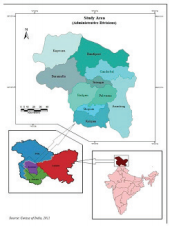
Saffron is an important crop in Jammu and Kashmir, known for its special aroma and used as a powerful flavouring and colouring agent. It is often called Red Gold. The land under saffron cultivation in Kashmir is about 5,707 hectares, with more than 90% in Pampore tehsil of Pulwama district in South Kashmir, while the rest is in central Kashmir’s Budgam and Srinagar districts of Jammu and Kashmir. This high crop supports many farming families. However, over the past two years, saffron production in Kashmir has seen between decline and revival, raising a question, has the sector truly recovered, or is the revival only partial and weak?
Source: Jammu and Kashmir Agriculture Department and Jammu and Kashmir ENVIS and Deputy Director, Planning Department, UT of J and K.
Jammu and Kashmir is the only state in India that can produce the world’s most expensive spice after Iran. But over the years, this sector has been showing a clear downward trajectory. In the late 1990s, saffron production was around 15.97 metric tonnes (1997), but it witnessed a sharp downfall in the following years due to multiple structural and environmental challenges. These may be explained with a lack of irrigational facilities, post-harvesting problems, a disorganised marketing system, financial constraint, deterioration of quality due to the traditional practices, nutrient deficiency in saffron fields, availability of fewer plants and many more. The area under cultivation declined from about 5707 hectares in 1997 to around some 3,674 hectares by 2015, reflecting a contraction over of 35%. The industry has faced a fall of nearly 68% over two decades, with farmers increasingly shifting to more profitable crops like apples and walnuts due to low productivity and uncertain returns.
This decline is not only numerical but also deeply structural. Study findings identify many problems, such as erratic climatic conditions, lack of irrigation facilities, soil degradation, pest infestations and illegal and unscientific farming practices. Also, urbanisation, illegal construction and the setting up of factories near the saffron growing fields have reduced cultivable land significantly. Nearly 17000 farming families depend on saffron cultivation, and if the downfall is so fast, it creates a serious tension among them, also making its decline a serious socio- economic concern. These factors collectively contributed to making saffron farming increasingly unsustainable.
In order to sustain saffron cultivation and production in Kashmir, which is considered the finest of all saffron, the local community has responded with The National Saffron Mission (NSM), which was announced by the then Prime Minister of India, Dr Manmohan Singh. It was introduced in the year 2010-11 by the Union Agriculture Ministry, and under this mission, the saffron cultivating farmers are given a subsidy of (Rs. 2,64,000 per acre) to meet the technical and material ends to boost the crop production. This mission covers almost all technical aspects of cultivation, like drip irrigation, mechanisation, research, and marketing support, to come out of the crisis. Under this mission Govt put forth many steps to enhance the market availability of the locally produced saffron. The government limited the importation of saffron, especially from Iran, as it flooded the market here because of the low cost, which directly impacted the state economy. This mission contributed to the substantial increase in saffron production. The annual yield of saffron in Kashmir crossed 13 metric tonnes in 2020 for the first time in 10 years, and the production was quite encouraging during the last harvesting season due to favourable temperatures and initiatives undertaken by the government. However, despite these efforts, government data suggests that the long-term decline has not been fully reversed.
Source: J&K Assembly data
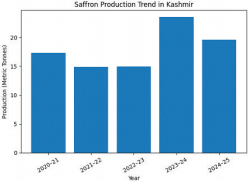
Current official data presents a mixed picture of Kashmir’s saffron sector, reflecting both long- term and short- term recovery. According to Lok Sabha discussion records in 2024, saffron production in Jammu and Kashmir has fallen significantly from 8.0 metric tonnes in 2010- 11 to just 2.6 metric tonnes in 2023- 24, marking an overall 67.5% drop since the launch of the National Saffron Mission, although a marginal 4% increase was recorded in the last year. At the same time, recent data present in the legislative assembly indicate a fluctuating but relatively improved trend in the short term, with production rising to 23.53 metric tonnes in 2023- 24 before declining to 19.58 metric tonnes in 2024- 25. Despite this Instability in output, the economic value of saffron has shown resilience, with saffron worth Rs 534.53 crore sold in 2024- 25, reflecting strong market demand and premium pricing. This contrast between long- term production and rising market values suggests that while government interventions have helped in stabling the sector to some extent. The GI tag granted to Kashmir saffron has also strong its branding and export potential. However, this economic growth does not necessary reflect an increase in production but rather higher prices and improved market linkages.
The current situation with saffron is a paradox. On one hand, we see some improvement in productivity and market value of saffron. On the other side, saffron still has some big problems, like less agricultural land being vulnerable to climate change, and not using government schemes properly. The amount of saffron produced can change a lot, which means saffron cultivation is still very dependent on weather, making it very susceptible to climate change.
Another important thing to think about is the livelihoods of saffron farmers. Because they are not producing much saffron and their income is not stable, many farmers are starting to grow other crops or do non-agricultural work. Some studies show that more than half of the farmers are either growing saffron or finding other ways to make money. This shows that farmers are losing confidence in growing saffron, which is a big problem for the long-term sustainability of saffron.
Recently, at the global stage, Kashmir is competing with countries like Iran, where they produce a lot of saffron, over 300 metric tons every year. India, on the other hand, is producing very little saffron, which affects its market share in the international market. Even though Kashmiri saffron is known for being very good, the low production of saffron limits its ability to compete.
In conclusion, saffron production in Kashmir is not doing badly, but it is not doing very well either. It is in a phase of recovery where there are still many structural problems, but there are also some policy interventions and market reforms. The National Saffron Mission has definitely helped to revitalise saffron. There are still some issues with how it is being implemented and climate-related risks that limit its impact. The recent sales of saffron, which were ₹534 crore shows that saffron can be very profitable. We need to make sure that production is consistent to achieve a sustainable revival. To really revive the saffron industry in Kashmir, we need to make sure that irrigation infrastructure is used properly, saffron lands are protected from urbanization farmers use climate techniques, and there is a good support system for farmers. If not, the story of Kashmir’s saffron will just be about improvements, not long-term sustainable growth.
The writer is a student of M.A. in
New Media Communication
at the Indian Institute of Mass Communication (IIMC), Jammu