Dr. Parveen Kumar
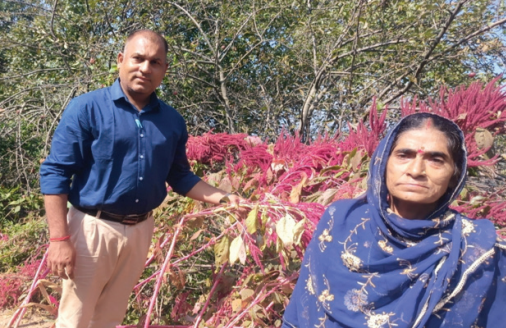
‘I have been growing this for the last 40 years’ told Bishno Devi when asked for how long she has been growing Amaranthus. Hailing from a remote village ‘Chakwa’ in block Batote of district Ramban, she calls its grain as ‘Seuol’ which she believes is a holy grain largely consumed during fast and other religious ceremonies. Like Bishno Devi, many other farmers in the Panchayat cultivate Amaranthus. Fields can be seen with a Burgundy boundary of Amaranthus and this gives them a very beautiful and unique look. Amaranth widely recognized name for plant and its seeds is also known as Rajgira, Chaulai or Ramdana in Hindi and other Indian languages. The name Rajgira itself mean Royal grain while Ramdana translates to God’s Grain reflecting the belief in its divine and nutritious qualities. ‘Chaulai’ often refers to its edible leaves.
Amaranthus, a Pseudo millet and regarded as one of the nutri-cereals has very high protein content (13-14%) and is a carrier of lysine, an amino acid that’s missing or negligible in many others; this grain has also an oil percentage of 6 to 9% which is higher than most other cereals. Amaranth oil contains approximately 77% unsaturated fatty acids and is high in linoleic acid. It is also high in dietary fibre, iron, magnesium, phosphorus, potassium and appreciable amounts of calcium. Recognizing its importance in the nutritional security, the Ministry of Agriculture and Farmers Welfare, (MoA & FW) GoI has put it under broad category of millets and comprising of Sorghum (Jowar), Pearl Millet (Bajra), Finger Millet (Ragi/Mandua), Minor Millets i.e., Foxtail Millet (Kanngani/kakun), Proso Millet (Cheena), Kodo Millet (Kodo), Barnyard Millet (Sawa/Sanwa/Jhangora), Little Millet (Kutki), Brown top millet and two pseudo millets i.e., Buckwheat (Kuttu) as well as Amaranth (Chaulai)) as ‘Nutri-Cereals’ for production, consumption and for trade and commerce. This group of crops is gluten free and non-allergenic and non acid forming foods. Their consumption decreases triglycerides and C-reactive protein, thereby preventing cardiovascular disease. All of them are rich in dietary fibre. Dietary fibre has water absorbing and bulking property that increases transit time of food in the gut thereby helping in reducing risk of inflammatory bowel disease and acting as detoxifying agent in the body. Millets act as a probiotic feeding for micro flora in our inner ecosystem. Millets hydrate our colon to keep us from being constipated. Niacin in millet can help lower cholesterol.
The most unfortunate part of agriculture sector in the country is that over its journey of last so many decades, many important and nutritive food grains were lost out to crops lie Maize, Rice and Wheat. This loss can be attributed to a variety of factors. The changing tastes, dietary habits and a policy that did not paid any attention to cultivation and promotion of these crops were the main reasons why crops like pulses, millets and oilseeds lost out to Paddy, Wheat and Maize. This loss has brought with it nutritional insecurity, non remunerativeness, climate change and various other environmental hazards. Studies reveal that Rice and Wheat always do not dominated our plates. Ancient civilizations especially in Asia and Africa thrived on millets. These grains were easy to grow, nutritious and suitable for dry climates. The green revolution in the 1960s in the country primarily focused on cultivation of High yielding varieties of Paddy and Wheat and it resulted in a phenomenal increase in their production which is referred to as the Green Revolution in the country. Thereafter huge investment was made with subsidies in fertilizers and machinery to ensure that a larger area is being brought under their cultivation. While all the focus was on Paddy and Wheat, no such effort was being made for pulses, oilseeds and millets. The result was that the area under these crops went on declining and declining until a few years back government came up with a host of initiatives to promote the cultivation of pulses, millets and oilseeds.
The International Crop Research Institute for the Semi-Arid Tropics (ICRISAT) estimates that more than 90 million people in Africa and Asia depend on millets in their diets and 500 million people in more than 30 countries depend on sorghum as a staple food. In the Indian subcontinent, these are recognized as traditional grains, grown and consumed in the Indian subcontinent from the past more than 5000 years. These are one of the oldest foods known to humanity. Millets owing to their unique characteristics have been identified as a major category of food commodities to be propagated and promoted for enhancing nutritional levels of the population. These groups of small grained cereal food crops which are highly nutritive are also tolerant to drought and other extreme weather condition; do not require much input and most of them are natives of the country. These crops are called as ‘Nutri-cereals’ as they provide most of the nutrients required for normal functioning of human body.
District Ramban in the Union Territory of Jammu and Kashmir is characterized by marginal and small holdings. Only 5-6% of cultivable area is under irrigation and thus cultivation of different crops is dependent upon timely and adequate rainfall. During Kharif season crop failure due to poor germination as a result of moisture stress adversely affects the productivity of Maize and other Kharif crops. Various type of Millets which once used to grown in this district have now largely been abandoned due to one or other reason. To revive the cultivation of Millets in this district, KVK-Ramban under its ‘10% under Millets’ initiative has been motivating the farming community to take on the cultivation of these nutri-cereals. Quality seeds of different type of millets along with sensitization on production technology of millets are being provided to farming community. Although no. of farmers cultivating millets in district are very less, but there are few villages in district where a considerable number of farmers have been cultivating millets for many years. Certain indigenous practices are also being associated with their cultivation. While millets like Finger millet, Little millet and Kodo Millet are being sown in the fields, Amaranthus is sown along the field bunds with main crop (Maize) in the field. In hilly terrains, growing Amaranthus on field bunds offers various advantages. Besides increasing food security and income, it helps in soil health management by controlling soil erosion, increasing biodiversity and enhancing land use efficiency by utilizing marginal spaces for a high yield crop.
Millets are wonder foods but owing to lack of knowledge regarding nutritional value of these crops, these have more or less lost their importance as vital crops. It is high time to promote the cultivation of these crops by educating masses about the health benefits of them. Considering the immense potential of millets in nutritional security and their ability to withstand climatic stress and grow in regions otherwise not feasible for cultivation and with minimal inputs, year 2023 was celebrated as International Year of Millets. There is a need for an urgent and strong push to recognize millets as a vital crop for food security, climate resilience, and nutritional health due to its high protein, fiber, and mineral content, and its ability to grow in challenging conditions like drought and low-fertility soils.
The author writes on agriculture and social issues; can be reached at [email protected]