Ajay Kumar, Sr Journalist, Lucknow (U.P.)
The storm of the BJP’s impressive victory in West Bengal has shaken the entire country. The people there, especially the Hindu community, united to give a strong response to Mamata Banerjee’s politics of appeasement. It would not be wrong to say that just as Muslim voters often consolidate in favor of parties practicing appeasement politics to defeat the BJP, now Hindu voters are also uniting and voting in favor of the BJP. The big question now is whether this trend will repeat itself in Uttar Pradesh as well. Will a united Hindu vote in UP halt Samajwadi Party chief Akhilesh Yadav’s politics of Muslim appeasement? Will caste divisions among Hindus lose their influence? And will strategist Sunil Bansal, who is credited with electoral success, once again take charge in UP and lead the BJP to victory as he did in 2017?
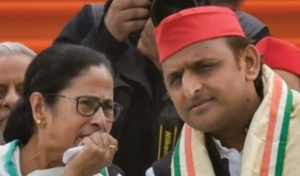
The politics of Uttar Pradesh has always been complex, largely driven by caste equations. The Samajwadi Party has long focused on strengthening its Muslim vote bank. Akhilesh Yadav has taken several steps to attract the Muslim community distributing tickets to Muslim candidates in panchayat elections, introducing special schemes in their areas in the name of development, and making controversial statements during Hindu festivals. However, the example of West Bengal is now before everyone. There too, Mamata Banerjee relied on a similar formula. Restrictions on Ram Navami processions, actions around Hindu temples, and perceived benefits extended to Muslims in exchange for votes led to a backlash among Hindus. The result is evident BJP raised the banner of Hindu unity and achieved significant success. After the West Bengal results, discussions among Hindu voters in Uttar Pradesh about unity have intensified. Social media debates are heating up, political messaging is echoing in religious gatherings, and old caste-based divisions seem to be weakening.
Strategist Sunil Bansal played an important role in BJP’s success in West Bengal by emphasizing Hindu unity. He implemented a micro-level strategy to unite Hindu society, trained workers at the grassroots, engaged with religious leaders, and ran awareness campaigns against appeasement politics. In the 2017 Uttar Pradesh Assembly elections, he demonstrated similar strategic skill. The BJP broke caste barriers and brought together Brahmins, Thakurs, Dalits, and OBCs on one platform, defeating Akhilesh Yadav’s Samajwadi Party. Under Yogi Adityanath’s leadership, Hindutva and development became key issues that attracted voters. Now, similar conditions are emerging again. As the upcoming UP Assembly elections approach, discussions about Sunil Bansal’s return are gaining momentum. If the BJP assigns him responsibility again, it could make Akhilesh’s path more difficult.
In fact, the electoral equations in Uttar Pradesh are changing. Earlier, Hindu votes were divided along caste lines Jatav Dalits leaned toward BSP, Yadavs toward SP, and Brahmins and Thakurs toward BJP. But now a trend of Hindu unity is emerging. Developments like the Ram Temple construction, the Kashi Vishwanath Corridor, and the development of Ayodhya have contributed to this consolidation. Social media has increased awareness. Leaders across the Hindu spectrum are speaking out against appeasement. The Samajwadi Party cannot rely solely on Muslim votes anymore. It has other possible strategies. One is to attract youth voters, as it did earlier with schemes like laptop distribution. It can also focus on unemployment, farm loan waivers, and rural development. Another path is alliance politics reviving ties with BSP or engaging smaller caste groups. However, breaking into the Hindu OBC vote will be the biggest challenge. Communities like Kurmi, Maurya, and Nishad have not been strongly aligned with SP. If Akhilesh offers targeted policies or reservations, he may gain some traction. A third approach is focusing on development if SP makes strong promises regarding infrastructure and urbanization, it may appeal to urban Hindu voters. But all of this would require moving beyond appeasement politics.
Amid all this, the reality is that the political winds in Uttar Pradesh appear to be shifting. West Bengal has signaled that appeasement politics may be losing its effectiveness. Hindu voters in UP are increasingly thinking beyond caste lines. BJP has a strong leader in Yogi Adityanath, whose strict law-and-order measures have strengthened public confidence. Crime control and action against mafias are reinforcing this perception. If Sunil Bansal returns, his strategy could once again prove effective activating booth-level workers, building alliances with Hindu organizations, and targeting the weaknesses of the Samajwadi Party. SP still has issues like youth, farmers, and development, but these will only have an impact if it does not ignore Hindu voters. Akhilesh must understand that traditional vote bank politics is becoming outdated. A consolidated Hindu vote may no longer respond to such strategies and instead prioritize its own perceived interests.
Overall, at present, BJP appears to have the upper hand in Uttar Pradesh’s political battle. The West Bengal victory has sent a message across the country. From rural areas to cities in UP, there is growing enthusiasm among Hindus. Political discussions are becoming common in religious gatherings. People are saying that unity, not caste divisions, will determine the outcome. If Akhilesh does not adapt, SP’s path may become more difficult. Sunil Bansal’s return could be a major advantage for BJP, potentially helping recreate the success of 2017. In conclusion, Uttar Pradesh politics seems to be at a turning point, appeasement politics is fading, and a new phase of consolidation and unity is emerging.