

Dr. Parveen Kumar
On July 24, the fourth largest economy of the world concluded a historic Comprehensive Economic and Trade Agreement (CETA) with sixth largest economy of the world. The CETA or Free Trade Agreement (FTA) between India and United Kingdom that came after three years of negotiations marked a significant milestone in country’s engagement with major developed economies and reflects a shared commitment to strengthening economic integration thereby advancing a new era of economic prosperity through partnership and opportunities. Hon’ble Prime Minister of the country Shri Narendra Modi himself flew to Australia to be a part of the historic moments where along with UK Prime Minister Sir Keir Starmer, the agreement was signed by Commerce and Industry Minister, Mr. Piyush Goyal and Secretary of State for Business and Trade, UK Mr. Jonathan Reynolds. Dr. S. Jaishankar, Minister for Foreign Relations and Ms. Rachel Reeves, Chancellor of the Exchequer of UK were also present.
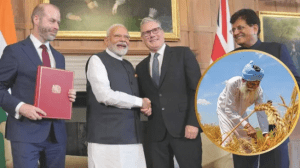
The agreement is expected to double the bilateral trade between the two countries to $ 120 billion by 2030 which at present stands at nearly USD 56 billion. The FTA gives unprecedented duty-free access for 99% of India’s exports to the UK, covering nearly the entire trade basket. It is expected to open new opportunities for labour intensive industries such as leather, textiles, footwear, marine products, sports goods, toys, and gems and jewellery, alongside fast-growing sectors like engineering goods, auto components, and organic chemicals. The services sector which has emerged s a strong driver of India’s economy in the recent years will also see wide ranging benefits. The agreement provides greater market access in Information Technology (IT) and IT-enabled services, financial and legal services, professional and educational services, and digital trade. Besides, Indian professionals, including those deployed by companies to work in UK across all services sectors, professionals deployed on contracts such as architects, engineers, chefs, yoga instructors, and musicians all are set to be benefitted from simplified visa procedures and liberalized entry categories, making it easier for talent to work in the UK. A Major Breakthrough of the FTA, the Double Contribution Convention (DCC) will exempt Indian workers and their employers from social security contributions in the UK for up to three years, significantly improving take-home pay and reducing costs for Indian companies. Around 75,000 workers and over 900 companies are expected to benefit, resulting in savings of more than INR 4,000 crore. The labour-intensive sectors; the export potential of which this historic agreement unlocks include textiles, leather, footwear, gems & jewellery, marine products, and toys generating large-scale employment and empowering artisans, women-led enterprises and Micro Small and Medium Enterprises (MSMEs).
The United Kingdom on the other hand will benefit from this FTA by a reduction of import duty on British Whisky and Gin from 150% to 75% before reducing to 40% by ten years of the deal; automotive tariffs will be reduced from over 100% to 10% under a quota. Under the deal, the U.K. will benefit from a 12 percentage point average tariff reduction — from the current average of 15% to a new average of 3%, for items it exports to India. It will see a removal or reduction of tariffs on 90% of the tariff lines, covering 92% of the items currently exported from the U.K .to India.
Agriculture in Indo-UK FTA:
Agriculture is a key sector contributing about 18% to the country’s GDP and almost fifty percent of the population deriving its livelihood from this sector directly or indirectly. The agreement opens the UK’s $37.5 billion agricultural market to Indian producers, with over 95% of agricultural and processed food items gaining duty-free access. This will also provide Indian farmers’ with direct access to premium buyers within the UK’s agri market. The trade data between the two countries reveal that in agriculture, India exports USD 36.63 billion globally, while the UK imports USD 37.52 billion, but imports just USD 811 million from India, revealing room for growth in high-value agri products. The UK is a high-value market for niche Indian agri-products such as tea, mangoes, grapes, spices, marine products, etc. The agriculture sector accounts for 1,437 tariff lines which constitute 14.8% of all product tariff lines indicating a significant presence of agriculture in the trade structure.
Food Processing accounts for 985 tariff lines, the sector holding a 10.1% share. The zero duty market access under FTA will allow Indian farmers to fetch premium prices for these products in the UK market. In the processed food sector, tariffs on 99.7% of lines have been slashed from as high as 70% to zero, offering a major boost for Indian exporters. India exports USD 14.07 billion processed food products globally, while the UK imports USD 50.68 billion, but Indian products make up just USD 309.5 million. India-UK CETA is expected to have a significant positive impact on the Indian agricultural and processed food sector, with exports of agri and processed food products exports expected to rise by over 50% in the next 3 years. The India-UK FTA will also bring Indian products at parity with major agri exporters such as EU, South Africa, Turkey, Canada, Peru, Vietnam which currently enjoyed zero/concessional duty access. The FTA will further strategically position India to outcompete major global players in various products like Fresh grapes, processed food, bakery products, sauces and juices. States like Maharashtra (grapes, onions), Gujarat (groundnut, cotton), Kerala (spices), and North East states (horticulture) stand to benefit from this agreement. State-specific agri-export plans (APEDA) already align with FTA goals, ensuring equitable regional benefits from enhanced UK market access.
United Kingdom already absorbs 1.7% of coffee, 5.6% of tea and 2.9% of spice exports from India. All these products will now witness exponential growth because of duty free access. Duty-free access on instant coffee will help Indian businesses compete with other European suppliers of instant/value added coffee such as Germany, Spain, and Netherlands. UK market can provide a new avenue for Indian Oilseed exporters to reach a broader consumer base and expand their market share. With reduced tariffs and streamlined procedures, Indian Oilseed exporters can become more competitive in the UK market, potentially leading to higher exports.
Due to a large Indian diaspora, the UK is a high-value consumer of Indian frozen seafood, especially shrimp and white fish. The CETA eliminates UK tariffs, improving the price realization for Indian exporters, benefits that flow down to coastal fisher folk through higher procurement rates. Coastal states like Kerala, Andhra Pradesh, Gujarat, Tamil Nadu, and Odisha stand to benefit significantly from export led job creation. With existing UK tariffs on Indian shrimp ranging between 4.2 to 8.5%, the FTA’s tariff elimination is expected to unlock rapid growth, particularly in shrimp, tuna, fishmeal and feeds. With the immediate and full tariff elimination for inorganic chemicals, organic chemicals, agrochemicals etc will improve the price competitiveness of these Indian chemical products in the UK market, leading to enhanced exports. The India-UK FTA is anticipated to trigger around 30%- 40% increase in India’s chemical exports to the UK (an estimated USD 650-750 million for the year 2025-26).
To conclude agricultural exports from India to the UK are projected to increase by more than 20% in the coming three years contributing to India’s goal of $100 billion agri-exports by 2030. The FTA has also been described as a proud moment towards journey for an Atmanirbhar Bharat and a launch pad for India’s entrepreneurs to tap global demand, scale faster, and lead with confidence. It is a transformative deal for both the countries, aiming to double bilateral trade to $120 billion by 2030.
*The author writes on agriculture and social issues; can be reached at [email protected]


