By Ravi Rohmetra
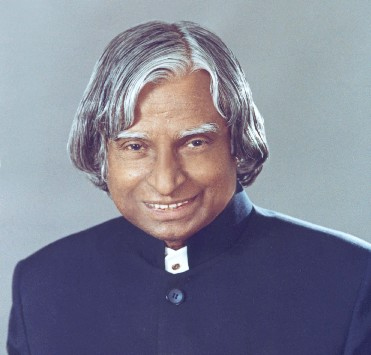
Bharat Ratna Avul Pakir Jainulabdeen Abdul Kalam, popularly referred to as Dr. A.P.J. Abdul Kalam, was an Indian scientist and administrator who served as the 11th President of India from 2002 to 2007. He was born on 15th October 1931 into a Tamil Muslim family to Jainulabdeen, a boat owner, and Ashiamma, a homemaker, at Rameswaram in the Indian state of Tamil Nadu.
Coming from a humble background, Kalam began working at an early age to supplement his family’s income. After completing school, he distributed newspapers to financially contribute to his father’s earnings. In his school years, he had average grades but was described as a bright and hardworking student with a deep desire to learn. He spent hours studying, particularly in mathematics.
After completing his schooling at the Rameswaram Elementary School, Kalam attended St. Joseph’s College, Tiruchirappalli, then affiliated with the University of Madras, from where he graduated in Physics in 1954. Towards the end of the course, he realized he was not enthusiastic about the subject and later regretted spending four years studying it.
In 1955, he moved to Madras (now Chennai) to study Aerospace Engineering at the Madras Institute of Technology (MIT). During his final year project, the Dean was dissatisfied with the progress and threatened to revoke his scholarship unless the project was completed within three days. Kalam worked tirelessly and met the deadline, impressing the Dean, who later said, “I was putting you under stress and asking you to meet a difficult deadline.”
Becoming a fighter pilot was his dearest dream, but he narrowly missed it—ranking ninth when only eight slots were available in the Indian Air Force.
Career as a Scientist
After graduating from MIT in 1960, Kalam joined the Defence Research and Development Organisation (DRDO) as a scientist. He began his career by designing a small helicopter for the Indian Army but remained unconvinced about his choice of job at DRDO. Kalam was also part of the INCOSPAR Committee working under the renowned space scientist Dr. Vikram Sarabhai.
In 1969, he was transferred to the Indian Space Research Organisation (ISRO), where he became the Project Director of India’s first indigenous Satellite Launch Vehicle (SLV-III), which successfully deployed the Rohini Satellite in near-Earth orbit in July 1980. Joining ISRO was one of Kalam’s greatest achievements, and he often said that he “found himself” while working on the SLV project.
Kalam had initially begun work on an expandable rocket project independently at DRDO in 1965. In 1969, he received the government’s approval to expand the program and include more engineers. In 1963–64, he visited NASA’s Langley Research Center in Hampton, Virginia; Goddard Space Flight Center, Maryland; and the Wallops Flight Facility, Virginia.
Between the 1970s and 1990s, Kalam contributed immensely to the development of the Polar Satellite Launch Vehicle (PSLV) and SLV-III projects, both of which were successful. He was invited by Dr. Raja Ramanna to witness India’s first nuclear test, Smiling Buddha, as a representative of TBRL in 1974.
In the 1970s, he directed two crucial projects—Project Devil and Project Valiant—which sought to develop ballistic missiles from the technology of the successful SLV program. Despite initial disapproval by the Union Cabinet, Prime Minister Indira Gandhi sanctioned secret funds for these aerospace projects under Kalam’s direction.
His leadership and research brought him great laurels in the 1980s and led the Government of India to launch the Integrated Guided Missile Development Programme (IGMDP) under his directorship.
He later served as the Chief Scientific Adviser to the Prime Minister and Secretary of the Defence Research and Development Organisation (DRDO) from July 1992 to December 1999. During this period, the Pokhran-II nuclear tests were conducted, where he played a key political and technological role. Kalam, along with Dr. R. Chidambaram, served as the Chief Project Coordinator during the testing phase. Media photographs and coverage from the event elevated him to the status of India’s top nuclear scientist.
The Presidency
Kalam was elected as the 11th President of India on 10th June 2002. The National Democratic Alliance (NDA), then in power, proposed his name and sought the support of the Opposition led by Congress President Sonia Gandhi. The Samajwadi Party and Nationalist Congress Party (NCP) also backed his candidacy.
On 18th June 2002, Kalam filed his nomination papers in the Parliament, accompanied by Prime Minister Atal Bihari Vajpayee and senior Cabinet colleagues. The polling was held on 15th July, and as media predicted, the election turned out to be a one-sided affair. The counting took place on 18th July, and Kalam won by a large margin, becoming the 11th President of the Republic of India.
He was sworn in on 25th July 2002, and moved into the Rashtrapati Bhavan. Kalam was the third President of India to have been honoured with the Bharat Ratna, India’s highest civilian award, before assuming the Presidency. The earlier recipients were Dr. S. Radhakrishnan (1954) and Dr. Zakir Hussain (1963).
He was also the first scientist to become President, and during his term, he earned the affectionate title of the “People’s President.”
Vision for Future India – 2020
In his visionary book India 2020, Kalam strongly advocated a roadmap to transform India into a knowledge superpower and a developed nation by the year 2020.
After resigning as the Scientific Adviser in 1999, he set a target to interact with 100,000 students within two years. In his own words:
“I feel comfortable in the company of young people, particularly high school students. Henceforth, I intend to share with them my experiences, helping them ignite their imagination and prepare to work for a developed India, for which the roadmap is already available.”
He continued to interact with students throughout his presidency and afterward, serving as a Visiting Professor at the Indian Institutes of Management (IIM) in Indore and Ahmedabad. He was nominated for the MTV Youth Icon of the Year Award in 2003 and again in 2006.
Awards and Honours
Kalam’s 79th birthday was recognized as World Students’ Day by the United Nations. He received honorary doctorates from over 40 universities. The Government of India honoured him with the Padma Bhushan (1981), the Padma Vibhushan (1990), and finally the Bharat Ratna (1997)—for his remarkable contributions to scientific research and the modernization of India’s defence technology.
The Final Journey
Dr. A.P.J. Abdul Kalam, the “Missile Man of India” and the “People’s President,” passed away on 27th July 2015 after collapsing during a lecture at IIM Shillong. His life continues to inspire millions across the globe—a symbol of humility, dedication, and the power of dreams.
(Ravi Rohmetra, Social worker and a freelance writer and can be reached at [email protected] Mob: 9419652999)