
By Rayees Ahmad Kumar
Ziya boarded the morning bus from the city bus stand on his way to work. Just as the bus was about to leave, a young woman, hardly twenty years old, entered with folded hands and appealed to the passengers for financial help. She said her family depended on such generosity to survive.
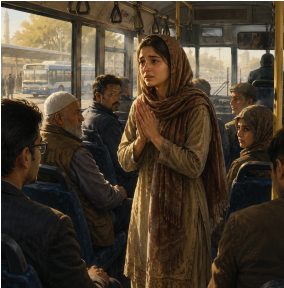
Though dressed in a faded outfit and worn-out slippers, she possessed an extraordinary grace. Her expressive almond-shaped eyes, thick black eyebrows, rosy cheeks, and long silky hair made her stand out despite her poverty.
Moved by her plight, Ziya opened his wallet and handed her a fresh hundred-rupee note. Most of the other passengers either ignored her or offered ten or twenty rupees.
The same scene repeated itself almost every day. Each time, Ziya quietly gave her a hundred rupees. Gradually, her image occupied his thoughts. Even while sitting at his desk as a bank clerk, he often found himself remembering her gentle face and dignified manner.
He learned that she and her family had come from Bengal. Every year, they stayed in a temporary tent beneath a flyover from April to October before returning home for the winter.
Ziya was unmarried. appointed as a bank clerk two years earlier, he travelled daily to a branch on the outskirts of the city. His parents had been searching for a suitable bride, but he rejected every proposal they brought. Neither his family nor his friends knew why.
The truth was that his heart had quietly turned towards the young woman. Yet he lacked the courage to confess it. He feared his parents would dismiss the idea because of the vast differences in their backgrounds.
Often he questioned himself. Was he confusing compassion with love? Could he build a life with someone whose family lived in extreme poverty and survived by seeking alms? The questions left him restless.
One day, even his branch manager advised him to marry within his community. Pressed repeatedly, Ziya finally revealed the reason for refusing every proposal. The manager was surprised. Later, after seeing the young woman himself, he admitted that she possessed remarkable beauty and dignity.
As months passed, the pressure from family and relatives increased. Everyone urged him to choose a bride from a respectable family. Slowly, reason began to outweigh emotion. He convinced himself that lasting companionship required more than attraction. Gradually, he let go of the dream he had silently nurtured.
Eventually, his parents selected a suitable match from among their relatives. This time, Ziya agreed without hesitation. His engagement was celebrated with joy, congratulatory messages poured in from friends, and soon the wedding date was fixed.
Three days before his marriage, Ziya reached the office as usual. The office peon informed him that the previous day the branch manager’s wife had stormed into the office and publicly humiliated her husband before the entire staff.
The reason left Ziya speechless.
The manager had secretly married the very same Bengali girl whose beauty had once captivated Ziya’s heart.
(Writer is a columnist based in Qazigund Kashmir)