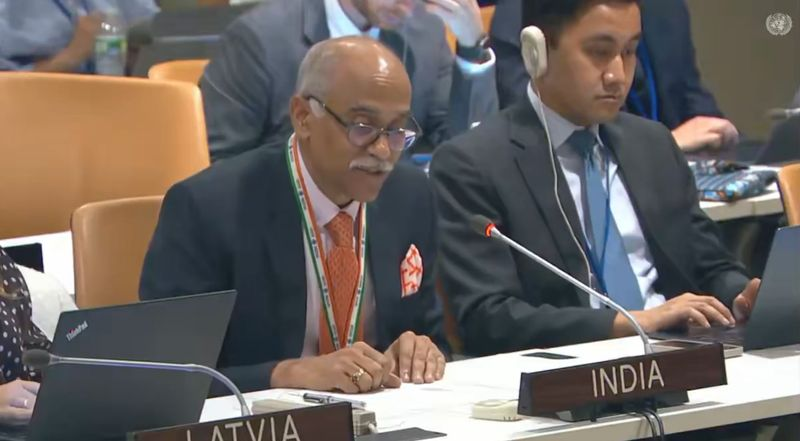
United Nations, Jun 24: India on Wednesday strongly rejected Pakistan’s remarks on Jammu and Kashmir at an informal UN Security Council meeting, asserting that the Union Territory is “strictly internal” to the country and accusing Islamabad of politicising the forum.
India’s Permanent Representative to the UN, Ambassador Parvathaneni Harish, made the remarks during an Arria-formula meeting on ‘Bridging the Implementation Gap: Security Council Resolutions and the Maintenance of International Peace and Security’, organised by the Permanent Missions of Pakistan and China to the United Nations.
Responding to Pakistan’s intervention, Harish said the remarks were “unwarranted” and criticised Pakistan, a co-chair of the meeting, for failing to remain impartial.
“It is incredible that a co-chair expected to be balanced and unbiased in conduct has chosen to politicise this forum,” he said.
“I would only like to stress, for brevity of time, that the Union Territory of Jammu and Kashmir is a matter strictly internal to India. It has always been, is, and will remain so,” Harish added.
The response came after Pakistan’s Permanent Representative to the UN, Ambassador Asim Iftikhar Ahmad, raised the Jammu and Kashmir issue during the discussion. Pakistan is currently serving a two-year term as a non-permanent member of the UN Security Council for 2025-26.
India reiterated its longstanding position that the Union Territories of Jammu and Kashmir and Ladakh are integral and inalienable parts of the country, while maintaining that relations with Pakistan remain strained over the Kashmir issue and that New Delhi does not accept third-party mediation.
Speaking on the broader agenda of the meeting, Harish said the UN Charter provides separate mechanisms under Chapters VI and VII for addressing conflicts, with Chapter VII dealing with threats to peace and acts of aggression, while Chapter VI focuses on peaceful settlement through measures such as negotiation, mediation, conciliation and arbitration.
He said Chapter VI mechanisms are not perpetual and should be reviewed in light of changing circumstances, citing the Palestine issue as an example where mediation frameworks have evolved over time.
India also called for a review of Security Council mandates under the UN80 initiative, arguing that such mandates should not remain outside reform efforts. Reiterating its demand for permanent membership in a reformed and expanded Security Council, India said the current 15-member structure no longer reflects contemporary global realities. (Agencies)