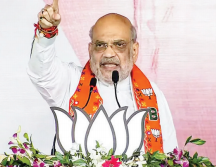
New Delhi, Jun 17: Praising Prime Minister Narendra Modi led regime for fundamentally transforming country’s national security architecture over the past 12 years, Union Home Minister Amit Shah on Tuesday said that the decisive steps like policy of zero tolerance towards terrorism, cross-border operations, abrogation of Article 370 and sustained efforts to curb insurgency and Naxalism have led to India emerging as a strong and secure nation.
In a statement marking 12 years of the PM Modi led government, Shah said India has emerged as a strong and secure nation capable of protecting its citizens and responding firmly to threats against its sovereignty.
Highlighting the government’s approach towards terrorism, Shah said India has moved away from what he described as a defensive posture and adopted a strategy of swift and decisive action.
He termed surgical strikes, air strikes and Operation Sindoor as examples of India’s willingness to target terrorist infrastructure beyond its borders.
According to Shah, Operation Sindoor marked a significant shift in India’s response doctrine, with security forces destroying nine terror camps and eliminating more than 100 terrorists.
He said the operation reflected the government’s policy of zero tolerance towards terrorism and strengthened India’s deterrence capabilities.
The Home Minister also cited the abrogation of Article 370 in Jammu and Kashmir as a major step in strengthening national integration and internal security. He said the move helped establish a new security paradigm and contributed to greater stability in the region.
Shah said incidents of stone pelting in Jammu and Kashmir had come down significantly, while security measures along the country’s borders had been strengthened. He noted that around 93 per cent of the border with Pakistan and nearly 80 per cent of the border with Bangladesh had been fenced to improve surveillance and prevent infiltration.
On defence preparedness, Shah said the government’s push for Aatmanirbhar Bharat had significantly boosted domestic defence manufacturing. He said defence production had increased from about Rs 46,000 crore in 2014 to nearly Rs 1.5 lakh crore, supported by policy reforms and a focus on indigenous production.
He said thousands of defence-related items had been identified for indigenisation, while investments in military modernisation, border infrastructure, defence satellites and indigenous weapons systems had strengthened India’s strategic capabilities.
Shah said the achievements of the past 12 years reflected the government’s commitment to safeguarding national interests and ensuring security across the country. He asserted that India’s response to security challenges now serves as an example of decisive governance and national resolve.
Amarnath Yatra:
MHA team to visit J&K on June 20
Jammu Tawi, Jun 17: A high-level team of Ministry of Home Affairs (MHA) led by Union Home Secretary Govind Mohan is likely to visit Jammu and Kashmir regions for two-days on June 20 and 21 to assess preparedness especially security arrangements for forthcoming Amarnath Yatra, slated to commence on July 3.
Sources said that the team will comprise heads of paramilitary forces, CRPF, BSF, SSB, and Intelligence Bureau and other key wings of the MHA. “Officers will review security arrangements for 57-day-long yatra in both Jammu and Kashmir divisions. The MHA meeting in Jammu is expected on June 20 followed by a similar meeting in Kashmir division on June 21,” sources added.
Pertinently, on June 12 Union Home Minister Amit Shah chaired a high-level meeting in New Delhi to review security preparedness for the Amarnath Yatra. He directed the top security brass to focus on ensuring a safe and smooth pilgrimage for devotees. “Safety of pilgrims remains the top priority of the PM Modi-led government,” Shah said.
The Union Home Minister directed officials to put in place a comprehensive, multi-layered security grid along the Yatra routes through close coordination between Central Armed Police Forces (CAPFs), the Jammu and Kashmir Police, and other security agencies.
Shah laid emphasis on integrating modern technology with traditional security mechanisms.
During the meeting officials were directed to ensure extensive deployment of drones, CCTV surveillance, and advanced monitoring systems to further strengthen situational awareness and threat response capabilities.
The Home Minister also instructed that senior officers from CAPFs and the Jammu and Kashmir Police be deployed at key camp locations to maintain continuous oversight of arrangements on the ground throughout the duration of the Yatra.
Apart from the Yatra routes, HM Shah asked officials to ensure enhanced security arrangements at other major tourist locations across Jammu and Kashmir so that visiting pilgrims can travel safely and without disruption.
The annual Amarnath Yatra, which draws thousands of devotees each year to the Himalayan shrine, is set to commence on July 3, with authorities working to ensure tight security and smooth management amid challenging terrain and weather conditions.