
Satya Prakash
During U.S. Secretary of State Marco Rubio’s visit to India in May 2026, new dimensions of Indian diplomacy came to the fore. These not only astonished the world but also delivered a stern message that India is no longer prepared to tolerate second-class treatment of any kind, and it possesses the resolve to respond in a “tit-for-tat” approach.
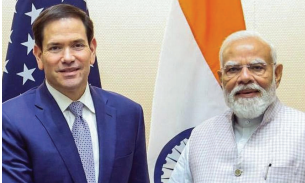
The U.S. Secretary of State was not accorded a traditional welcome in India, nor was any major bilateral dialogue organized at the official level. However, he did a meeting with Prime Minister Narendra Modi, and a joint press conference was held alongside External Affairs Minister S. Jaishankar.
During the conference, Marco Rubio faced a highly uncomfortable question, in response to which he was compelled to indirectly label his own country’s President as a “fool.” At this very conference, S. Jaishankar unequivocally stated that Indian foreign policy serves the interests of India and the Indian people, and that the Indian government would make its decisions accordingly. This remark was made in the context of purchasing crude oil from Russia. He clarified that just as the United States prioritizes its own interests; India guided by an “India First” policy and will continue to secure affordable energy from multiple sources in alignment with its own national interests. Marco Rubio expressed his concurrence with this stance adopted by India and acknowledged its strategic autonomy. The Indian government’s stance has remained clear, sovereignty-centric, and firmly rooted in the “India First” policy. Over the past several years, the Indian government has clearly and unequivocally conveyed its displeasure regarding the unbridled statements made by U.S. President Donald Trump, as well as the racial slurs directed at Indians and individuals of Indian origin.
In a move designed to underscore its stance regarding U.S. policy toward India, Marco Rubio was accorded only minimal protocol courtesies throughout the visit. In Kolkata, Agra, and Jaipur, the responsibility for extending courtesies to him was entrusted to local and junior-ranking officials. Neither Union Ministers nor State Ministers, nor even officers belonging to the All India Administrative Services were deputed to attend his arrival or departure ceremonies. India—a nation steeped in the tradition of *Atithi Devo Bhava* (The Guest is God)—has perhaps never before treated a foreign guest in such a manner. The Trump administration has driven the mutual relations between the United States and India to an all-time low.
Following the recent historic political shifts in West Bengal specifically the Bharatiya Janata Party’s rise to power, this marked the first visit by a major global leader, a visit deemed to be of immense strategic significance. In stark contrast to the traditionally grand reception accorded by the Indian government to top American leaders, the approach adopted this time appeared somewhat formal and austere. The primary reasons behind this stance were the U.S. President’s controversial “hellhole” remark and his racially charged statements. These comments have sparked widespread indignation across India. By welcoming Rubio with a highly restricted and measured protocol, the Indian government signaled to the U.S. that India does not take such statements lightly.
India has viewed with skepticism America’s recent efforts to revitalize its defense and strategic ties with Pakistan. Against this backdrop, rather than deferring to Marco Rubio, India chose to assert its strategic autonomy.
In the realm of diplomacy, such “optics” serve to convey a clear message that India is currently adopting a purely pragmatic and transactional approach to its relations, rather than offering any special concessions. Furthermore, Delhi’s scorching summer heat and prevailing heatwave lent a somewhat sluggish and uncomfortable atmosphere to the visit, a fact that Marco Rubio himself wryly acknowledged from the podium, remarking that “this is even hotter than the humid heat of Miami.”
On the other hand, Marco Rubio endeavored to normalize relations with India. In the United States, Marco Rubio is widely regarded as a formidable contender for the presidency. Rubio stated that India and the U.S. would very soon sign a historic bilateral trade agreement. He offered assurances that the United States, for its part, stands ready to supply India with abundant energy resources (crude oil). The primary objective of the U.S. Secretary of State’s visit was to participate in the Quad meeting. During meetings held between Marco Rubio and India’s National Security Advisor Ajit Doval, as well as S. Jaishankar, a consensus was reached on countering China’s growing influence in the Indo-Pacific region. Furthermore, key strategies were formulated regarding maritime security, critical minerals, and secure technology supply chains. India firmly raised the issue of difficulties encountered in obtaining US visas before Marco Rubio. However, this visit by the US Secretary of State has made it clear that, despite trade-related differences, the India-US strategic partnership remains unshakable, and the United States regards India as its most significant ally on the global stage.
On May 23, 2026, U.S. Secretary of State Marco Rubio commenced his inaugural visit to India in Kolkata, rather than New Delhi. His visit to Kolkata was driven by a confluence of strategic, religious, and diplomatic considerations. A devout Catholic, Marco Rubio—accompanied by his wife—first visited the headquarters of Mother Teresa’s Missionaries of Charity (the Mother House). He also paid a visit to ‘Nirmala Shishu Bhavan.’ Internal discussions are currently underway between the United States and India regarding the regulations governing the Foreign Contribution (Regulation) Act (FCRA) in India and the funding of Christian charitable organizations. Through this visit, Marco Rubio conveyed a message affirming his commitment to human rights and global humanitarian endeavors, signaling that the United States stands in solidarity with these causes. Kolkata shares a long-standing historical bond with the United States. The U.S. Consulate General situated in Kolkata is one of the oldest American diplomatic missions in the world and was the very first U.S. consulate to be established in India.
(The writer is a senior journalist from New Delhi)


