Bhushan Parimoo
It has been four and a half years since the Kalij Pheasant was officially designated as the state bird of Jammu and Kashmir on October 21, 2021. The declaration sparked immense joy and jubilation among ornithologists, environmentalists, and, above all, the local communities that have lived alongside this bird for centuries and share an emotional bond with it. It was sincerely presumed that, henceforth, this bird—like many other species facing acute stress due to rapid deforestation and the destruction of ecological shelters—would receive greater protection and a better chance to survive and thrive.
Ecologically, the Kalij Pheasant belongs to the Phasianidae family of heavy, ground-living birds, which includes pheasants, grouse, partridges, junglefowl, chickens, turkeys, and Old World quail. The family is believed to have originated in Asia around 30 million years ago during the Oligocene epoch. The Kalij pheasant itself evolved as a specialized forest dweller in the Himalayan foothills, its lineage shaped by climatic oscillations during the Pleistocene era.
Surprisingly, soon after the initial enthusiasm, the momentum nosedived without any apparent reason. The situation today presents a dismal picture, with hardly any visible difference between what existed before the declaration and what exists now. It is baffling that, over all these years, the concerned departments have made little effort to clear the confusion surrounding the local names of the bird and the official terminology used for it.
“Kalij” itself is an English rendering unfamiliar to many locals and, as such, creates communication barriers. Across the region, pheasants are known by different local names depending on the place and language. The Monal is commonly called Neel, while the Kalij is variously referred to as Van Kakour, Van Cichour, Kolsa, or Janglee Murga. The onus lies on the Wildlife Department to bridge this communication gap through simple and locally understood language, thereby fostering grassroots awareness and cooperation.
Even sections of the media have contributed to the confusion by jumbling local names with anglicized terminology. On October 21, 2021, ETV/National reported the Kalij Pheasant as “Kalij Teeter.” For a long time, this writer presumed the bird to be the Neel, only later discovering that the latter refers to the Monal pheasant, which is restricted to snow-bound ridges, whereas the Kalij inhabits the Kandi belt and the plains of Jammu. The Kalij can withstand hotter climates but requires dense thickets for shelter and survival.
It may be hard for readers to believe that this writer personally struggled to find the Dogri name for the bird. The search proved to be an uphill task. Despite casting the net far and wide and even approaching officials in the Department of Wildlife Protection and its elder sister department, Forests, Ecology and Climate Change, no clear answer emerged. Fortune finally smiled when Dr. Pankaj Chandra of World Wide Fund for Nature, and a member of the J&K Wildlife Board, identified the local name Kolsa. That discovery became a master key, unlocking a treasure long ignored because of confusion over nomenclature. It also highlighted the difficult scenario through which this bird is presently passing.
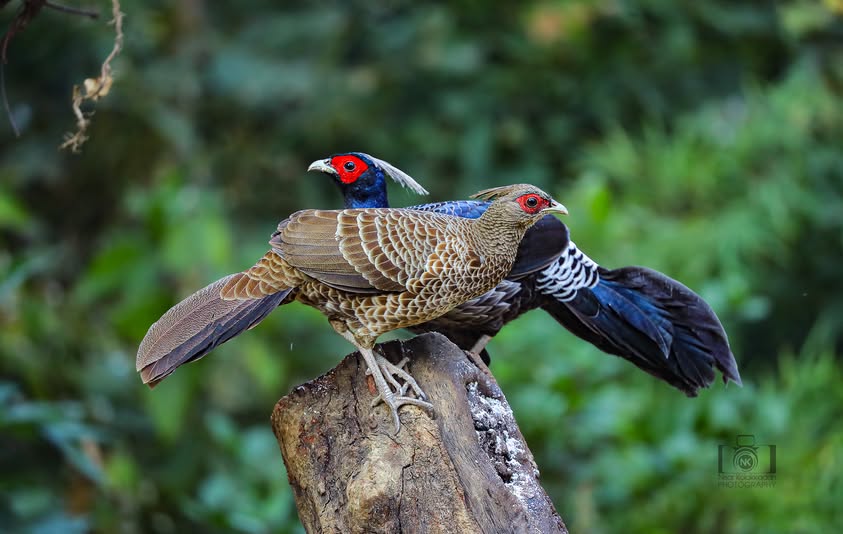
To the common people of the soil, the Kalij is a striking, sexually dimorphic, ground-dwelling bird of the Himalayan foothills. Both males and females have red facial skin and iridescent neck plumage. The male is especially attractive, with glossy blue-black feathers and, in some cases, white patches on the back or chest. Females, in contrast, are dull brown with scale-like feather patterns that help them blend into their natural surroundings and avoid predators while nesting.
The species can be distinguished from similar pheasants, such as the Silver Pheasant, by its grey legs. Males measure around 63–70 cm in length, while females are about 50–60 cm long. Breeding generally occurs during spring, especially in May and June. Females lay six to nine creamy-white to reddish-buff eggs, though some reports mention up to twelve. Kalij pheasants are often seen in pairs or in small groups consisting of one male and two or three females.
Like many pheasant species, the females undertake most of the nesting and rearing responsibilities. Their duller plumage is an evolutionary adaptation that allows them to blend seamlessly into grassy fields and undergrowth, protecting both themselves and their chicks from predators.
The concerned authorities owe an explanation to the public as to why the laid-down guidelines following the declaration of a state bird have not been implemented in letter and spirit. Declaring a state bird should never remain a symbolic act alone; it must trigger a series of statutory and conservation measures aimed at protecting both the species and its habitat.
Following such a declaration, the government is expected to ensure that the species is placed on the state’s high-priority conservation list. Breeding, feeding, and nesting habitats should be identified, mapped, and notified as protected areas, such as wildlife sanctuaries, bird sanctuaries, or community reserves. Habitat management policies must also be implemented to ensure ecological suitability.
Regular population censuses—annual or biannual—should be conducted to monitor population trends. Modern scientific techniques, such as visual counts, transect sampling, and passive acoustic monitoring using sound recorders and AI, can help estimate populations, especially where the bird is elusive. Simultaneously, data on migration patterns, habitat health, and species richness should be systematically compiled.
Dedicated funds are needed for the research and monitoring of high-concern species. A comprehensive conservation plan must be developed to address poaching, illegal trade, and habitat destruction. Public awareness campaigns should actively involve local communities, schools, NGOs, and birdwatchers through platforms such as eBird to contribute to monitoring and conservation efforts.
Only through such sustained and coordinated action can the designation of a state bird translate into tangible improvements in the species’ population and habitat. Community participation remains crucial. When custodians entrusted with protection fail to uphold that responsibility, serious questions naturally arise about accountability and commitment.
(The writer is an Environment Activist)