Nikita Kandpal
Jammu and Kashmir is developing at a faster rate, with population increasing, tourism expanding, and more people moving into the region. This development comes with an urge to increase public transport in these areas to smooth out the connectivity and make a comfortable experience for locals and tourists, as Jammu and Kashmir is home to many dreamy destinations and is always busy serving tourists. Earlier, much of this movement depended on informal and diesel-based transport systems, often leading to congestion, confusion, and rising pollution levels.
As the geography of both cities is a combination of narrow streets and hilly terrains, the locals and outsiders find it difficult to reach the outskirts. However, the government is working to keep up with the demand for public transport to meet the needs. This shift reflects a transition from limited accessibility to a more structured and inclusive mobility network.
Jammu has moved towards a Jammu smart city through a 12-year contract with Tata Motors to supply and operate 100 electric buses locally called the government e-bus. Which offers a variety of facilities such as air conditioning, GPS tracking, CCTV on board, ramps for disabled passengers, free tickets for women passengers, and for men, a minimal ticket cost. These features not only improve comfort but also signal a move towards safer, tech-enabled, and gender-inclusive public transport.
These buses run from 07:00 AM to 09:00 PM, and there’s a companion app called “Chalo” for live tracking, where the locals as well as tourists can track the buses available on the routes and their timing. There is a feature of taking an e-ticket for men to travel on the bus. This digital integration reduces uncertainty and waiting time, making public transport more reliable for daily users and visitors alike.
The bus routes are not just limited to the city; it goes beyond the city core. Around 5 buses of 12 metres run on the Jammu – Udhampur corridor, which is the gateway to many destinations such as Patnitop, Nathatop, Krimchi Temples and serene Sanasar Lake. This expansion highlights how public transport is now supporting tourism circuits, not just urban commuting.
The other route of this e-bus is the Jammu-Katra corridor, which is a big relief for the pilgrims coming to Jammu to visit Mata Vaishno Devi, as this bus is serviceable to Katra, and also, there are many nearby locations such as Shivkhori and Devi Pindi. Improved connectivity for pilgrims reduces travel stress and promotes more organised movement in high-footfall religious routes.
The other major route, which the larger buses handle, is the Samba, Akhnoor, Sunderbani route, which is the gateway to Akhnoor fort, Pandav gufa, Showa mata mandir, Mathwar Mandir and many more hidden locations in Jammu. For the heritage city, there is a small 7 metre e-bus that runs on local routes and provides connectivity to locations such as Jewel Chowk, KC Chowk, Amar Palace, and more. At the 17th Urban Mobility India Conference (2024), Jammu was awarded for the Most Innovative Financing Mechanism under Jammu Smart City Ltd. Such recognition reflects how innovative financing and planning can transform regional mobility systems.
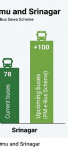
Srinagar’s situation until recently was starker. There was no formal city bus system, and public transportation meant privately operated diesel minibuses and informal shared rides. This lack of structure earlier made commuting inconsistent and environmentally taxing. Later in November 2024, Srinagar under Srinagar Smart City Ltd launched an e-bus service again by Tata Motors under a gross cost contract by covering 16 routes through 78 buses serviceable from 07:00 AM to 09:00 PM daily. By the end of 2024, those buses had carried over 61 lakh passengers, including locals and tourists to several places across the city. This rapid adoption shows a strong public response to cleaner and more organised transport systems.
The same UMI conference that recognised Jammu’s financing also gave Srinagar the Best Non-Motorised Transport award for its cycling infrastructure work. These electric buses not only connect the people with outer locations but also help in saving the environment from air pollution, as Electrifying 100 buses cuts around 5,642 tonnes of CO₂ and 5.6 tonnes of NOₓ annually. This positions Jammu and Kashmir’s transport shift as not just infrastructural but also an important environmental intervention.
There is one positive development upcoming in the pipeline, as under the PM e Bus Sewa Scheme, both cities will induct another 100 electric buses. Jammu is getting 25 twelve-metre and 75 seven-metre vehicles; Srinagar is getting 20 twelve-metre and 80 nine-metre vehicles. This upcoming expansion indicates a scaling-up phase that could further strengthen connectivity and reduce dependency on private vehicles. This development must grow faster to keep pace with the needs of people and also include more depots, denser routes, and give last-mile access. Ensuring last-mile connectivity will be crucial in making this system truly accessible and widely adopted.
The writer is a student of M.A. in New Media Communications at the Indian Institute of Mass Communication (IIMC), Jammu.