
- Prabhat Kishore
After years of long struggle, when Nitish Kumar came to power in November 2005, he focused himself on law & order and infrastructure sector. Fast track courts were set up for speedy trial of criminals, resulting in political heavyweight criminals Prabhunath, Anand Mohan, Shahabuddin (all Ex MPs) and many others being put behind bars. Being a technocrat himself, he re-oriented all the infrastructure works and chalked out its time bound implementation & completion schedules. Roads, bridges, school/college/hospital/police station/Panchayat buildings etc. were constructed in every nook and corner of the state. The production & distribution of electricity increased. Cycle/Dress/sanitary napkin/stipend/student credit card and other educational schemes have resulted in a decrease in the drop out ratio. Technical and Medical institutions have been opened in backward regions. Supply of drinking water to every household & metallization of drains & streets are in progress. The provision of 35% reservation for Women in recruitment, reservation in Panchayats for SC/ST/EBC community and reservation in judicial services has changed the gender as well as socio-political scenario. He organized yatras at regular intervals to make himself aware of the ground reality of the schemes & public opinion about it.
Along with good governance, Nitish Kumar put his hand on social issues also, which are of no importance to politicians. He made laws and started intensive campaign for public awareness against social evils like dowry system, child marriage & alcoholism. There is often a hue & cry by the Opposition and mafias over the ban on alcohol, but in fact it has led to a reduction in domestic violence against women. Eradicating such evils is not only the duty of the government but also of the society. Plantation for environmental conservation has been his ambitious agenda at the government as well as Party level. After 20 years, if one compares the ground reality, it itself tells the success story of the changed Bihar.
A generation has changed in the span of three decades. They have not faced the anarchy & havoc situations like their parents or grandparents. The bench mark of the current generation is not the same as it was 20-30 year ago. After the bifurcation of Bihar, all the mineral & coal-fields as well as factories moved to Jharkhand. Revenue collection is at stake, as the southern part of the State is draught-affected and the northern part is flood-affected. The Central government did not provide any special assistance after its bifurcation to cope up the situation. There is problem of unemployment like in other states. With no major factory in the State, there is a limited scope in the government service sector. Educated youth do not want to work in farm sector, private sector or in the field of self-employment, but all want government jobs. Whatever limited resources the State had, Nitish worked day & night to accelerate the development works. But the dark face of democracy is that, caste-oriented society does not keep in mind development works during elections and ultimately votes are being cast on the caste lines.
A lot of work has been done under Nitish’s regime, but a lot of work is still to be done. The racist fundamental forces in the administration, which are grabbing the interests of the depressed class, should be controlled. Small-scale and agro-based industries will have to be encouraged. The rivers of north and south areas need to be interconnected. The ambitious 7-Nischay programme have to be intensified and properly monitored. Education, health, transport sectors need more attention. Defunct sugar factories should be revived.
Since three and half dacades, upper caste lobby has been away from Chief Ministership. Despite having only 13-14% of the population, they ruled the State for over 40 years; so naturally they are feeling in exile. In the so-called Modi wave, their dream is to install CM of their own homogenate group on the pattern of UP, HP, Maharashtra, Uttarakhand Assam & other BJP-ruled states. Like Laloo, Nitish are also pricking in their eyes. BJP, a Party dominated by the upper castes, have supported Nitish only to keep hard backward-minded Laloo away from power. As soon as the BJP found Laloo weak, it grabbed the influential seats of JDU tilting the balance to its side. Its core upper caste voters are openly working against the ally JDU. Liquor-Mafia, criminal gangs as well as TRP thirsty electronic media are all together to dethrone Nitish.
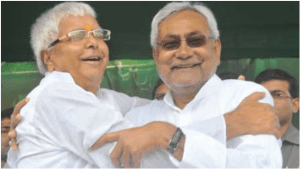
Whatever be the ifs and buts of the two personalities, both of them have served the State in their own ways. It was Laloo Prasad who rolled & crushed the fundamentalist forces and strengthened the political pitch for the depressed masses; which also helped Nitish to bat & ball immensely. Nitish has paid attentions to the poorest of the poor and kept himself away from caste & family-based politics. One, the lawyer, is the symbol of social justice & resurgence; the other, the technocrat, is the synonym of development and good governance. Laloo and Nitish are strengths and weaknesses for themselves; but in the power politics of Bihar as well as India, both are relevant.