From Agriculture and the Lavender Revolution to Industry, Pilgrimage, and Infrastructure, the Region is Driving Jammu & Kashmir’s Growth Story
By Nitin Kumar, IIMC Jammu Tawi
Jammu Tawi- often referred to as the “City of Temples” is not merely a center of faith, but also the gateway to North India where tradition and progress walk hand in hand. Nestled between the flowing rivers of Chenab, Tawi, and Ravi, this region plays a pivotal role in the economy of Jammu and Kashmir, acting as a strong vertebra in its economic backbone through its agriculture, industry, pilgrimage, and natural resources. The Jammu division comprises districts such as Jammu, Samba, Kathua, Udhampur, Reasi, Doda, Kishtwar, Ramban, Rajouri, and Poonch. Its geographical diversity ranging from plains to mountainous terrains makes it economically vibrant. It is estimated that the economy of Jammu and Kashmir will reach ₹2.86 lakh crore in 2025–26, with Jammu playing a decisive role in this growth.
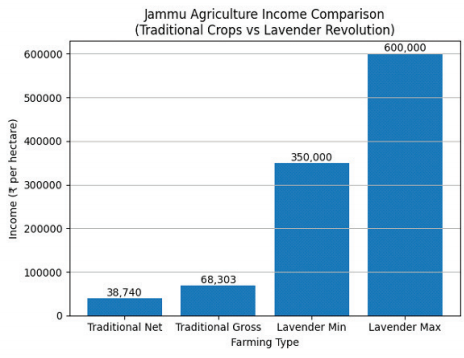
The roots of Jammu’s economy lie deeply embedded in its agricultural sector. Fertile land, adequate rainfall, and the waters of the Tawi, Ravi, and Chenab rivers together create a rich agricultural landscape. The plains of Jammu, Kathua, Samba, and Udhampur are ideal for cultivating wheat, rice, maize, sugarcane, pulses, and oilseeds. Ranbir Singh Pura, Kathua, and Samba are key centers of wheat production, while rice productivity reaches up to 40 quintals per hectare. According to a study, the cultivation of maize, wheat, and rice in Jammu district yields a gross income of ₹68,303 per hectare and a net income of ₹38,740 per hectare, making agriculture a profitable occupation. Mandis linked to the e-NAM platform recorded fruit and vegetable trade worth over ₹501 crore in 2024–25, reflecting improved market access for farmers.
Alongside traditional farming, Jammu has embraced innovation, the most striking example being Bhaderwah in Doda district. Known as “Mini Kashmir,” this region has emerged as the hub of India’s “Purple Revolution.” Under the CSIR-IIIM-led Aroma Mission, lavender cultivation has significantly transformed farmers’ incomes. Where maize once generated ₹40,000–60,000 per hectare, lavender now yields between ₹3.5 lakh and ₹6 lakh per hectare. Thousands of entrepreneurs in Bhaderwah are engaged in producing lavender oil, dried flowers, and related products. This initiative has gained national recognition and is being replicated in other states. Additionally, the cultivation of aromatic and medicinal plants such as rosemary, marigold, and jasmine is expanding rapidly in the hilly districts of Jammu.
The industrial sector in Jammu division has also witnessed remarkable growth. Areas like Narwal, Samba, and Kathua have become major industrial hubs, hosting pharmaceutical units, food processing industries, chemical manufacturing, and packaging industries. In recent years, substantial investments and the establishment of hundreds of new units have positioned Jammu as the industrial engine of Jammu and Kashmir. Initiatives such as “Mission YUVA” have encouraged youth entrepreneurship, generating new employment opportunities. The availability of mineral resources such as bauxite, gypsum, and limestone further strengthens industrial development.
Jammu’s identity is also deeply intertwined with pilgrimage and tourism. Religious sites such as Raghunath Temple, Bahu Temple, and Mahamaya Temple attract millions of devotees, but the Vaishno Devi shrine stands as the economic pillar of the region. Every year, millions of pilgrims visit Katra, sustaining local businesses, hotels, and transport services. Improved connectivity through infrastructure projects such as the Chenab Bridge and Vande Bharat trains has further integrated Jammu with the rest of the country. Tourist destinations like Patnitop, Sanasar, and Basholi are emerging as hubs for adventure tourism, adding a new dimension to the region’s tourism sector.
In the field of energy and infrastructure, Jammu is advancing rapidly. Hydropower projects on the Chenab River serve as major sources of electricity, with plans to further expand capacity in the coming years. Initiatives like solar energy adoption and smart metering mark important steps toward modern energy management. Heavy investments in highways and road networks have significantly improved connectivity, boosting trade and transportation.
Jammu also plays a crucial role in trade and exports, acting as a gateway to North India. Pharmaceuticals, textiles, and dairy products contribute significantly to exports, strengthening the local economy. Sectors such as dairy farming and fisheries are also witnessing steady growth, supporting rural livelihoods.
However, despite these achievements, several challenges persist. Natural disasters, particularly floods and landslides, disrupt economic activities every year. Security concerns in border districts can affect investment and tourism. Youth unemployment remains a serious issue, while the lack of cold storage facilities and market access limits farmers’ incomes. Although digital connectivity has improved, remote areas still face significant infrastructural gaps.
Despite these challenges, the greatest strength of Jammu’s economy lies in its diversity and its hardworking people. A balanced development of agriculture, industry, tourism, energy, and entrepreneurship provides a strong economic foundation. With increasing investments, improved connectivity, and proactive government initiatives, Jammu is poised to play a significant role not only in the economy of Jammu and Kashmir but also in India’s broader economic landscape. The region stands as a testament to the idea that a harmonious blend of tradition and modernity is the most powerful path toward sustainable development.