By Ashutosh Pandey
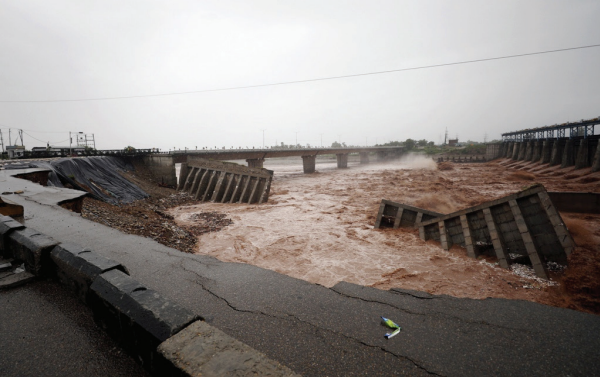
The controversy surrounding an important bridge over the Tawi River in Jammu has raised not only questions about the quality of a construction project but has also provided an opportunity to examine the functioning of governance, transparency, and democratic accountability. According to recent reports, the Jammu and Kashmir administration has attributed the damage to the bridge—built at a cost of crores of rupees—to an “Act of God,” that is, natural causes, and has refused to order any investigation. This stance is not only administratively discomforting but also reflects a broader tendency to avoid fixing clear responsibility for failures in publicly funded infrastructure.
The total cost of the bridge was reported to be around ₹67 crore. It was not merely a structure for transportation but a crucial link for the city’s traffic system, regional economic activity, emergency services, and daily life. However, during heavy rainfall last year, the bridge suffered damage, which the administration initially described as “minor.” Despite this, the estimated cost of repairs has now risen to over ₹38 crore—an inconsistency that raises serious concerns.
The most fundamental question here is: if the damage was truly minor, why is the repair cost so high? And if the damage was severe, why was it downplayed initially? Either scenario reflects a lack of administrative clarity and transparency.
The term “Act of God” is generally used in situations where natural disasters are so unpredictable and uncontrollable that damage cannot be prevented despite human efforts. But can rainfall or rising river levels in the Jammu region truly be considered entirely unpredictable? This is an area where monsoonal patterns and hilly terrain regularly cause fluctuations in water flow. Therefore, accounting for such factors is a basic engineering requirement during the design and construction of any bridge.
This is why experts refuse to view the incident solely as a natural disaster. They argue that if a structure is properly designed and built in accordance with its environmental context, it should be capable of withstanding normal seasonal conditions. Failure to do so points towards possible flaws in design, construction quality, or supervision.
In recent years, Jammu and Kashmir has witnessed several incidents where roads and bridges were damaged due to heavy rains or landslides. However, attributing each case solely to natural causes risks ignoring the root problems. This tendency not only reduces the scope for improvement but also increases the likelihood of more serious risks in the future.
The Tawi River is not just a water body; it is the lifeline of Jammu city. Rapid urbanization, encroachment, and unplanned development along its banks have disturbed its natural flow. Any interference with a river’s natural course increases the risk of flooding and intensifies water currents. In such a scenario, infrastructure projects that fail to meet scientific and environmental standards are unlikely to remain durable.
Perhaps the most concerning aspect of this case is the administration’s refusal to conduct any investigation. In a democratic system—especially when public money and public interest are involved—an inquiry is essential. It is not merely a tool to assign blame but also a means to develop better policies and processes for the future.
Refusing an investigation also means that the role of construction agencies, contractors, and supervisory mechanisms will not be scrutinized. This creates a form of institutional complacency where accountability weakens. If no action is taken despite flaws in a project, it sends a dangerous message that adherence to quality and standards is optional.
It is also important to note that India has witnessed a rapid pace of infrastructure development in recent years. Roads, bridges, and other projects are being constructed on a large scale. However, alongside speed, equal emphasis must be placed on quality control and monitoring systems. Accelerating construction alone is not enough; ensuring long-term durability and safety is equally critical.
From an economic perspective, the Tawi bridge case is equally significant. The original cost of ₹67 crore combined with a repair cost of ₹38 crore brings the total expenditure close to ₹100 crore. This is a substantial amount drawn from taxpayers’ money. Citizens have the right to know how this money was spent and whether it was used effectively.
There is also a strong human dimension to this issue. Damage to a bridge is not just a structural failure—it directly affects people’s lives. Traffic is disrupted, businesses suffer, and access to emergency services becomes difficult. In many cases, people are forced to spend additional time, money, and effort, often at considerable risk.
Therefore, this issue should not be viewed merely as a technical or administrative matter but as a broader social and policy concern. It also tests whether our governance system is truly accountable or tends to rely on convenient explanations to avoid difficult questions.
The argument of an “Act of God” may be valid to a certain extent, but it cannot be used as a universal excuse for every failure. If overused, it becomes a convenient way to evade responsibility. On the contrary, a responsible administration must ensure a fair and transparent investigation in every such case, hold the concerned parties accountable, and take concrete steps to prevent recurrence.
The Tawi bridge controversy clearly indicates the need for a shift in our approach to infrastructure development. Beyond construction, equal importance must be given to quality, sustainability, and environmental balance. This requires policy-level reforms, better use of technical expertise, and stronger monitoring mechanisms.
Ultimately, this issue goes beyond a single bridge or a single city. It serves as a lesson for the entire country—that true progress lies in balancing development with accountability. If this balance is maintained, not only will infrastructure improve, but public trust—arguably the greatest asset of any democracy—will also be strengthened.
(The writer is a student of IIMC, Jammu)