
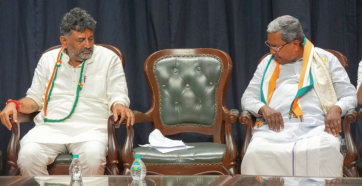
Uncertainty over decision is adversely affecting governance in the state
By Kalyani Shankar
Karnataka’s political crisis is rooted in an intensifying power struggle between Chief Minister Siddaramaiah and Deputy Chief Minister D.K. Shivakumar. The unresolved question of a rotating chief minister system has deepened the crisis, making it critical for the Congress High Command to act decisively to stabilize the state.
The origin of this power struggle could be traced to May 2023, when speculation surfaced about a possible leadership-sharing deal that remains unresolved. Congress won the majority and formed the government.
To address internal rifts, the High Command appointed Siddaramaiah as chief minister and Shivakumar as his deputy, amid rumours that Shivakumar would take over after 2.5 years.
After Siddaramaiah completed 2.5 years in office on November 20, 2025,Shivakumar’s supporters demanded a leadership change, but Siddaramaiah insisted on serving out his full term. DKS may have publicly stepped away from any talk of replacing CM Siddaramaiah, but his camp hasn’t backed off. The push for a leadership change in Karnataka has been very much alive for the past few weeks.
The Congress High Command’s continued indecision heightens the political stalemate and further endangers state stability.
The result is maladministration for the people. The BJP is also accusing the Congress of failing to provide proper governance. When there is an open fight between the chief minister and his deputy, the party is divided into two camps.
Recent developments show Siddaramaiah and Shivakumar as distinct yet complementary Congress leaders—one with mass voter appeal, the other as a troubleshooter. DKS is an organisational man.
Siddaramaiah is a veteran leader with a direct connection to voters, particularly with a strong hold over AHINDA communities (Kannada acronym for minorities, backward classes, and Dalits). He is said to be an able administrator. Both the contenders may try to get the better of each other, but the Congress in Karnataka is a divided house. The Siddaramaiah camp has revived its demand for the appointment of deputy chief ministers from other castes and a new state party chief. The Shivakumar camp has called for the chief minister’s replacement, reminding the high command of the power-sharing formula. The high command, meanwhile, is buying time to make a decision. Either of the leaders is capable of splitting the party. Any decision has to be taken after careful consideration.
Recent meetings in Mysuru and Delhi between Siddaramaiah, Shivakumar, and Rahul Gandhi underlined Shivakumar’s ambitions and Siddaramaiah’s desire to retain his position. Shivakumar voiced his ambition online, and Siddaramaiah deferred to party leadership. The opposition is waiting to topple the government. To make matters worse, on December 19, Siddaramaiah reaffirmed his intent to remain in office, denying any term limits.
Siddaramaiah dismissed BJP and JDS claims of a no-confidence motion: “With only 60 and 18 members respectively, they can’t challenge our 140. This effort is pointless. We will address their baseless claims.”
Congress leader Rahul Gandhi had talks with both leaders again. The outcome of talks with Rahul Gandhi remains unclear as both leaders are expected in Delhi for further dialogue.
After meeting with Rahul Gandhi, both leaders said at that time they would follow the leadership’s decision. Leadership delays have revealed deep divisions within the high command, with Rahul Gandhi seen as favouring Siddaramaiah while others support Shivakumar, risking public backlash over ongoing uncertainty.
The unresolved contest between Siddaramaiah and Shivakumar now directly jeopardizes Congress’s stability in Karnataka, underscoring the urgent need for a clear and decisive resolution.
Both leaders act from distinct ambitions. Siddaramaiah aims to complete his term, maintain party authority, and continue his policy agenda. Shivakumar wants to advance his political career and establish his legacy as chief minister. Congress president Kharge said that the high command will intervene in Karnataka’s leadership dispute as needed.
At the Udyami Vokkaliga Expo 2026, D.K. Shivakumar expressed confidence in the party’s decision: “I do not come from a political family, yet I have reached this level. I trust the party will decide my future. I have faced many challenges in politics.”
Meanwhile, as the Congress central leadership is seen as procrastinating, the chief minister said he had proposed a cabinet expansion. This provoked the DKS camp, with supporters demanding that DKS should be made the chief minister.
With elections imminent in five states (Tamil Nadu, Assam, West Bengal, Kerala, and Puducherry), the unresolved leadership battle between Siddaramaiah and Shivakumar is emerging as a key threat to Congress’s stability and public image in Karnataka, while providing opposition parties an opportunity to exploit the Party’s internal divisions.
The high command must retain Ahinda voters and Vokkaligas, some of whom left the JD(S) in the hope of a Shivakumar chief ministership. Past abrupt chief minister removals increase the pressure to manage expectations.
With local body elections approaching and pressure mounting to stabilise governance and address Bengaluru’s infrastructure challenges, the Congress leadership is aware that Karnataka remains a critical state for the party.
The upcoming leadership decision will shape Karnataka’s political future and determine the Congress party’s stability in the state. (IPA Service)


