
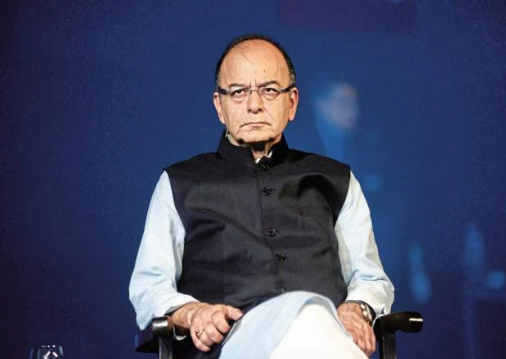
A Tribute to Padma Vibhushan Arun Jaitley Ji
Former Union Minister of Finance, Defence, Corporate Affairs, Commerce & Industry, and Law & Justice; Leader of Opposition in the Rajya Sabha
By Ravi Rohmetra
Arun Jaitley was born on 28 December 1952 in Delhi into a Punjabi Hindu Brahmin family. His father, Maharaj Kishen Jaitley, was a lawyer, and his mother, Ratan Prabha Jaitley, was a homemaker. He studied at St. Xavier’s Senior Secondary School, Delhi (1957–1969), graduated with Honours in Commerce from Shri Ram College of Commerce, Delhi University (1973), and earned his LL.B. from the Faculty of Law, University of Delhi (1977).
Jaitley emerged as a prominent student leader with the Akhil Bharatiya Vidyarthi Parishad (ABVP) at Delhi University and became President of the Delhi University Students’ Union in 1974. During the Emergency (1975–77), when fundamental rights were suspended, he was detained for 19 months. He played an active role in the anti-corruption movement led by Jayaprakash Narayan and Raj Narain, serving as Convener of the National Committee for Students and Youth and helping found the PUCL Bulletin.
In 1977, Jaitley became President of Delhi ABVP and All-India Secretary of ABVP. He later served as President of BJP’s youth wing and Secretary of BJP Delhi Unit (1980).
Since 1977, he practised law in the Supreme Court of India and various High Courts. He was designated Senior Advocate in 1990 and served as Additional Solicitor General in 1989. A prolific thinker and writer, he presented scholarly papers on corruption and crime and represented India at the UN General Assembly (1998).
He entered the Union Cabinet in November 2000 as Minister for Law, Justice & Company Affairs and Shipping, becoming the first Minister of Shipping after bifurcation. He later served as Commerce & Industry Minister and Law Minister (2003). From 2009 to 2014, he was Leader of the Opposition in the Rajya Sabha, where he played a key role in constitutional amendments, parliamentary debates, and national policy discussions.
In May 2014, Prime Minister Narendra Modi appointed him Finance Minister, along with Defence and Corporate Affairs portfolios. As Finance Minister (2014–19), Jaitley led landmark reforms, including Demonetisation (2016) and the implementation of the Goods and Services Tax (GST), integrating India into a single national market. He also launched the Income Declaration Scheme (2016) and advocated major economic and legal reforms.
Due to ill health, Jaitley declined a ministerial role in 2019. He passed away on 24 August 2019 at the age of 66. The nation mourned his loss; the Indian cricket team wore black armbands in tribute. His legacy endures in institutions that bear his name — notably the Arun Jaitley Stadium in Delhi and the Arun Jaitley Stadium, Hiranagar (Jammu). In December 2020, a statue of the leader was unveiled in his honour.
Arun Jaitley will always be remembered as a visionary statesman, master parliamentarian, brilliant jurist, and one of the finest political minds of contemporary India.
(The compiler is a Social Activist and Writer and can be reached at Mob : 9419652999)



