A slow-motion public health disaster unfolds in the National Capital
By T N Ashok
Before the Indian Supreme Court, there’s not just another plea on Delhi’s choking air; it’s not adjudicating a new emergency. It is confronting an old failure—one that has returned with brutal predictability, thick smog, and a mounting toll on public health.
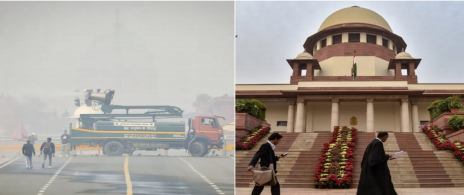
Each winter, the national capital descends into a toxic haze that blots out landmarks, grounds flights, and turns breathing into a health risk. This year has been no different, except perhaps in scale. Air Quality Index (AQI) readings have surged into the “severe” and “severe plus” categories for days at a stretch, with PM2.5 concentrations reaching levels many times higher than what the World Health Organization considers safe. For millions of residents, the air has become unfit to breathe.
Hospitals across Delhi report a sharp rise in respiratory distress cases—children with asthma attacks, elderly patients gasping for breath, and middle-aged adults with sudden cardiac and pulmonary complications. Emergency rooms are crowded. Pulmonology wards are full. Doctors speak of a grim déjà vu, evoking memories of the COVID-19 crisis—less dramatic, perhaps, but eerily familiar in its systemic unpreparedness.
“This is a slow-burning public health emergency,” said Dr. Randeep Guleria, former director of AIIMS, in an interview. “Unlike COVID, this disaster is entirely predictable, seasonal, and man-made. And yet we behave as if it has arrived unannounced every year.”
Delhi’s pollution crisis is often explained away as a problem of geography. The city sits landlocked, surrounded by the plains of northern India, with winter inversions trapping pollutants close to the ground. Dust storms from the deserts of Rajasthan sweep in during the summer months, adding coarse particulate matter to an already polluted atmosphere.
But experts say geography is only the backdrop, not the cause. “Topography doesn’t explain policy paralysis,” said Sunita Narain, director general of the Centre for Science and Environment. “Beijing also has adverse geography. So does Los Angeles. What matters is what governments do despite those constraints.”
Delhi’s pollution cocktail is well documented: emissions from millions of vehicles, coal-based power plants in neighbouring states, construction dust, industrial pollution, open waste burning, and seasonal stubble burning by farmers in Punjab and Haryana. Each contributor is known. Each has been studied. Each has been litigated. What has been missing, critics argue, is enforcement with teeth.
Blame for Delhi’s air crisis is routinely traded between the central government, the Delhi state government, and neighbouring states. Court-mandated bodies such as the Commission for Air Quality Management (CAQM) issue directives, but compliance remains uneven. Emergency measures—odd-even traffic rules, construction bans, school closures—are rolled out late, lifted early, and often poorly enforced.
“India excels at temporary fixes,” said an environmental policy analyst who has advised multiple state governments. “We respond to headlines, not to data. Once visibility improves, political attention moves elsewhere.”
The result is a cycle of performative governance: crisis meetings, grim statements, and judicial admonishments, followed by policy drift. Meanwhile, vehicle ownership continues to rise, public transport expansion lags demand, and emission standards—though tightened on paper—are weakly enforced on the ground.
Delhi today has more than 12 million registered vehicles, far exceeding its road capacity. Electric vehicle adoption, while improving, remains marginal in the absence of robust charging infrastructure and affordable options for mass transit users.
Perhaps the most uncomfortable comparison for Indian policymakers is China. Two decades ago, cities like Beijing and Shanghai were global symbols of air pollution. Today, while still imperfect, China has achieved dramatic reductions in PM2.5 levels through aggressive regulation, industrial relocation, massive investment in clean energy, and ruthless enforcement. “China treated air pollution as a national security issue,” said Narain. “India treats it as a seasonal inconvenience.”
China shut down coal plants near cities, forced industries to adopt cleaner technologies, electrified transport at scale, and empowered regulators with sweeping authority. India, by contrast, remains cautious—balancing environmental goals against economic growth, electoral politics, and federal sensitivities.
“There is a strange reluctance to acknowledge that this is a technical problem as much as a political one,” said a former bureaucrat from the environment ministry. “India could easily collaborate with China, Europe, or the U.S. on pollution control technologies, air modeling, and health surveillance. Instead, we prefer to reinvent the wheel.”
The human cost of Delhi’s polluted air is becoming impossible to ignore. According to public health researchers, prolonged exposure to high pollution levels increases the risk of stroke, heart disease, lung cancer, and chronic obstructive pulmonary disease. Children exposed to toxic air show reduced lung capacity and cognitive development issues.
“Pollution is shortening lives quietly,” said Dr. Arvind Kumar, chairman of the Institute of Chest Surgery at Sir Ganga Ram Hospital. “Patients come in breathless, but the real damage is cumulative. We are talking about years shaved off life expectancy.”
Yet hospitals remain ill-equipped for seasonal surges. There is no citywide pollution-health emergency protocol, no surge capacity planning, and limited public advisories beyond generic warnings. N95 masks are recommended but not distributed. Air purifiers remain a luxury. “This is a humanitarian crisis hiding in plain sight,” Dr. Kumar added. “And it is entirely preventable.”
As the Supreme Court prepares to hear the latest plea questioning “failing enforcement,” the underlying issue remains unresolved: Is Delhi’s air crisis a failure of capacity or of will? Most experts argue it is the latter.
“India has the money, the science, and the manpower,” said an environmental economist at a Delhi-based think tank. “What it lacks is sustained political attention. Pollution doesn’t swing elections. GDP numbers do.”
National priorities—from economic growth to geopolitics—have pushed environmental health down the agenda. Federal tensions complicate coordinated action. And long-term solutions often clash with short-term political costs. But the costs of inaction are mounting.
There is no silver bullet. Experts broadly agree on a multi-pronged strategy: aggressive electrification of transport, massive public transit investment, strict industrial enforcement, clean energy transition, regional coordination on crop burning, urban redesign to reduce dust, and a health-first approach to policy. Above all, Delhi needs year-round action, not winter panic. “Clean air is not an aspirational goal,” Narain said. “It is a constitutional right.”
As judges hear arguments in courtrooms and officials debate responsibility, Delhi’s residents continue to breathe air that would be considered unsafe in most of the world. The question before the Supreme Court is not whether the crisis exists, but whether India’s governance system is capable of confronting a disaster that is both visible and self-inflicted. For a capital city aspiring to global stature, the answer remains disturbingly unclear. (IPA Service)